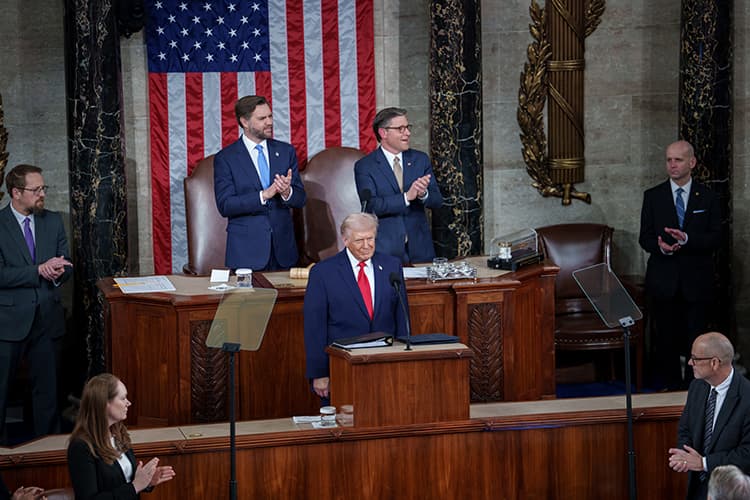
The Australia Institute’s International & Security Affairs advisor Allan Behm said the “decapitation of the regime” in Iran marks the beginning of “massive instability bordering on long-term chaos”.
Wed 4 Mar 2026 01.00
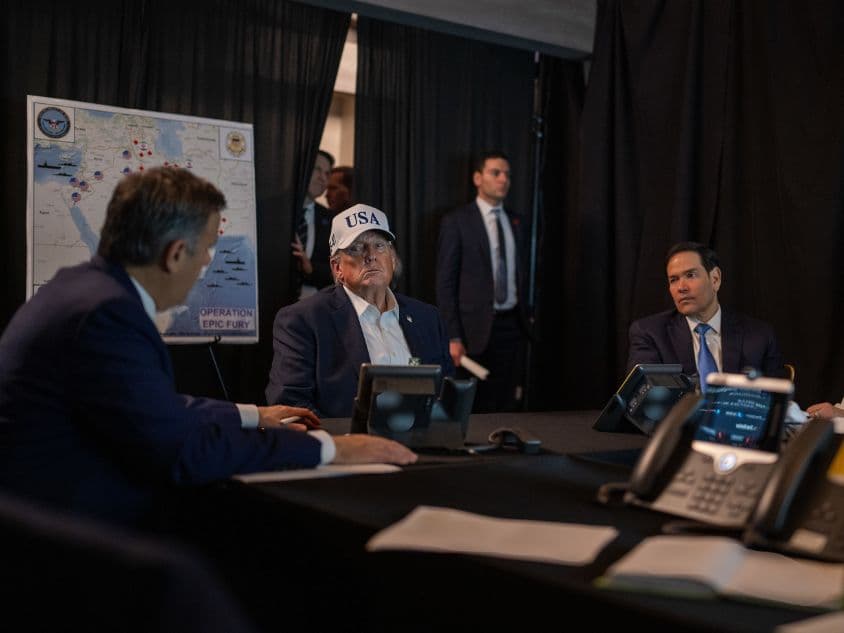
The White House/Flickr


US President Donald Trump has warned there’s a “big wave” of strikes still to come as war breaks out in the Middle East following the US–Israeli attacks on Iran.
The Australia Institute’s International & Security Affairs advisor Allan Behm said the “decapitation of the regime” in Iran marks the beginning of “massive instability bordering on long-term chaos”.
“This is worse than I’d actually forecast,” Allan Behm told the Australia Institute’s After America podcast.
The former senior Australian defence official has warned the fallout of the joint US-Israel airstrikes could be “deeply disturbing” as retaliatory attacks spread well beyond Iran’s borders.
“I think what Israel is looking for here is an Iran that is so self-absorbed, so preoccupied with survival that it’s incapable for the time being of mounting any kind of serious threat to Israel,” said Mr Behm.
“It’s a bit less clear what the United States wants except for the performative glory of using its massive military power to smash down another power.”
The joint strikes – which killed Iran’s supreme leader and other senior figures – have sparked war in the Middle East with US President Donald Trump projecting the campaign could last four to five weeks but could “go far longer than that”.
Speaking at his first press conference at the White House since the attacks began, President Trump said he’d taken the “last best chance” to strike Iran’s “sick and sinister regime”.
Mr Behm told the podcast he believes what the US and Israel “really want is a broken, fractured, unstable, chaotic Iran incapable of standing anything up, least of all itself”.
The conflict has already claimed lives on all sides.
Iranian state media has reported more than 160 people were killed in a strike on a girls’ school launched by the US and Israel.
Six US service members have been killed in an Iranian retaliatory strike on a makeshift operations centre in Kuwait.
Lebanon is now also caught in the crossfire with the Israeli military confirming it’s killed Adham Adnan al-Othman, the Palestinian Islamic Jihad commander in Beirut.
The United Arab Emirates, Qatar and Bahrain have also come under attack as Iran launched missiles at US assets in the Gulf.
Australia’s Defence Minister, Richard Marles has confirmed all Australian military personnel are “safe and accounted for” after an air base used by the ADF was struck near Dubai.
Meanwhile, Qatar’s air force says it has “successfully shot down” two Iranian fighter jets.
The Australia Institute’s Director of International & Security Affairs Dr Emma Shortis said the regions have been hit with “the type of violence that can spread out so quickly”.
“I think it’s more likely than not that this gets significantly worse and continues to get out of control.”
She said it’s become clear that the US was “never interested in actually finding a deal [with Iran]. They were just delaying while they amassed military force in the region”.
President Trump has outlined what he called “clear objectives” for the ongoing operation, dubbed ‘Operation Epic Fury’ including destroying Iran’s ballistic missile stocks and “annihilating” the Iranian navy.
Prime Minister Anthony Albanese has released a statement saying, “We support the United States acting to prevent Iran from obtaining a nuclear weapon and to prevent Iran continuing to threaten international peace and security”.
Dr Shortis called the comments “deeply disappointing if not unsurprising”.
“I think the problem for Australian governments in general is that they do understand that we are deeply welded onto the United States in the exercise of US power,” said Mr Behm.
“And that is because along with Britain, Australia is the other country that is bolted into the United States extended command control and intelligence system, and there’s not much we can do about it.”
Subscribe to After America on Apple Podcasts, Spotify, Pocket Casts or wherever you get your favourite podcasts.
“It’s a bit less clear what the United States wants except for the performative glory of using its massive military power to smash down another power.”
The joint strikes – which killed Iran’s supreme leader and other senior figures – have sparked war in the Middle East with US President Donald Trump projecting the campaign could last four to five weeks but could “go far longer than that”.
Speaking at his first press conference at the White House since the attacks began, President Trump said he’d taken the “last best chance” to strike Iran’s “sick and sinister regime”.
Mr Behm told the podcast he believes what the US and Israel “really want is a broken, fractured, unstable, chaotic Iran incapable of standing anything up, least of all itself”.
The conflict has already claimed lives on all sides.
Iranian state media has reported more than 160 people were killed in a strike on a girls’ school launched by the US and Israel.
Six US service members have been killed in an Iranian retaliatory strike on a makeshift operations centre in Kuwait.
Lebanon is now also caught in the crossfire with the Israeli military confirming it’s killed Adham Adnan al-Othman, the Palestinian Islamic Jihad commander in Beirut.
The United Arab Emirates, Qatar and Bahrain have also come under attack as Iran launched missiles at US assets in the Gulf.
Australia’s Defence Minister, Richard Marles has confirmed all Australian military personnel are “safe and accounted for” after an air base used by the ADF was struck near Dubai.
Meanwhile, Qatar’s air force says it has “successfully shot down” two Iranian fighter jets.
The Australia Institute’s Director of International & Security Affairs Dr Emma Shortis said the regions have been hit with “the type of violence that can spread out so quickly”.
“I think it’s more likely than not that this gets significantly worse and continues to get out of control.”
She said it’s become clear that the US was “never interested in actually finding a deal [with Iran]. They were just delaying while they amassed military force in the region”.
President Trump has outlined what he called “clear objectives” for the ongoing operation, dubbed ‘Operation Epic Fury’ including destroying Iran’s ballistic missile stocks and “annihilating” the Iranian navy.
Prime Minister Anthony Albanese has released a statement saying, “We support the United States acting to prevent Iran from obtaining a nuclear weapon and to prevent Iran continuing to threaten international peace and security”.
Dr Shortis called the comments “deeply disappointing if not unsurprising”.
“I think the problem for Australian governments in general is that they do understand that we are deeply welded onto the United States in the exercise of US power,” said Mr Behm.
“And that is because along with Britain, Australia is the other country that is bolted into the United States extended command control and intelligence system, and there’s not much we can do about it.”
Subscribe to After America on Apple Podcasts, Spotify, Pocket Casts or wherever you get your favourite podcasts.
Advertisement
An extract from Amy Remeikis’ new book, Where It All Went Wrong: The Case Against John Howard’
Prime Minister Curtin’s Christmas 1941 newspaper column advised the Australian people that henceforth we would look to America as our protector rather than Britain. To have questioned our trust in the USA at that time would have been unthinkable. A decade later, under Prime Minister Menzies, trust was cemented into the ANZUS treaty, which has remained the cornerstone of Australia’ security and self-confidence ever since. It has become an article of faith.
It isn’t always easy to keep up with what’s happening in the US. “Shorter America” is a series where Dr Emma Shortis loops you in on what’s going on in America and shares news and analysis that you can trust.