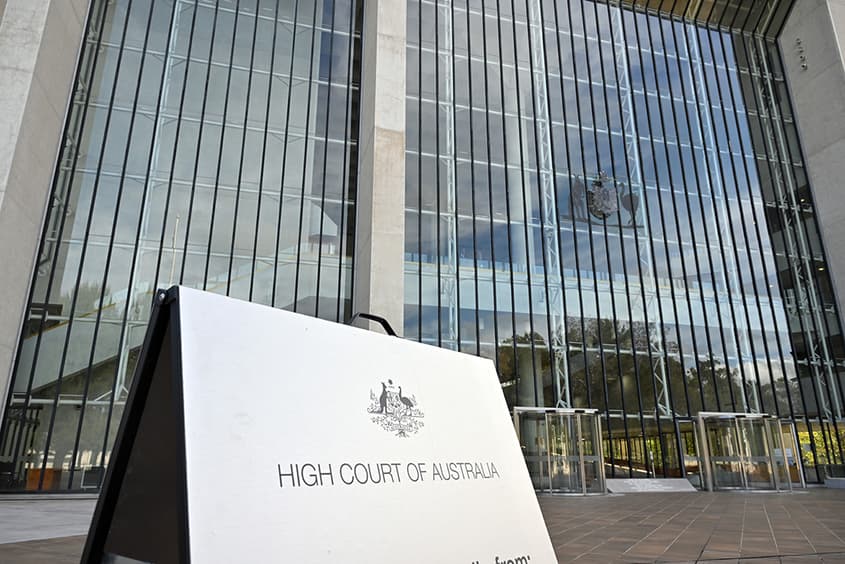
Australia’s first climate case to reach the High Court will be heard next week, in a landmark legal battle that could reshape how fossil fuel projects are approved nationwide.
MACH Energy – a subsidiary of Indonesian conglomerate Salim Group – is challenging last year’s NSW Court of Appeal ruling that sided with an Upper Hunter community group.
The decision invalidated approval for a 22-year expansion of its Mount Pleasant coal mine in Muswellbrook.
“The NSW Court of Appeal’s decision was truly groundbreaking and is already changing how proposals for new and expanded fossil fuel projects are assessed in NSW,” said Elaine Johnson, who will represent the community group in the High Court proceedings.
The ruling hinged on the Independent Planning Commission’s (IPC) assessment approach, with the court finding it failed to properly consider the full scope of the project’s emissions and the impact on the local environment – including from exported coal burned overseas, known as Scope 3 emissions.
“Our communities are enduring increasingly terrifying climate disasters, and nature is deteriorating before our very eyes,” said community advocate Wendy Wales.
“Yet our governments are continuing to throw fuel on the fire by approving massive new projects and expansions like MACH Energy’s Mount Pleasant Optimisation Project.”
Ms Wales and her partner Tony Lonergan – both retired science teachers – live on Wonnarua country in the Hunter Valley, on land farmed by Tony’s family for several generations.
The property sits adjacent to the Mount Pleasant mine.
As president of the Hunter Valley community group DAMS HEG (Denman Aberdeen Muswellbrook Scone Healthy Environment Group), Ms Wales has spearheaded their grassroots campaign through three courts over four years.
“We have felt the catastrophic impacts of droughts, bushfires, floods and a myriad of other tragic events. The short-term economic benefits cannot be given priority over the exponentially increasing long-term consequences,” said Ms Wales.
The NSW Court of Appeal ruling was a significant victory for DAMS HEG and the broader environment movement.
The community group had previously and unsuccessfully tried to overturn the approval through a judicial review in the Land and Environment Court, which found the IPC had considered Scope 3 emissions by acknowledging they would contribute to global climate change.
It also held there was no obligation to impose conditions once the issue had been addressed, a position previously considered in Queensland’s Waratah Coal decision.
The NSW Court of Appeal found the approach to be legally flawed, ruling the IPC had a mandatory obligation to consider how global climate change would translate into specific local impacts in the Upper Hunter, such as more intense bushfires and prolonged drought.
“What could be more important than protecting our unique natural heritage and biodiversity or ensuring we can live safely in Muswellbrook and the Upper Hunter for generations to come?” said DAMS HEG treasurer Tony Lonergan.
“The continuation of coal mining in NSW prioritises the private interests of a few over a safe climate and the future of our children and grandchildren.”
MACH Energy Australia is seeking to double the mine’s output to 21 million tonnes annually and extend operations to 2048.
The community group says if it proceeds, Mount Pleasant would become one of Australia’s largest export coal mines.
Mr Lonergan urged the Albanese government to start putting communities and the environment first.
“Addressing global heating means cutting our greenhouse gas emissions, and fast. Political parties have to face reality. Do you want to address this existential problem or not? Stop pretending,” he implored.
The Climate Council said the Albanese government’s climate credibility was being eroded, having now approved 36 new, expanded or extended coal, oil and gas developments since coming to power.
“Continued fossil fuel production is driving climate harms here at home, and Australia is still one of the largest exporters of coal in the world,” said Elaine Johnson, director at Johnson Legal.
The case will be heard in the High Court on 13 May 2026.