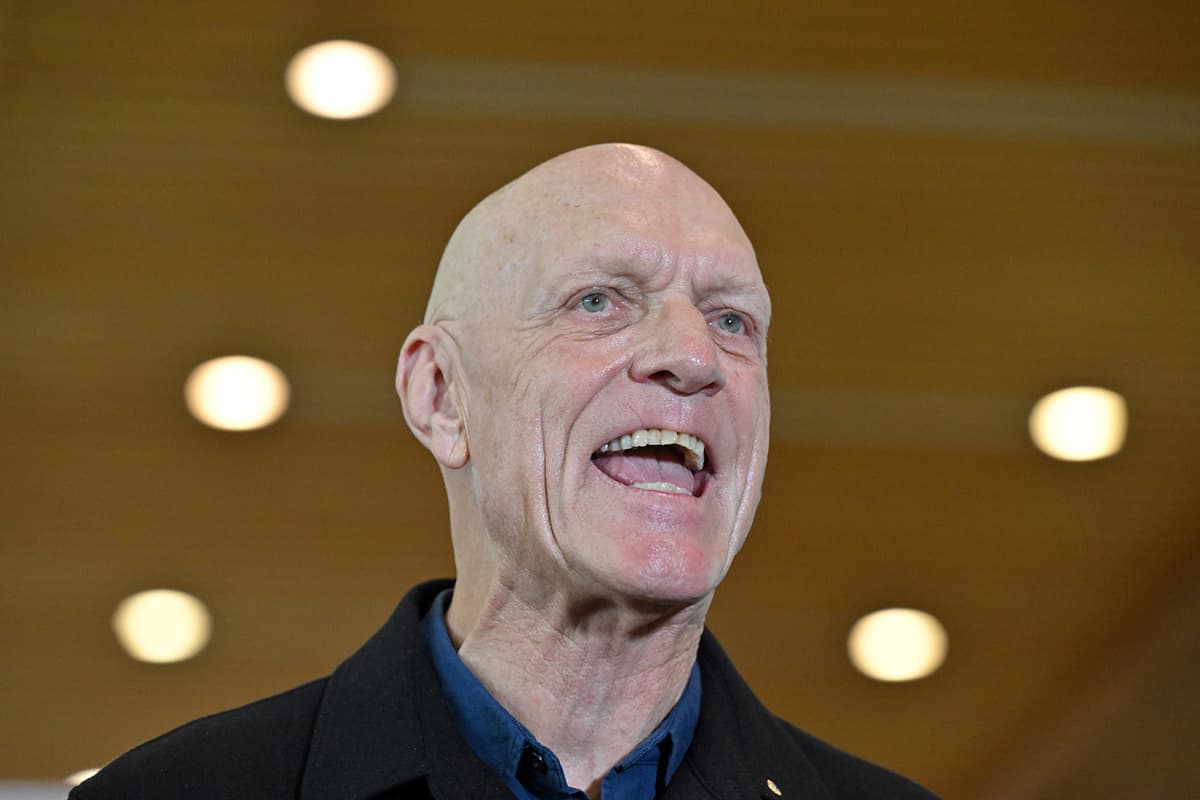
Former environment minister Peter Garrett will lead a public inquiry into the Australian Government’s $368 billion AUKUS defence pact, amid growing concerns over the lack of scrutiny surrounding the nation’s most expensive defence project.
The independent inquiry will run for five months, with the Midnight Oil frontman and environmental campaigner saying there has never been a more critical time to uncover the facts.
“This is a once in a generation, if not once in a century, serious level decision making exercise by Australian governments plural. The Australian people need to be a part of it,” he said.
Peter Garrett will lead the inquiry with four other Commissioners, including Admiral Chris Barrie, the former Chief of the Defence Force, and Carmen Lawrence, WA’s first female Premier.
Leanne Minshull, the Australia Institute’s Co-CEO, will also serve as a commissioner, alongside Karina Lester, whose father went blind due to British nuclear tests in SA in the 1950s.
“AUKUS is by far the most expensive and complex undertaking ever entered into by any Australian Government and yet the opportunity to question, debate and decide has been taken out of the hands of the parliament and the people,” Mr Garrett said.
“A public inquiry into this massive spend of taxpayer’s money is long overdue.”
Commissioner Leanne Minshull said the project’s enormous cost was difficult to comprehend.
“Think about Australia’s biggest wealth fund, set up in 2006,” she said.
“After 20 years of squirreling away money and banking investment returns, the future fund is now worth $337 billion.
“The cost of AUKUS would wipe out these generational savings and then some.
“If we are to spend the equivalent of our national savings, on a single project, the benefit needs to be clear and overwhelming.”
Under the initial agreement, Australia was set to receive two used Virginia-class nuclear-powered submarines from the United States, plus one new model as early as 2032.
However, Minister for Defence Richard Marles released a statement over the weekend announcing that this plan had changed and Australia would now buy three second-hand submarines to ‘streamline’ the acquisition.
According to the ABC, Mr Marles told journalists at the IISS Shangri-La Dialogue in Singapore that Australia needed to “place a premium on simplicity” and that the change would deliver “significant” savings.
Independent senator David Pocock said the inquiry was necessary because Australians had been left in the dark about AUKUS.
“It shouldn’t take citizens actually standing up an inquiry, but here we are because of the total lack of transparency,” he said.
“Their [The government’s] recent announcement at an overseas conference that we’re now buying second-hand subs – that goes to the core of the lack of accountability and transparency with the Australian people.”
Tasmanian MP Andrew Wilkie said there was a “clear need to shine a light” on the deal.
“It wasn’t taken to an election, and it motors on at the expense of billions of dollars, but yet much of it is in secret. We don’t know the answer to so many questions,” he said.
Commissioner Barrie AC investigated the possibility of Australia acquiring nuclear-powered submarines between 2004 and 2010.
“Our idea was built on the notion that we would have a nuclear power industry,” he said, noting Australia still lacks a permanent solution for managing the radioactive nuclear waste that would be generated by the submarines.
“We didn’t get past go in 2010,” he said. “We could make no headway, either in the UK or in the United States … so now I ask myself, what’s changed?
“I want to know what’s been going on behind some of those closed doors to find out what the deal really looks like.”
Commissioner Lester, a Yankunytjatjara woman, said it was vital that First Nations peoples be consulted on decisions that could affect their traditional lands and waterways.
“Will Australia be taking in nuclear waste from the UK and the US under this agreement?” she asked.
“We fear it will be our mobs and our countries that is expected to take it. And once again, no one has bothered to talk to us.
“We have the lived experience and that’s why First Nations voices are crucial to this public inquiry.”
The inquiry will hold public hearings and take written submissions before delivering a report by 31 October.
Commissioner Carmen Lawrence said transparency was a “basic requirement for any functioning democracy”.
She argued Australians deserved to know the details of private deals involving “US and UK technology companies and foreign governments to access the Australian mainland and our data”.
The inquiry will investigate whether the submarines can be delivered on time and within budget, as well as how the submarine’s radioactive waste will be managed.
Admiral Barrie said it would also consider the rise of China, “which is looking like it will dominate world affairs in the near future”, and the state of Australia’s alliance with the US and the UK.
“My fear, as a former chief of the Defence Force, is that the kinds of expenditures and the kinds of workforce and the way in which we would go about supporting something like AUKUS might drain other parts of our defence force and leave us vulnerable in ways that we would not appreciate,” he said.
“I ask myself, are we really being sensible about our future to disregard our relationships in the Asia Pacific region at the expense of keeping the Anglophone society going on this project.”
Mr Garrett said the inquiry would provide a forum for Australians of differing political views to have their voices heard, including representatives from the government and the Department of Defence.