On average, each year of sending a child to high school costs Australian families just under $5,000, almost four times the OECD average. Who's to blame?
Tue 3 Feb 2026 01.00
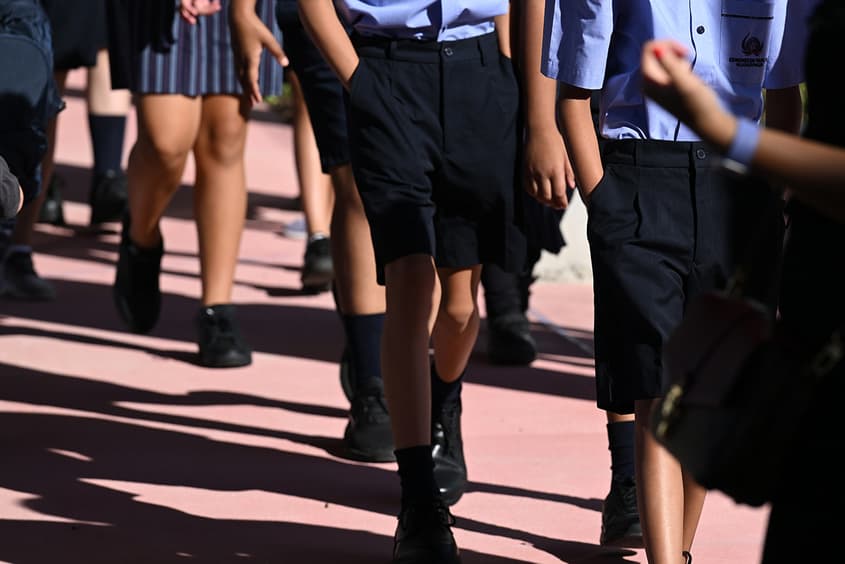
Photo: AAP Image/Dean Lewins


On average, each year of sending a child to high school costs Australian families just under $5,000, almost four times the OECD average. That’s across both public and private schools, with families that send their children to private schools paying even more — fees now reach as high as $55,000 per year.
What’s to blame? According to new Australia Institute research, it’s the unusually high number of Australian students going to private schools, combined with unusually high private school fees.
Over 40% of Australian high schoolers are now privately educated, a number that continues to grow. Only Chile, where swathes of the economy were privatised by the dictatorial Pinochet regime in the 1980s, has a more privatised education system than Australia.
In most OECD countries, private schools that receive public funding are not allowed to charge fees; Australia’s system of ‘double-dipping’ is highly unusual. For example, while large portions of the student population attend privately run (often religious) schools in the UK, Sweden, Belgium and the Netherlands, these schools are heavily subsidised by governments and cannot charge fees – not exactly “private” schools in the way Australians understand them.
Unlike many other developed countries, Australian private schools are free to charge any fees they like and choose which students to admit, despite receiving government funding. Unsurprisingly, as rising income inequality drives up the incomes of Australia’s wealthiest, expensive private schools have increased their fees well in excess of inflation.
It now costs an Australian family over $11,000 per year to send their child to a private high school, though fees can reach as high as $55,000.
Only New Zealand and Greece, where private schools receive little to no government funding, have higher average private school fees. But their high fees don’t have a major impact on the overall cost of sending a child to high school because their private school sector is tiny compared to Australia’s – only educating 6% and 7% of students respectively.
Australia’s rising costs are not leading to improvements in Australia’s educational performance. In fact, Australia’s results on the international PISA test have dropped since 2008, especially in private schools.
While private schools often advertise high test results to entice parents, their success on tests like PISA and NAPLAN is almost entirely driven by the socio-economic backgrounds of their students. A wide range of studies show that students from wealthier families perform better academically for reasons including the education of the parents, the amount of time they’re able to spend teaching their kids to read, and access to tutoring.
Once this socio-economic advantage is accounted for, public schools generally perform on par with their private counterparts – doing better than catholic and only marginally worse than independent schools.
Put another way, despite Australian private schools sometimes charging fees as high as $55,000 per year, that price tag far from guarantees a better education. In the case of Catholic schools, parents are paying significant amounts to receive what is, on average, a lower-quality education than if they sent their children to public schools.
The performance of public schools is even more impressive given that they face a funding shortfall of over $4 billion dollars per year. Under current agreements, public schools will not reach the funding benchmarks agreed by Australian governments until 2034, while private schools are currently overfunded by those same benchmarks – by hundreds of millions of dollars.
Private high schools are continuing to grow, and, if current trends continue, they’ll educate most of Australia’s secondary students by 2055.
Combining this growth with surging fees means Australian education is fast becoming a tale of two systems: private schools, which can afford to spend millions on non-educational facilities like swimming pools and ski lodges, and public schools, which can’t afford to repair their classrooms.
But those swimming pools aren’t actually improving educational performance – for students or the country.
Instead, all this really achieves is the segregation of Australia’s rich and poor between expensive private schools and underfunded public schools. That means already disadvantaged kids will be left worse off, and allows Australia’s wealthiest to keep their children in an elitist bubble.
In short, the Australian system of privatised schooling is costly and creates an ever-growing gap between the non-educational experience of students at wealthy private schools and students at underfunded public schools.
Without policy change, the inequality between private and public education will continue to grow, and Australian students, along with the Australian community and economy, will suffer.
In February the unemployment rate rose from 4.1% to 4.3%, providing further evidence the Reserve Bank misread the economy when it raised rates in both February and this week.
The Senate Select Committee on the Operation of the Capital Gains Tax Discount tabled its report on Tuesday. In short, it found that Australia’s current tax system favours investors and fuels intergenerational inequality. But the Coalition maintains the CGT discount is “working as intended.”
As South Australia prepares to vote amid escalating anti-abortion rhetoric, new polling research shows that a clear majority of Australians support a woman’s right to choose.