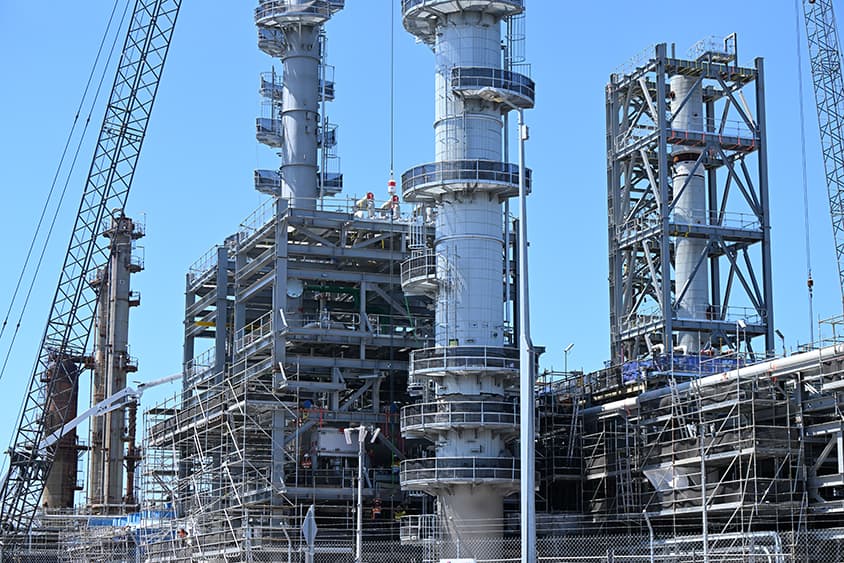
For decades, Australia has tolerated a rapidly growing gas industry that pays little tax and royalties, employs few people, pushes up gas and electricity prices for Australian families and businesses, and worsens the climate crisis.
The tax designed to ensure Australians benefit from the extraction of our publicly owned petroleum resources, the Petroleum Resources Rent Tax (PRRT), is broken. Despite liquified natural gas (LNG) exports surging by $47.7 billion from 2014-15 and 2024-25, the amount of revenue collected via the PRRT was actually $450m lower in 2024-25 than it was in 2014-15. Other taxes, royalties and charges have also failed to ensure Australians benefit substantially from surging exports of these publicly owned resources.
As seen in the chart below, Australia’s gas industry revenue has exploded while its contribution to government revenue has remained stubbornly flat, only ticking up slightly in recent years as the scale of the industry’s massive profits meant that the industry couldn’t entirely dodge taxes.
But it didn’t have to be this way, other countries show another path was and is possible. In the words of Australia Institute co-CEO Richard Denniss..
“In Norway, they tax the fossil fuel industry and they give university education to their kids for free”
“In Australia we subsidise the fossil fuel industry and we charge our kids a fortune to go to uni.”
This is true. As shown in the chart below when Norway’s petroleum industry booms, so do Norwegian government revenues.
Norway achieves this through various mechanisms, the biggest is an effective tax regime. There are two main taxes, a standard company tax (like Australia’s company tax) and a special tax on petroleum super-profits (like the PRRT, except effective). These taxes interact to create a combined marginal tax rate of 78%.
Another major component of the Norwegian model is public-ownership. The Government owns holdings in a number of oil and gas fields, pipelines and onshore facilities. The Government also owns most (67%) of Equinor, a multinational energy company. This public ownership is another tool that ensures the Norwegian people benefit from the exploitation of their natural resources.
Qatar similarly has also not allowed multinational gas companies to take the piss. While Qatar and Australia export a similar value of LNG, Qatar raises around five times more government revenue from these exports. Qatar uses a similar combination of effective taxes and public ownership to achieve this. In Qatar, some government revenue is generated through a combination of royalties and corporate income taxes on the foreign-owned shares of joint venture operations. In addition, the Qatari Government owns significant stakes in LNG projects. Some LNG projects are 100% government owned, with all profits adding to government revenue while most LNG operations are at least 50% government owned through Qatar Energy as joint ventures with foreign-owned fossil fuel energy companies.
What should Australia do?
Some commentators have suggested improving the PRRT or creating new super-profits taxes to better copy Norway and Qatar’s success. While appropriate in theory, complicated reforms like this have failed in the past; they risk being undermined by an industry with a history of being more across the details of Australia’s gas tax regime than those in Treasury or our Parliament.
Better solutions for Australia right now will be simpler and less manipulable. One such solution would be a 25% tax on the value of gas exports, as proposed by the Australian Council of Trade Unions. This could raise up to $17 billion per year, bring down the cost of gas for Australian families and businesses and is highly popular. If the Albanese Government had implemented this tax shortly after its election in May 2022, it could have already raised $63.8 billion. This is enough for the Albanese government to have deposited $2,500 into the bank accounts of each and every Australian, including children. This tax could fund free university and TAFE education, free universal early childhood education and childcare, or bring dental into Medicare.