According to the Australian Financial Review (AFR), Tania Constable, the head of the Minerals Council of Australia (MCA), was in Canberra yesterday ‘launching a “Hands off our Fuel” online messaging blitz’.
Unsurprisingly, the mining lobby’s ads are full of misleading, or downright false, claims. Let’s take a look at the example below:
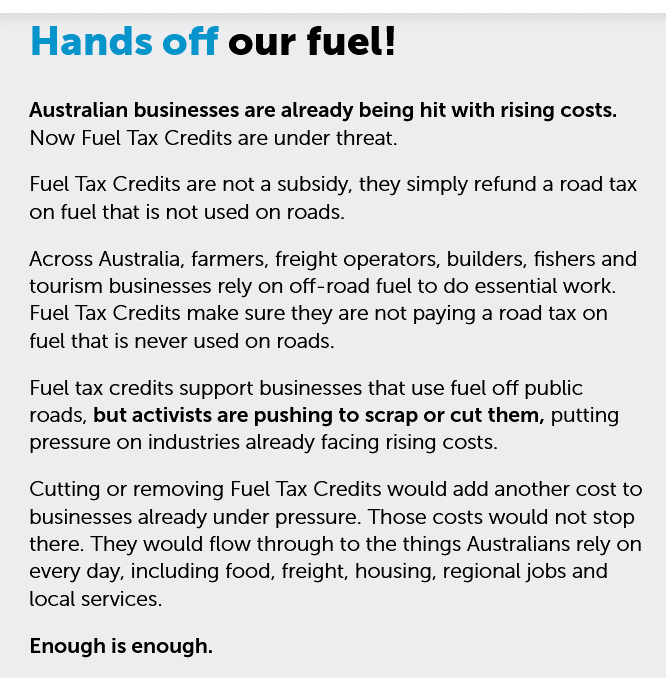
Firstly, Fuel Tax Credits do not “simply refund a road tax on fuel that is not used on roads”.
The Fuel Tax Credits Scheme (FTCS) fully or partially refunds fuel excise (tax) paid by certain businesses, costing over $10 billion a year. Fuel excise is not a ‘road tax’; the vast majority of fuel excise flows into general revenue rather than being tied to any road spending. Additionally, things like lorries that do drive on public roads also get a partial refund on their fuel tax.
Secondly, there is something notable about the list of industries the MCA says would be affected — “farmers, freight operators, builders, fishers and tourism” — it omits mining companies.
The 2023-24 ATO taxation statistics, released last week, show which industries receive the most from the fuel tax credit scheme.
Mining companies claim far more in fuel tax credits than any other industry, receiving three times as much as farmers and accounting for almost half (47%) of all fuel tax credits.
Mining companies received $4.6 billion, well ahead of freight operators with $1.3 billion and farmers with just $900 million.
But when we look at the average amount of credit each entity received, the disparity is even greater. Mining companies received on average $1.2m in fuel tax credits, compared to farmers with just $12,671.
Additionally, unlike other industries, such as transport and agriculture, mining is dominated by a small number of big companies, many of which claim over $100 million in fuel tax credits. Perhaps because they are less politically sympathetic than farmers or fishers, mining companies have been conveniently left off the MCA’s list.
The campaign also engages in scaremongering about the impacts of fuel tax credit reform on businesses, costs and jobs. The ads appear to suggest businesses would both go bust and pass costs on to consumers, while ignoring many of the reform proposals that have actually been put forward.
For instance, one option would be to cap fuel tax credits at $50 million per company. This would predominantly impact huge mining companies, while leaving farmers, truckies and tradies unaffected.
At the Australia Institute’s Revenue Summit last year, Deidre Willmott, Strategic Advisor at Fortescue Metals Group, called for a $50 million cap credit per company.
Such a policy would only capture mining companies, no one else would be touched. And that is why the MCA is desperate to make it sound like any changes to the fuel tax credit scheme will hurt farmers and others.
In reality, there is no way the government would end the fuel tax credit scheme for farmers or fishers, but suggesting our more profitable industry needs $4.6bn in tax credits is pretty much the height of arrogance.