Tue 2 Dec 2025 00.00

Photo: The NSW Supreme Court (AAP Image/Dean Lewins)


At a time of collective resistance to legal authority, when laws and governance systems around the globe are being questioned, challenged and renegotiated, the complicated, nuanced and embodied understanding that legal anthropologists offer about how power and social ordering works is more necessary and imperative than ever.
With roots in colonialism, historically legal anthropologists looked at how power structures and social ordering through laws, order, crime and punishment worked in what were then seen by primarily white Western male anthropologists as “primitive” or “proto” legal systems used in different countries by different cultures.
In more recent decades, anthropology as a discipline, and with it legal anthropology, has undergone rightful critique and subsequent self-reflection around its traditional elitist and hierarchical foundations.
This has led (among other things) to a more encompassing understanding of legal anthropology.
Now, rather than seeing different legal systems or ways people order their societies as necessarily being “right” or “wrong”, “better” or “worse”, legal anthropology is more interested in understanding how legal systems affect peoples’ lives on an everyday level as well as how people experience and feel about the law.
Legal anthropology makes space for us to poke holes in the collective faith held in the functional and presumed beneficial role the law plays in society, and in its seemingly innate order-maintaining and problem-solving capabilities. It problematises the regulatory power accorded to the law to order all citizen-state relations.
Legal anthropologists are increasingly moving away from ideas about the law as being something solely enacted and reproduced through official institutions like parliament, police, lawyers and courts to something that is broader and more encompassing.
In this reading, the “law” is something that affects all our lives in intricate, complicated and nuanced ways both at conscious and unconscious levels. For example, legal anthropologists are interested in how experiences of war affect peoples’ subsequent understanding of the law in Australia; how people with a disability practice kinship and care while navigating decision making around their legal agency; or how a person’s citizenship can be affected by the redrawing of borders.
In Australia, legal anthropologists were some of the first to bring to the attention of White Australians that for Australia’s First Nations people, and most other First Nations people too, the way law is practiced is not some esoteric or romanticised notion of law but something that is, for them, a set of rules that govern life and death.
This ability of legal anthropology to highlight that the law is experienced in different ways that depend on one’s personal history as well the socio-economic, racial or religious identity of an individual or community has great practical purpose.
Through in-depth fieldwork with people the law treats “differently”, legal anthropology shows how states rely on the sanctity and perceived morality of the law to legitimise political violence and how this violence is often enacted through routine bureaucratic proceedings. These include who is entitled to a passport, a visa or a bank account. Legal anthropology has the ability to highlight the discomfort between the legalised normalisation of, for example, migrant deaths at sea or the detention of asylum-seekers at borders or in offshore processing centres, and the brutal, lived reality of such legal practices.
Amid the polycrises we currently find ourselves – conflict, rising authoritarianism, climate catastrophe – understanding how the law, broadly defined, operates and shows up in peoples’ lives is particularly useful and necessary to policy and decision making.
Greater investment in and support for legal anthropology as a discipline at Australian universities is needed as well as acknowledgement and value of the information legal anthropology is able to provide decision-makers such as parliamentarians, judges or other officials. A nuanced, in-depth understanding about how people think, feel and engage with the law and legal systems will ultimately lead to more humane laws, more effective and timely relationships with the legal profession and a less broken, more equitable legal system.
Lessons from legal anthropology could save much time, money, frustration and heartache.
Less measurable but perhaps even more importantly, the in-depth fieldwork anthropology offers gives us a firm grounding about how to be better in relation with others. To live, and make decisions from a sophisticated relational understanding that incorporates, values and contemplates other ways of ordering society that value diversity is sorely needed by decision-makers in these tumultuous times.
Legal anthropology highlights an expansive connectivity between human, more-than-human and our environment. It suggests that while our individual stories have unique facades, foundationally they are more often than not, the same.
Ishika Chatterjee is a PhD candidate and Research Assistant at the Melbourne Law School’s Peter McMullin Centre on Statelessness. Her research seeks to better understand how law both helps and hinders people living in borderland areas.
Marika Sosnowski is a Senior Research Fellow at the Peter McMullin Centre on Statelessness at Melbourne Law School. Her research straddles law, anthropology and conflict studies. Her book 58 Facets: on law, violence and revolution is out now with Melbourne University Press.
If you live in Sydney, do you know how many guns are being stockpiled just down the road?

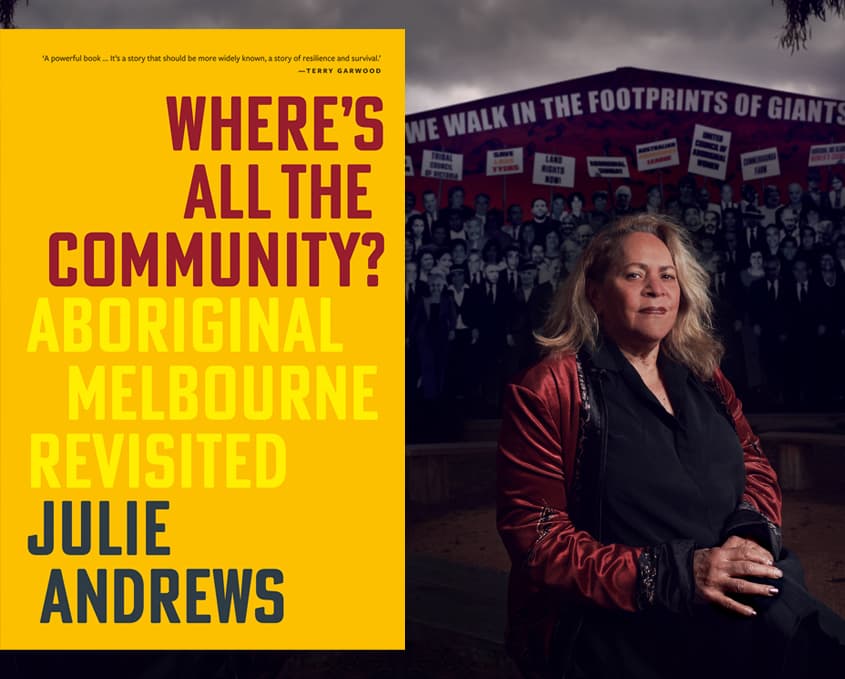
An edited extract of Where's All the Community?: Aboriginal Melbourne Revisited by Julie Andrews, published 3 March and available at all good bookstores and online.
The Four Corners program aired on Monday night detailed how Melbourne gynaecologist Simon Gordon performed surgeries to remove the ovaries and uteruses of dozens of young women who did not need these highly invasive and life-changing procedures. But beyond these shocking examples, Australia has a widespread problem with unnecessary and inappropriate medical interventions.