Where's All the Community: Aboriginal Melbourne Revisited
An edited extract of Where's All the Community?: Aboriginal Melbourne Revisited by Julie Andrews, published 3 March and available at all good bookstores and online.
Sat 28 Feb 2026 01.00
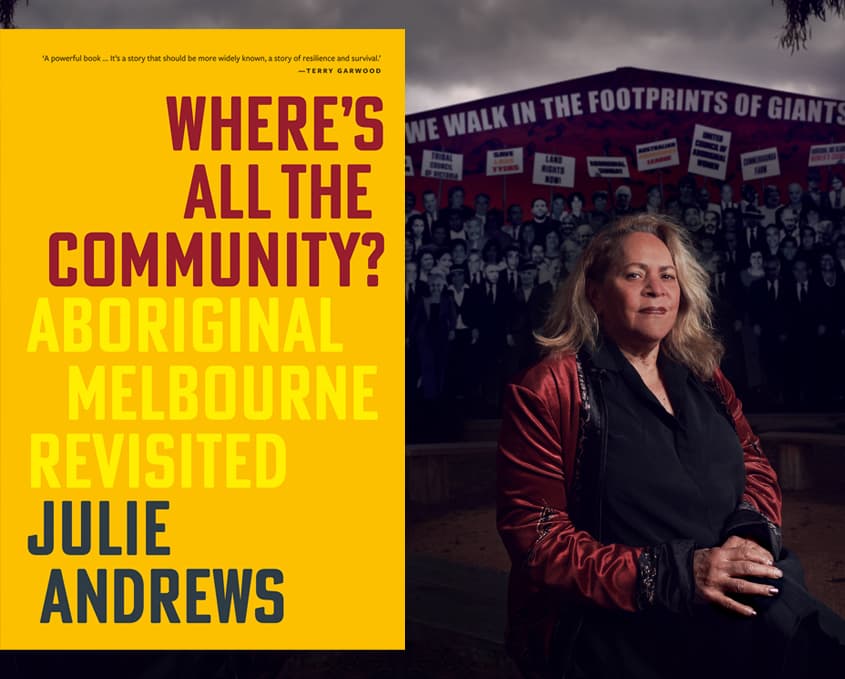
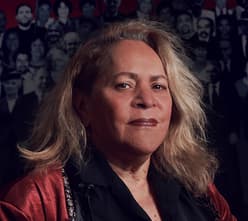
Photo: Julie Andrews (2025, Photographer Nicole Cleary)


In the 1960s, the Aboriginal community in Melbourne was all about ‘keeping our people together’. It held many social functions while advocating for the community’s rights. The community had its own Aboriginal organisation to use as a base, namely the Victorian Aborigines Advancement League (VAAL).
Today’s community has become much more diverse and manages itself in very different ways. There are many more opportunities to advance and to be included. And yet there remain complex barriers to the advancement of Aboriginal peoples and to acceptance in the broader Melbourne community.
Engaging Aboriginal people through consultation or leadership in projects is the most effective way to achieve better outcomes. Decolonising research and teaching is essential if knowledge is to be applied to improve Aboriginal community wellbeing. Research is a form of teaching, and involving our community in partnership with academic scholars will build momentum and growth.
There is so much diversity in Aboriginal Melbourne, shaped by the community itself. This vibrant community thrives on collaboration and support from a variety of people from all backgrounds. Visual media, music, art, discussions and networking are central to the everyday experiences of Aboriginal people. It is crucial to recognise how Black scholars have shaped global literature, fostering deeper discussions between Black and white academics and students. In Melbourne, there are eight universities where Aboriginal scholars such as Tony Birch, Mark Rose, Marcia Langton, Colin Bourke, Ian Anderson, Gary Foley, Gaye Sculthorpe, Wayne Atkinson, Barry Judd and I have contributed to this discussion and to the governance of Aboriginal higher education. Black scholarly research does not work in isolation and is not homogenous. Black scholars have always challenged Australia to acknowledge the barriers established through colonisation.
Growing up, I lived in and visited many Aboriginal homes, and these experiences were vital to my research. Today, increased interaction between Aboriginal and other communities allows us to better address lingering barriers. The Aboriginal community has grown significantly over the past fifty years, and social media has facilitated ongoing connections. From the 1960s to the present, the experiences of Aboriginal peoples in Melbourne are storied through their lives in ways that articulate the richness of their social and cultural contexts.
I am particularly interested in how the data I collected reveals key aspects of identity and mobility within Melbourne’s Aboriginal community, including relationships, interactions and narratives of survival, resistance and cultural resurgence. These are all characteristics that I associate with my own identity. However, not all Aboriginal people strive to identify in this way; some are unable to, and others choose not to. As an Aboriginal man said to me once: ‘It’s no one’s business how I am Aboriginal,’ and that is fine. Public Aboriginality is not for everyone; many just want to live a quiet life.
When I was growing up, Aboriginal Victoria was a relatively closeknit community in which everyone knew who was who and how they were related, and you instantly knew by people’s family names which Aboriginal mission or reserve they were connected to. In other words, we knew our kinship structure – this creates Aboriginal ways of knowing. There was an extensive Aboriginal kinship that was identifiable as generational; that is, Elders knew who their immediate forebears were, and often also their earlier ancestors, and this knowledge was passed down to the younger ones.
Interaction, also known as ‘mixing with your people’, from a young age and not just with your immediate family, has benefits: you are taught who is who, and this interaction has helped successive generations to know how they are related to others. Aboriginal kinship pre-colonisation would have sorted all this out, but traditional ways of knowing and cultural practices ceased after colonisation. It was unusual for Aboriginal Victorians to learn this information from institutions, but this changed over time as Aboriginal people began to be employed inside such places and/or to have access to documents compiled by government institutions. Access to documents was made possible by the advocacy of Aboriginal people on Aboriginal advisory committees.
For too long, Aboriginal people knew government institutions were compiling data and documents on them. These documents included historical journals in which explorers recorded conversations with Aboriginal people, mapped tribal boundaries (many are still in dispute today), took photographs and wrote biographies. What was missing in all this was our voice, our oral history – the Aboriginal cultural practice of passing down knowledge through stories that often told where the boundaries lay, the sacred cultural practices of men and women, fire burning practices and water management. Such cultural practices and Aboriginal knowledges are now emerging as the Traditional Owners of Aboriginal Melbourne are increasingly willing to share them in public or privately with their families. Community programs are important for such cultural teaching and are supported by government legislation. This teaching is available not only to Aboriginal people but to all. This is why our Aboriginal community organisations are so important, as they can provide a space for our community to learn and share with each other.
Although there have been changes to the Aboriginal Melbourne community over the past fifty years, its social profile remains intact. That is, the Aboriginal community has not lost its identity, nor its culture or community ties. In fact, the community appears to be more empowered than ever; Aboriginal organisations have grown and have advanced on previous gains made by the Aboriginal community. Additionally, Aboriginal Melbourne has its own state and federal politicians who have successfully been elected and who use their platforms to argue for change.
The most significant changes in Aboriginal Melbourne have been access to education and the acceptance of Aboriginal people in public spaces, particularly in sport and the arts. This has influenced Aboriginal people’s social mobility, their place within the city, and their ability to live independently – to an extent. The social mobility of the Aboriginal community can be measured in many ways, including how Aboriginal people themselves see their mobility, not just how the government and mainstream Australia see it. Some Aboriginal people measure their social mobility through education, home ownership, their ability to escape complex life situations, learning their culture, being accepted by their community, growing their family, and/or becoming well known or empowered as a leader or Elder. Understanding what Aboriginal people consider important is key to understanding what drives the Aboriginal Melbourne community today and what has driven us since European settlement.
We reclaim our cultural rights through government legislation for Treaty and Truth-Telling, leading to a resurgence of Victorian languages and connections to Country. I have frequently been asked by non-Aboriginal people if I can speak my language – another judgemental tactic revealing white misunderstanding of the impact of colonisation on Aboriginal Australia. Missionaries were allowed to instil harsh penalties upon Aboriginal people for speaking their languages and practising their culture. However, Aboriginal people growing up with their own people still learnt words and the social context in which to say them. I am proud to say today that my great-grandmother and grandmother passed on language to our family, and this has been dis-tributed to the community, where language is now thriving – even non-Aboriginal children are learning it in primary school. There are many urban Aboriginal people who originate from rural, remote parts of Australia and still have family there – our kinship ties are strong through our ancestral ties.
Growing up, I witnessed my family and other trailblazers advocate for Aboriginal Melbourne, a skill I’ve learnt to apply throughout my academic career while exploring diverse storytelling methods to convey the cultural and social features of Aboriginal Melbourne.
Professor Julie Andrews OAM is director of the Gabra Biik Wurruwila Wutja Indigenous Research Centre at La Trobe University. Her book Where’s All the Community: Aboriginal Melbourne Revisited is published by La Trobe University Press.
Advertisement
Related Articles
Factcheck: Do Australians 'overwhelmingly support' gun control? Yes they do.
Yes, they do. Polling surveys consistently show that Australians support strengthened gun control.