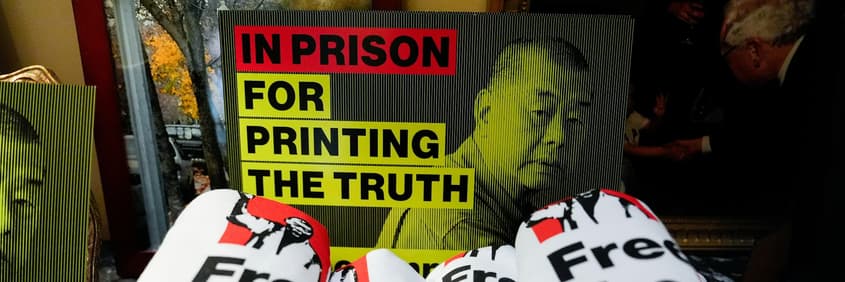


This week, after a 156-day trial, the Hong Kong pro-democracy campaigner and media tycoon Jimmy Lai was convicted of sedition and collusion with foreign or external forces.
Now facing life in prison, Lai was convicted under the country’s National Security Law, introduced in 2020.
During the 2019 protests in Hong Kong, Lai and the media outlet he owned — Apple Daily — regularly presented the views of pro-democracy activists.
It openly criticised the Hong Kong and Beijing governments, and encouraged readers to participate in pro-democracy rallies and protests.
Apple Daily and Lai came to symbolise the democratic ideal of a free press, able to criticise those in power without fear of censorship or sanction.
His conviction represents a major blow to those ideals.
The end of press freedom in Hong Kong?
In the years since the introduction of Hong Kong’s National Security Law, press freedom has slowly been limited. Lai’s conviction symbolises it has now ended altogether.
In 2002, Hong Kong was ranked 18th globally for press freedom in the Reporters Without Borders Press Freedom Index. It fell to 39th in 2005, and then to 73rd in 2019.
After the introduction of the national security law in 2020, a chilling effect soon took hold. Many pro-democracy media outlets and NGOs quickly disbanded.
This included Apple Daily and Hong Kong’s last opposition party, the Democratic Party.
Hong Kong has now plummeted to 140th place in the world press freedom rankings. Press freedom conditions are “bad” or “very serious”, according to Reporters Without Borders.
However, Lai’s trial symbolises a shift from self-censorship to an official view that certain media outlets are illegal.
It comes across as a clear message from the government that dissenting views will not be tolerated.
The Hong Kong media no longer serves as a vehicle for alternative views and airing of different political positions.
From rule of law to ruled by law
In the common law tradition, it is not uncommon for legislation to contain some degree of ambiguity. This is so courts can consider the “spirit” or “purpose” of the law as they pertain to each unique case. It allows flexibility as circumstances change.
In the 2020 National Security Law, however, what counts as violating national security is left completely undefined. This means virtually anything could be construed as violating national security.
In July 2022, the United Nations Human Rights Committee raised concerns about this law and the lack of clarity around the definition of “national security”.
This ambiguity means Hong Kongers are left in a state of uncertainty over which activities will or will not be perceived as undermining Beijing’s political authority.
Lai’s conviction (along with the conviction of 47 pro-democracy advocates) signifies that one possible definition of “national security” could be anything against Beijing’s agenda.