The leaders of Sydney’s Jewish community have more reason to be appalled than most other religious leaders that the remembrance event in Bondi descended into cat-calling and insolence towards the nation’s highest democratically elected office holder.

Wed 24 Dec 2025 06.00
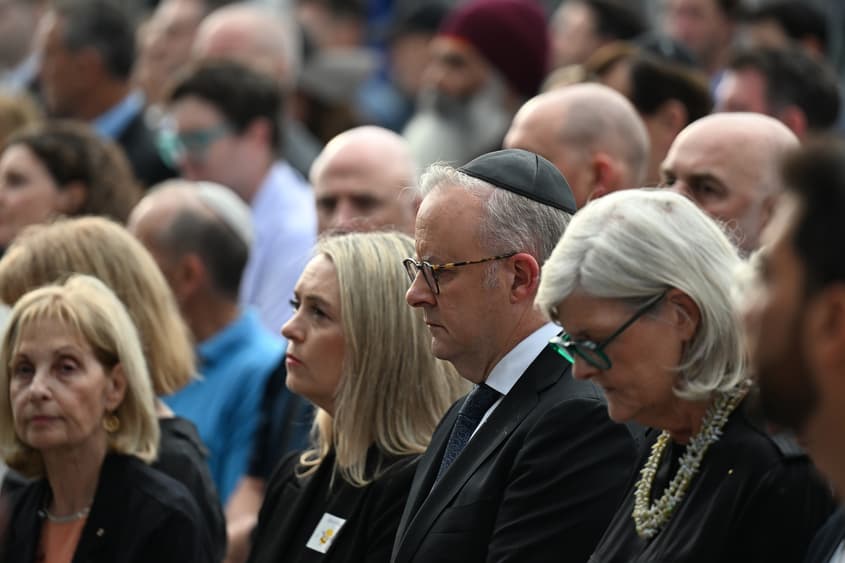
Image: AAP Image/Dean Lewins


The leaders of Sydney’s Jewish community have more reason to be appalled than most other religious leaders that the remembrance event in Bondi descended into cat-calling and insolence towards the nation’s highest democratically elected office holder. The solemnity of a memorial event was transmuted into a sectarian sideshow.
Dignity became disrespect, not just for the person of the Prime Minister but for the institution that he leads – the Commonwealth government.
The leaders of Sydney’s Jewish community had even more reason to be appalled as the leader of the federal opposition, with her most experienced Jewish frontbencher standing behind her, embarked on a stupefyingly petty attack on the Minister for Foreign Affairs.
It’s as though Israel’s Prime Minister Netanyahu, along with his (literally) take-no-prisoners supporters Smotrich and Ben-Gvir, have become Australia’s moral and political arbiters. Moral and political ambiguity is exacerbated when senior politicians and former politicians indulge in dog-whistling and petty politicking.
When the downturned face of grief turns into a sneer, grief is replaced by venom, re-generating the very forces that caused grief in the first place. Victims are re-victimised, and new victims found.
Habituation to victimhood engenders defensive behaviours that can be self-abnegating and self-destructive. This is a constant threat for minorities everywhere, especially in countries that are effectively lawless.
The awfulness of the Warsaw ghetto images of 1940 was prefigured in the Armenian genocide during WW1. It has been amplified repeatedly over the decades since: the slaughter of Rwandan Tutsis in the early 1960s; the Cambodian genocide in the 1970s; Yazidis fleeing Iraq in 2014; and the Hazaras escaping persecution in Afghanistan for over a century, but most recently after the American capitulation in 2021.
In so many cases, these persecuted minorities have taken refuge in Rule of Law countries, including Australia and New Zealand, where they have been welcomed and protected. That welcome and protection reflects the strength of the political institutions and social structures that are the foundations of strong democracies.
For those institutions and structures to endure, they must be respected. And that respect extends to the leaders of those institutions, the Governor-General and judges, and the holders of high elected office. That includes the Prime Minister, Premiers and parliamentarians. And because “the loyal opposition” is such an intrinsic part of the Westminster system, respect is due to Opposition leaders too.
None of them earn it. Their offices confer it. But they all must honour that fact.
As Australia’s Jewish community leaders appreciate better than most, their communities are privileged. They are well represented in academe, the arts, commerce, construction, the law and medicine. They are highly urbanised and both contribute to and enjoy the amenity of Australia’s fabulous cities.
That makes the Bondi shootings all the more confronting, because when traditional standards of public decency, respect and tolerance are under attack, the system that supports such standards is also under attack. The fabric of Australian society is under attack.
Whether the Albanese government has done enough to counter antisemitism, and islamophobia for that matter, is moot: some agree, and some do not. But the Prime Minister, the democratically leader of the nation, has acted with propriety and restraint. He and his Cabinet ministers should be respected for that, and not subjected to the political and quasi-religious sectarianism more typical of less democratic and less law-abiding countries.
Once again, we have an opportunity to take strength from adversity. The holiday season is a good time to think about the things that unite us as citizens and to remember that the care, compassion, inclusion, respect and tolerance that rose above the discord of the past short while are actually what distinguish us as a nation.
Allan Behm is an advisor in the Australia Institute’s International and Security Affairs Program.
The oil crisis has not only caused petrol prices to soar, it has revealed just how little competition there is among the big oil companies. A couple weeks ago the ACCC announced that it would be looking into uncompetitive behaviour by petrol companies in the rural areas.

Australia’s shrinking local media landscape has fuelled growth in independent news outlets, with publishers gathering in rural South Australia to discuss the challenges facing community journalism. The Local and Independent News Association (LINA) summit in Murray Bridge comes amid growing concerns about the sustainability of regional news.

Combined with the 50 basis points rise in February and March in less than 2 months households are paying the equivalent of a 90 basis point rise in interest rates.