Wed 21 Jan 2026 01.00


The members of the North Atlantic Treaty Organisation (NATO), and members of the European Union (EU) more generally, are facing the age-old question: how to unscramble an omelette not of their own making?
The answer is, of course: with difficulty, because the question is as meaningless as the answer. NATO’s, and Europe’s, best option is to bin the omelette, start from first principles and plan a calibrated response.
NATO, like ANZUS, is predicated on a cocktail of insecurity and sentimentality.
In NATO’s case, the insecurity derives from the disaster of WW2 and the difficulty of reuniting enemies one of which at least displayed unspeakable bestiality, compounded with a visceral fear of the Soviet Union, particularly during the Cold War. The sentimentality derives from the platitudes and placebos embedded in “shared values”, the default expression that tells everyone that there’s nothing to say.
Insecurity and sentimentality are no basis for strategy.
Strategy is constructed around interests, and alliance strategy is constructed around shared interests. The European NATO members and the members of the EU more broadly certainly share interests. They are mutually invested in each other’s prosperity, stability and security, and deeply invested in the maintenance of a continental peace that was forged out of unbelievable suffering and destruction. “Never again” may express a negative. But it is deeply embedded in Europe’s political and strategic DNA.
EU members are also deeply invested in a political and social system built upon the rights of citizens and clear limits to the power of the state to circumscribe individual freedoms.
Democracy is always a fragile system, especially when nationalism inspires the manipulation of electoral systems and courts. Europe is sensitive to both phenomena. Under Donald Trump, America, it would appear, is less so.
European sensitivities have been heightened by the amorality, capriciousness and base transactionalism of Donald Trump and, until the present moment at least, the apparent inertia of the US institutions that were supposed to constrain an out-of-control Executive.
Trump’s bluster and bullying over the annexation Greenland, and his devil-may-care attitude to the costs and responsibilities associated with American leadership of the so-called free world, have not only intimidated the Europeans but have provoked destabilising levels of insecurity.
Neither Trump nor his main advisors understand or care that the long-term national security and global leadership aspirations of the US depend critically on its ability to create and manage alliances built on shared interests and trust. Trump, by threatening to invade an alliance partner, has negated any notion of shared interest and has obliterated trust. That has shaken NATO to the core.
Insecurity drives fear, and fear is no basis for strategy either.
The European leaders – Britain, France, Germany, Spain, the Benelux, the Nordics and even Italy, the most pro-Trump of EU members, simply do not know what to do. And that’s because they have yet to settle the basis of a collective strategy. Denmark’s refusal to cede Greenland, and the Europeans’ support for Denmark, is nothing more than an essential first step in Europe’s resistance to Trump’s bullying.
The more important shared interest is European cohesion and unity, both in taking the initiative and in responding to pressure.
For the US, e pluribus unum (one from many), which appears on the Great Seal, may provide the inspiration for its exceptionalism and manifest destiny.
For the Europeans, however, the inspiration is to be found more in Shakespeare’s “one for all, or all for one”. Without that core conviction, there can be no European strategy for dealing with the US or anyone else, including Russia. Collective action is the essential strategy of the European Union.
So what do the Europeans do?
First, the European heads of government need to keep on telling Trump that he’s on a loser. Britain, France, Denmark, Germany, Spain, Sweden, Norway, Poland and Italy have already done that, and whether by phone or by Truth Social, they need to keep up the pressure.
Second, as President Macron has already suggested, retaliatory tariffs must now come into play in response to Trump’s ten percent tariff on European exports to the US. Trump has no respect for international agreements, and regards “deals” as ephemeral.
A trade war fought through countervailing tariffs is ultimately a self-defeating tactic – everyone loses. But Trump has already learned that tariffs hit his political approval ratings. He needs to learn that lesson again.
Third, it is time now for the NATO partners to act in concert and recall their Ambassadors from Washington “for consultations”.
While the recall of Ambassadors is largely performative, as Macron’s withdrawal of the French Ambassador from Washington (following the announcement of AUKUS and the abrogation of the submarine agreement between Australia and France), it is a clear signal to the US Congress that it needs to step in and do its job of constraining the excessive use of the power and authority of the executive. This will probably demand some real soul-searching in Ottawa.
It is for the EU members to follow suit should Trump fail to heed the signal given by NATO.
Fourth, NATO’s senior diplomatic and military leaders should convene, not in Brussels but in a member capital, perhaps Copenhagen, without the attendance of the American civilian and military leaders, to initiate planning for joint maritime patrols in the North Atlantic by the European NATO members. The Pentagon and the State Department would find such an action mortifying – but not as humiliating as it has been for Denmark to consider the annexation of Greenland, or for Canada to consider its own incorporation into the US.
Finally, the European Parliament should move quickly during its current meeting in Strasbourg to signal to the Trump Administration that Europe is an economic, political and social entity where the territorial rights of all its members are sacrosanct.
In a world where symbolism remains important, the European Parliament needs to ensure that the symbol of European unity is at least as strong as Trump’s symbol of aberrant use of American power.
Allan Behm advises on international and security affairs at The Australia Institute, Canberra
Advertisement
It isn’t always easy to keep up with what’s happening in the US. “Shorter America” is a series where Dr Emma Shortis loops you in on what’s going on in America and shares news and analysis that you can trust.
The President of Peace has started another war. It began with the bombing of a school in southern Iran. According to Iranian authorities, the death toll from that strike now sits at 168. Many of the victims were children.
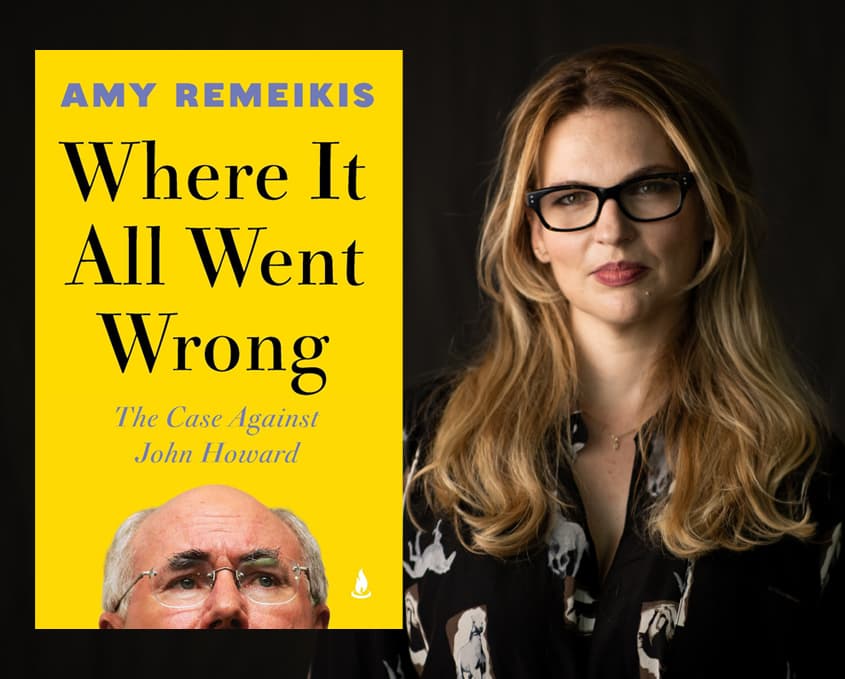
An extract from Amy Remeikis’ new book, Where It All Went Wrong: The Case Against John Howard’
The Australia Institute’s International & Security Affairs advisor Allan Behm said the “decapitation of the regime” in Iran marks the beginning of “massive instability bordering on long-term chaos”.