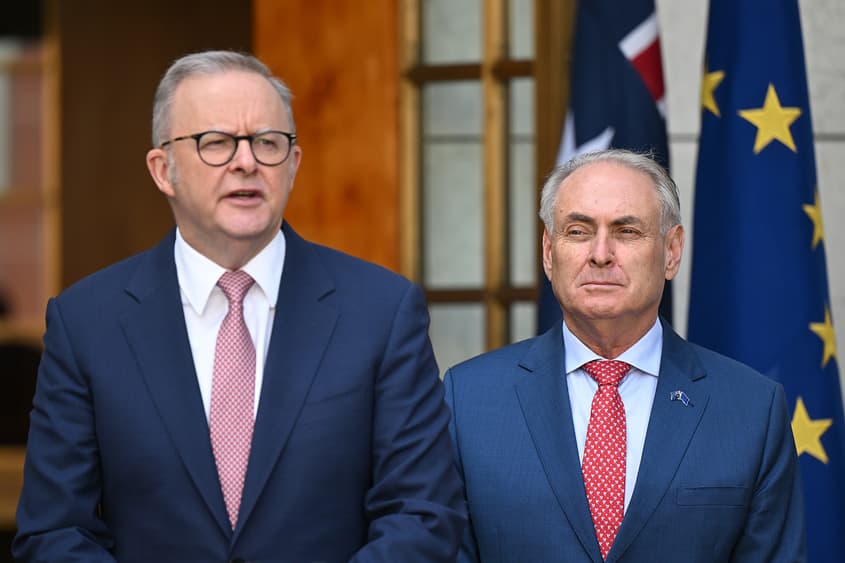
On Sunday 15 February, Prime Minister Albanese and Defence Industry Minister Conroy, with South Australian Premier Malinauskas in tow, launched the new AUKUS nuclear-powered submarine construction site at Osborne, to the west of Adelaide. Defence Minister Marles was conspicuously inconspicuous.

Wed 18 Feb 2026 01.00
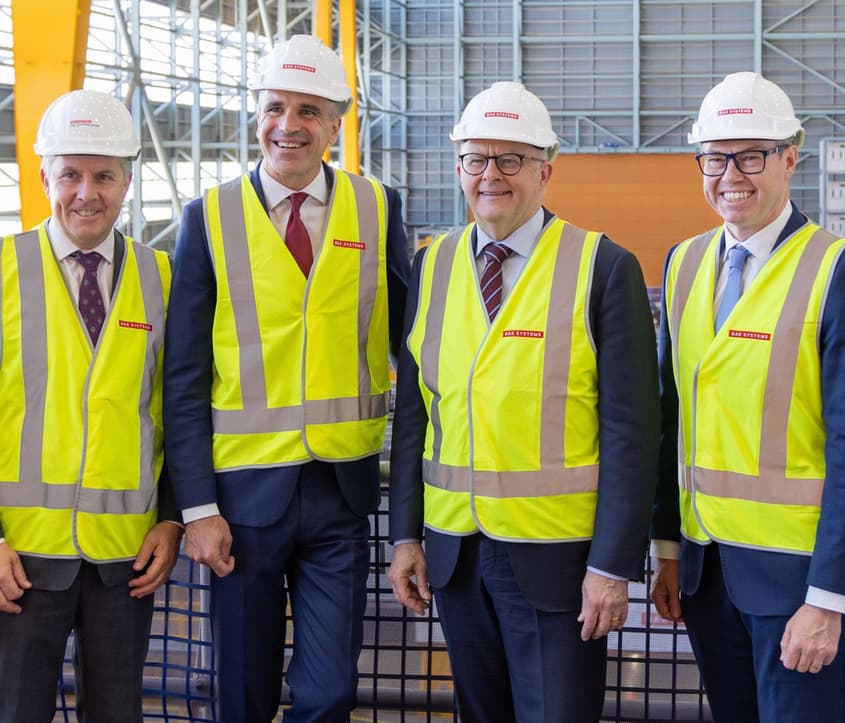
Photo: Mark Butler, Peter Malinauskas, Anthony Albanese and Pat Conroy at announcement of an initial $3.9 billion down payment to deliver the Osborne Submarine Construction Yard.


On Sunday 15 February, Prime Minister Albanese and Defence Industry Minister Conroy, with South Australian Premier Malinauskas in tow, launched the new AUKUS nuclear-powered submarine construction site at Osborne, to the west of Adelaide. Defence Minister Marles was conspicuously inconspicuous.
With a $3.9 billion “down payment” to build a Skills and Training Academy – it doesn’t appear that we’re going to leverage private sector offerings like other enterprises do – and another $30 billion to follow, the proverbial rainbow is certainly hitting the arse-end of Adelaide. By way of comparison, HMAS Stirling in Western Australia managed to land a mere $8 billion to provide the facilities for four USN Virginia Class and one RN Astute Class to support the Submarine Rotational Force (West) and the defence-funded housing for the 1200 US sailors (and their dogs) who come with the submarines.
When he wrote and illustrated The Magic Pudding, Norman Lindsay could not have imagined the endless flow of cash that AUKUS has generated. The disabled Australians who rely on the NDIS would really appreciate a similar deal.
In a press release full of frothy statistics, the Prime Minister informed the world that the new construction yard will create nearly ten thousand jobs in South Australia alone – four thousand to build the yard and five and a half thousand to build the submarines. Quite what the four thousand construction workers will do when they’ve finished the yard is left unsaid. Maybe they’ll hang around to make up the numbers.
A few more exciting statistics: in a clear bras d’honneur (or should it be ‘the bird’) to France – now busily selling its submarines to its European partners after the Australian debacle – we are told that construction will use an amount of steel equivalent to 17 Eiffel Towers, and the “Fabrication Hall” will be two-and-as-half times the length of Adelaide Oval. Oh, and construction will take 66 million man-hours. It is assumed that it will be the same number of gender-neutral hours. This is riveting stuff, even for a naval shipyard.
And in a Linkedin post, Minister Conroy added a breathless metaphor to proceedings by telling us that Osborne “isn’t just a shipyard – it’s the engine room of AUKUS” – an engine room that will lack engines for decades to come, and will never actually produce an engine. Nor perhaps will Rolls Royce succeed in producing the PWR3 reactor for the Dreadnought class, but that’s another story.
What’s still unannounced is when construction of the Virginia-class submarines will commence. As the recently released Congressional Research Service Report suggests, the US could decide to de-risk the entire AUKUS project by “procuring up to eight additional Virginia-class SSNs that would be retained in US Navy service and operated out of Australia along with the US and UK SSNs that are already planned to be operated out of Australia”. That is, no submarines under Australian command.
On the basis of all the information presently to hand, this is looking like the most likely outcome. If indeed there is an outcome.
The constraints imposed by construction facility obsolescence, low workforce numbers, skills deficiencies and production demands may well sink the Australian Virginia-class submarine before it is even launched. Harland and Wolff, the Belfast shipbuilders that constructed the Titanic, at least launched the ship before it encountered the iceberg. Harland and Wolff’s luck ran out, too. It went into receivership in 2024, and was sold last year to the Spanish shipbuilder Navantia. The Peninsular War has come to a hubris-deflating end.
And if declining skill levels and a declining workforce are strangling the production rate of American and British SSNs, what hope have South Australia and Western Australia – with their low populations, slender technology base and high labour uptakes – in meeting the demands of an ambitious submarine program?
Other countries currently in the submarine purchase and construction market are not buying nuclear powered submarines, American or British. The Netherlands is acquiring four French Barracuda submarines (NAVAL Group), similar to those that Australia walked away from in 2021, at a cost of $830 million. For its part, Canada is in the final stages of selecting either the South Korean Hanwha Corporation or Germany’s ThyssenKrupp Marine Systems (TKMS) for the twelve conventionally powered submarines that will replace its ageing Victoria-class submarines.
Indonesia is purchasing two of the Naval Group’s Scorpene diesel-powered vessels, while India is also on the verge of selecting TKMS for its twelve diesel-powered submarines. Brazil has acquired French technology to construct its four diesel-powered submarines, and is working towards developing an indigenous nuclear-powered submarine again based on the French Barracuda design. They all appear to know something about emerging battering technology and conventionally powered submarine endurance abilities that we don’t. Funny, that.
As the tide of AUKUS cash continues to flow into facilities in the US, the UK, Adelaide and Perth, the Albanese government will face increasing calls for transparency around the policy, political and security implications of a project for which there appear to be no guarantees of delivery.
The Magic Pudding ends in a retreat. The sooner a measure of reality brings the AUKUS dream down to earth, the sooner Australia can return to a disciplined and realistic approach to defence strategy and defence capability acquisition.
Allan Behm is an advisor at The Australia Institute’s International and Security Affairs Program.
Advertisement

Last night, the Australian Prime Minister had the chance to face reality. His address to the nation was a recognition that Australians are deeply worried about the state of the world – as they should be. What the prime minister did not say is that this trouble lies at the feet of the President of the United States.
Will a gas export tax harm our diplomatic relationships? No. Foreign companies being sad about having to pay some tax in Australia is quite different to foreign countries losing trust in Australia as a reliable trade partner.
China is emerging as a quiet winner from Donald Trump’s escalating war in Iran, with its economy largely shielded from the worst of the global energy crisis.