
Fri 6 Mar 2026 01.00
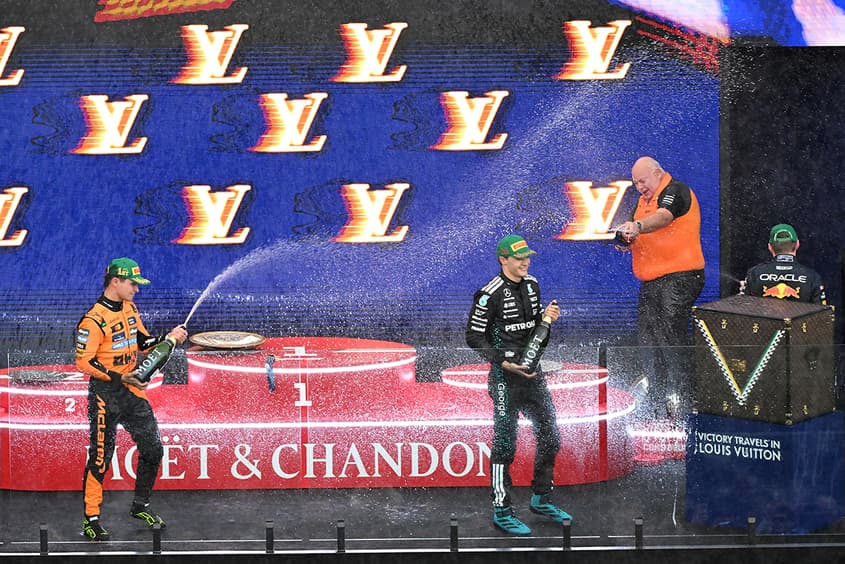
Photo: AAP Image/James Ross


The Melbourne F1 Grand Prix has already delivered another bill for Victorian taxpayers. The discovery of asbestos contamination during works in Albert Park has left taxpayers on the hook for a costly clean-up, adding to the already eye-watering public subsidy required to host the race.
It’s a fitting prelude to an event that has spent decades running up losses for the state, and months of noise and disruption for local residents.
For most Australians, the F1 Grand Prix held in Melbourne’s Albert Park Reserve means a car race will be on TV for a couple of hours. For more serious fans it means a couple of days at the track.
However, for locals, this week is simply the midpoint of five months of noise and disruption.
Construction of the “temporary circuit” begins in December and the pack up lasts until May. It takes that long for many thousands of tonnes of infrastructure to be trucked in and then out – and even longer, depending on Melbourne’s Autumn weather, for the grounds to regenerate.
During this time, you’ll need a bit of luck if you want to walk your dog, go for a run or a picnic next to the lake. Sports clubs often can’t access their usual facilities.
This might all be okay if Formula 1 brought significant benefits to Victorians. But it doesn’t. The race loses around $100 million dollars each year and Victorian taxpayers pick up the tab.
You can see this from the annual report of the Grand Prix Corporation itself (page 35). It costs roughly $200 million to put the race on and about $100 million comes back in ticket sales and sponsorship.
That’s $100 million in government subsidies every year. That’s almost double what the Victorian Government spends on community sport. It’s more than enough to buy the airfares for all the visitors who apparently come to see the race.
The GP has already lost more than $1 billion for Victoria, and losses will reach around $3 billion by the end of the contract in 2037. Yet this barely rates a mention from all the economic commentators who criticise the Victorian Government for spending on public transport.
It’s worth remembering that former Victorian premier, Jeff Kennett, once declared that “Victorian taxpayers would not be asked to meet the cost of the event.”
So where does all that money go?
It goes to a US-owned corporation, Liberty Media, which owns the Formula One franchise.
Every year Liberty Media will pocket an estimated $100 million GP licence fee and around $30 million revenue from the exclusive Paddock Club corporate facility, as well as all revenue from trackside advertising and global TV rights. Ticket sales for the event also pass through a Liberty Media owned company, Ticket Master.
There’s a great explainer video on how Liberty Media uses F1 to exploit cities – including Melbourne – around the world.
The business model of Formula 1 is well-known – use public space and taxpayer money to extract private profit. Labor and Liberal Governments have shown that they don’t care, as long as they get to host VIPs trackside.
Governments claim that there are benefits to the wider economy, local businesses and visitation, but these claims fall apart when subjected to any scrutiny.
Every economic analysis that has formally compared the costs and benefits of the race concludes that it’s a loser for Victoria. So instead of cost benefit analysis, the Vic Government commissions “economic impact studies”. This is the same kind of dodgy modelling that mining companies like Adani use to inflate their jobs figures. Economist, Professor John Quiggin has described “impact” studies as “utterly discredited”. They always return a positive as costs are not included.
Many local businesses either lose money or experience no change because of the event’s “go away/stay away” effect. Locals go away to escape the noise and disruption of the GP and normal tourists stay away for the same reasons. Of course, hotels increase their tariffs during major events, including Grand Prix weekend. In Melbourne many hotels – and the casino – are foreign owned, so GP profits leave Australia.
Perhaps most frustrating are the government lies on attendance. For a sport that is supposedly at the absolute forefront of technology, readers may be surprised to discover that Australia’s Grand Prix Corporation is unable to count how many people pay for tickets or walk in the gate.
Instead, attendance is estimated through a methodology and this methodology is considered commercial in confidence. Save Albert Park has been trying for years to get this methodology released. What we know is that attendance numbers include staff and free tickets, often counted four or five times over the whole event. This is important because it is the attendance numbers (and the dodgy modelling figures) that the Victorian Government uses to justify the ongoing subsidisation of the race.
So if you see the Formula 1 on a TV this week, please enjoy it because you and taxpayers around Australia are paying for it.
And please spare a thought for the Albert Park locals as we endure the noise, the closed roads, the traffic snarls and, of course, the loss of our lovely park. Again.
Joan Logan is the vice president Save Albert Park. She is also a nurse, a farmer and a runner.
Advertisement
The claim that half of voters rely on the Government for 'most of their income' that has been repeated across the media and by politicians, simply isn't true.
If you live in Sydney, do you know how many guns are being stockpiled just down the road?
The debate over the capital gains tax discount comes down to a very simple question: who do you think should pay more income tax? Should a high-income executive who makes a $400,000 capital gain (that is, a profit) from selling an investment property pay a higher tax rate than a full-time retail worker on minimum wage who decides to pick up a few extra shifts?