Tue 24 Mar 2026 22.39 AEDT
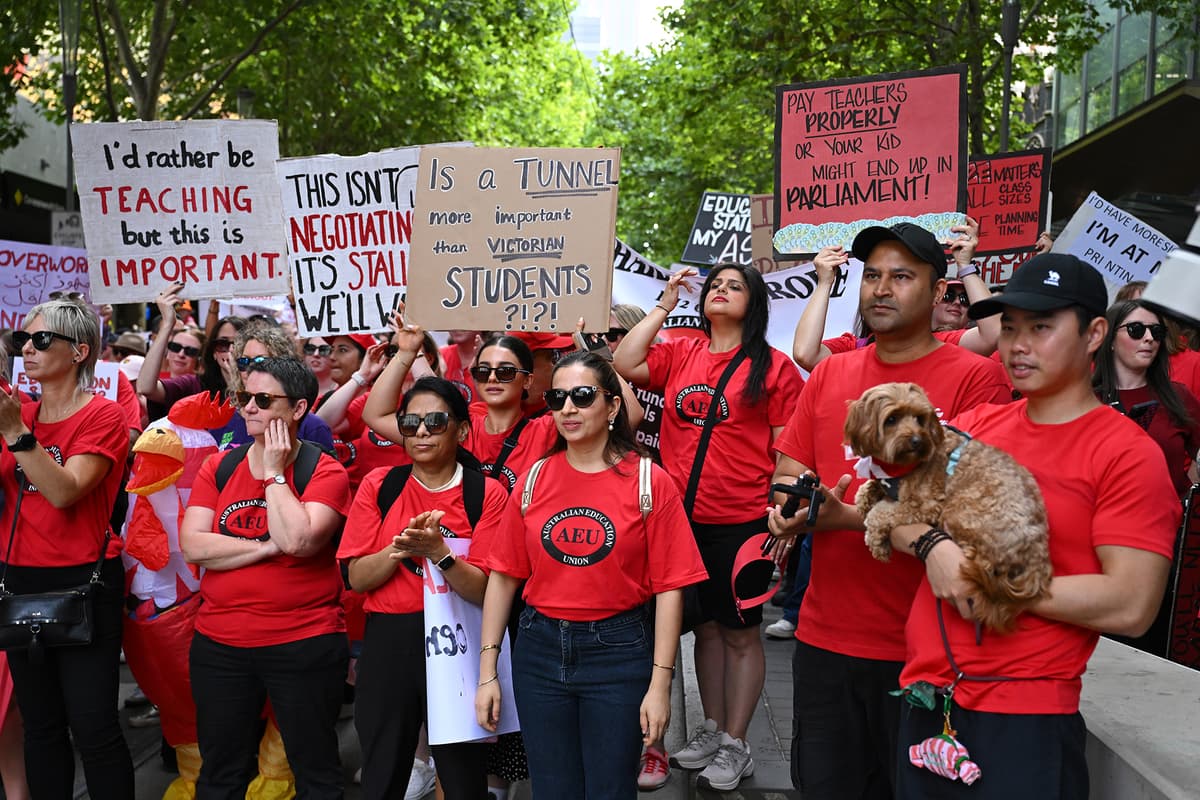
Photo: AAP Image/James Ross


Most people have a nostalgic story to tell about their favourite teacher. We often invoke them when teachers are bargaining for better pay and conditions, or when another story of violence in schools reaches the headlines.
The memories return: – the English teacher who taught us what it meant to be a reader, the history teacher who altered our trajectory, the teacher who saved us.
Hearing these stories is affirming. They reflect the familiar cultural script we hold about teachers. They’re selfless, they’re caring, they do “the most important job in the world”.
If these platitudes are familiar, it’s because they are. They precisely echo the language we use to sanctify mothers.
Like days we set aside to demonstrate gratitude for teachers, Mother’s Day has also become a cultural moment for public tributes to maternal sacrifice. Social media posts genuflect to endless patience, boundless care and unconditional love.
We thank mothers for everything they’ve given while acknowledging that our sentiments could never possibly repay the debt. Ironically, what began as an anti-war movement has become sanitised to the point where its political roots seem absurd.
And, like we do teachers, we’re more willing to praise mothers than we are to recognise the injustice of their position – the unequal distribution of labour, the impossible standards of care and expectation, the focus of blame when their children go awry.
What is key to note is that beneath the effusive praise for both teachers and mothers sits an unspoken social bargain – some forms of labour (usually those performed by women, or in the case of the teaching profession, more women than men) are expected to be acts of generosity rather than work that deserves recognition, protection or proper pay.
But praise can also be used to control. It can insinuate that you work for love and passion and duty, not for recognition of expertise or remuneration that reflects your value.
When teachers ask for higher pay or safer working conditions, the public conversation often turns back to gratitude. Teachers shape the future. Teachers change lives. We value their contribution.
All of which is undeniably true. But these declarations of admiration often do something else entirely, and they do it intentionally. That is, they replace structural recognition with symbolic praise.
Like what unfolds each Mother’s Day, effusive praise for teachers allows us to celebrate them while avoiding the harder conversation about why the profession is persistently underpaid, overburdened and increasingly unsustainable. We want the praise to satiate the calls for reform.
Gratitude also becomes a mechanism for maintaining inequality. It softens the edges of exploitation while reinforcing the expectation that some workers will simply keep giving.
This logic is not unique to teaching. It’s a pattern that runs through many feminised professions – nursing, childcare, social work and community services. These are jobs that hold societies together. They require enormous skill, knowledge, intellect, judgment and emotional labour. Yet they’re consistently undervalued precisely because they’re framed as care rather than expertise.
Teaching carries an additional burden, too – few understand the incredible complexities of a single day in a teacher’s work life without experiencing it for themselves. Violence, misogyny, curriculum demands, administrative burden, social and relational work; the scope is unimaginable. Meeting your basic needs like drinking water, a toilet break and stopping for lunch are luxuries.
It’s very much like early motherhood, when the child’s needs supersede the mother’s, and if she complains, she’s reminded to be grateful that her work is important.
Gratitude, while earned and deserved, cannot be the rationale that maintains an ongoing denial of entitlements and respect.
Admiration alone does not retain teachers. Nostalgia does not keep experienced educators in classrooms. Gratitude does not address the structural conditions that are driving thousands of teachers out of the profession.
And gratitude is not what is expressed by many students in Australian schools who are exhibiting increasing levels of violence towards their teachers.
What teachers are asking for now is not extraordinary. They’re asking for what most workers expect in any profession – fair pay, manageable workloads and safe workplaces.
The strike in Victoria should not be understood as a failure of teacher dedication. It should be understood as a refusal to keep honouring a social bargain that has always been deeply unequal and unjust.
As long as we continue to treat teaching like a form of moral sacrifice rather than skilled professional labour, the system will continue to rely on goodwill it has no intention of properly valuing. And no number of nostalgic stories about our favourite teachers will fix that.
Stephanie Wescott is a lecturer at the School of Education, Culture and Society at Monash University
Adriana Bonifacio is a PhD candidate in the Faculty of Education at Monash University
This article was first published on Monash Lens. Read the original article
Advertisement


