In life it is nice to have things you can count on, and every time this year you can absolutely be guaranteed to hear business groups and their friendly economists screaming in fear that the ACTU and the Labor Government’s recommendation for an increase in the minimum wage will cause a recession.

Fri 27 Mar 2026 11.00
Photo: AAP Image/Joel Carrett


In life it is nice to have things you can count on, and every time this year you can absolutely be guaranteed to hear business groups and their friendly economists screaming in fear that the ACTU and the Labor Government’s recommendation for an increase in the minimum wage will cause a recession.
This year the noise is a bit more hysterical than in the past couple years, but consider this opening in the AFR:
“Employers and economists have warned the 7 per cent minimum wage rise demanded by unions would make it impossible to contain inflation, tipping the nation into recession.”
Oh wait. Sorry that was from 2023 when the ACTU was pushing for a 7% increase. Let’s try again:
“Employers have warned that the union movement’s claim to increase minimum wages to cope with higher inflation could trigger further rate rises, while unions say that bosses are ignoring productivity gains.”
On dear. I have to apologise again. That was from 2022 when the ACTU was pushing for a 5.5% increase.
Ok, third time’s the charm, because this year the ACTU is pushing for a 5% increase, and the Government supports an above inflation increase (which is forecast to hit 4.2% — so 5% is roughly what it supports):
“The Albanese Government’s demand for an above-inflation wage increase for almost 3 million workers in the middle of a global oil price spike risks repeating the mistakes of the 1970s stagflation shock, economists warn amid predictions Australia could have one of the highest inflation rates among advanced economies.”
Sigh. It’s a veritable greatest hits of business scare quotes – stagflation, the 1970s highest inflation…
Let’s have a look at what is being asked.
The Reserve Bank in February, before the Iran War began, forecast that inflation by June would hit 4.2%. We know this is going to be wrong – it will be closer to 5%, but let’s go with it.
The ACTU is calling for a 5% increase in the minimum wage and award wages. This is for the lowest paid workers in Australia – those who really have no bargaining power and is the minimum you can get paid for doing each type of work.
Each year the Fair Work Commission raises the minimum wage and award wages to recover lost value due to inflation – and usually also gives a small real increase to help improve their cost of living and to take account of productivity improvements. This means that when you chart the real minimum wage and award wages on a graph it looks like a sawtooth pattern:
As you can see during the pandemic and when inflation took off in 2022, the value of award wages and minimum wages collapsed (like they did for all wages).
The ACTU is proposing a 5% rise, but because of inflation this would end up really being just a 1.4% real increase.
But here’s the thing – the value of the award wages would still be lower than it was in 2020!
Business groups would want you to believe that giving Australia’s lowest paid workers a pay rise that still leaves them worse off than they were 6 years ago will be the end of times.
Please.
Australia Institute research has shown there is no link between increases in the minimum wage and future inflation, because guess what – most people don’t actually compare themselves to those on the lowest wages in Australia.
Also, we know what is causing the current increase in inflation – the oil crisis and company profits.
You can pretty much breakdown the cause of inflation to wages, profits and government taxes and subsidies. And in the last part of 2025, wages went down in real terms and profits began to rise significantly:
The good news at least is we are not the only one noting this. In the AFR’s own scare article they quote former Deputy Governor of the RBA Luci Ellis, who is now Chief Economist for Westpac. She says:
“Unit labour cost growth has been slowing and productivity growth in the market sector has been growing at a decent clip, contrary to some more alarmist commentary.
“Australia faces numerous cost and price challenges at the moment, but a wages breakout is not one of the most important.”
Absolutely correct.
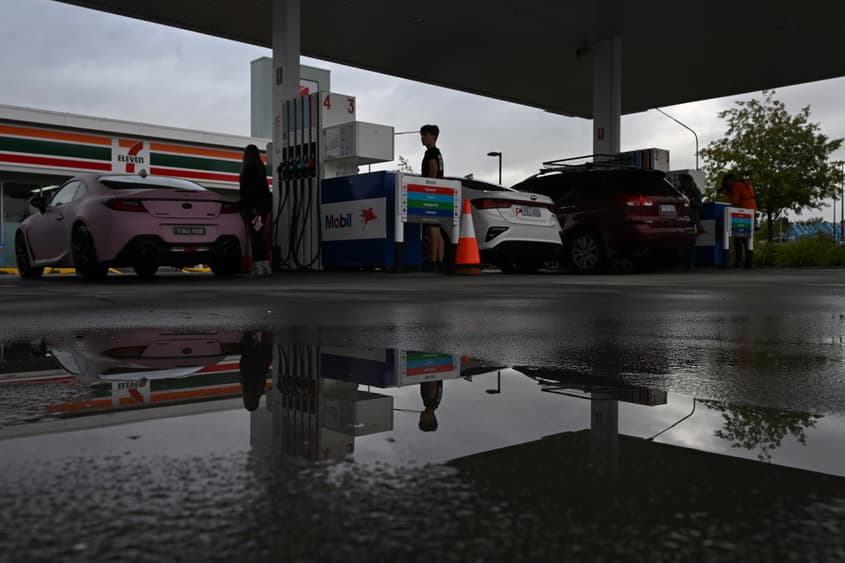
The oil crisis has not only caused petrol prices to soar, it has revealed just how little competition there is among the big oil companies. A couple weeks ago the ACCC announced that it would be looking into uncompetitive behaviour by petrol companies in the rural areas.
Advertisement
Combined with the 50 basis points rise in February and March in less than 2 months households are paying the equivalent of a 90 basis point rise in interest rates.
News has come out today that the Government’s submission to the Fair Work Commission for the annual wage review will recommend an “economically sustainable real wage increase” for the National Minimum Wage and the Modern Awards.