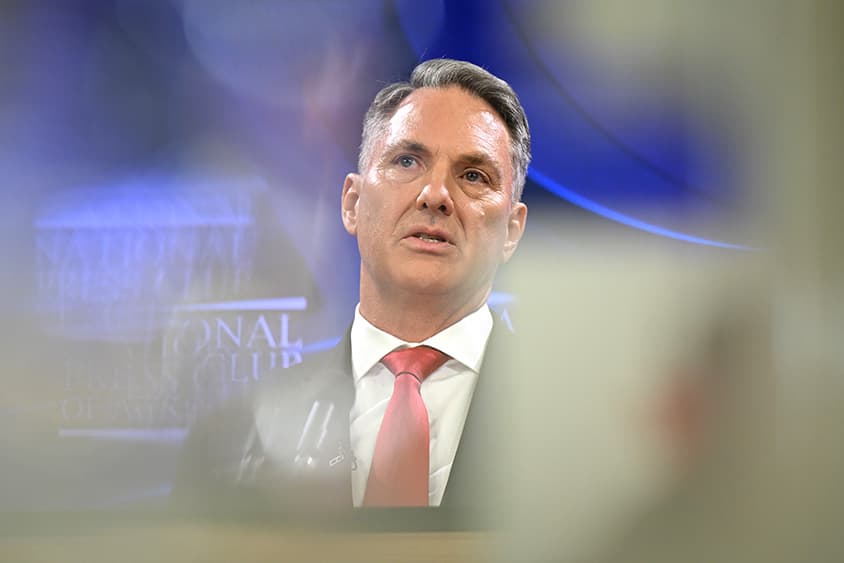
Deputy Prime Minister Richard Marles has released the defence strategy you have when you don’t have a defence strategy. The budget outcomes are unremarkable: $53 billion over ten years, with the biggest licks of money scheduled for the later years, beyond the forward estimates. In real (i.e., political) time, that’s three elections away, by which time, everything becomes someone else’s problem.
In other democracies, that might be called cynicism. In Australia, it’s called prudence and fiscal rectitude. Naturally, we will continue to build substantial naval shipbuilding and maintenance yards at Henderson (WA), essentially to manage the US Virginia class nuclear-powered submarines that the Royal Australian Navy is unlikely to own or operate, and certainly not within the next decade. Still, there’s something to be said for prudence when it really doesn’t cost you much.
The Deputy Prime Minister still had to justify the increase in the Defence spending target from just over 2 percent of GDP to something closer to 3 percent of GDP – a target inflated somewhat by adopting NATO accounting rules. But it moves us closer to the magical target of 3.5 percent prescribed by the US for all its allies and partners.
You don’t need a diploma in creative accounting to understand the problem with spending targets. It means a successful defence strategy is measured by hitting the target, not by ensuring that the nation has the means to deal with security risk.
A simple comparison illustrates the point. The NDIS (National Disability Insurance Scheme) is about the same size as the Defence budget. It is structured around needs: what disabled Australians need to improve their well-being and their quality of life. The budget cloth is cut to fit the need. There is no target. And if the budget provision comes under pressure, what does the government do? It reassesses and redefines the need and adjusts the budget accordingly.
But not in the Defence universe. Inefficiencies and perverse outcomes notwithstanding, the KPI is the spend, not what you get for it. As my colleague Greg Jericho pointed out recently in Australian Quarterly, “Spending a percentage of annual economic output does not guarantee defence capability uplift and is likely to lead to poor decisions and waste”.
Targets are one thing; the reasons for targets are altogether another. This is where the 2026 National Defence Strategy is especially disappointing. What the Deputy Prime Minister offers as justification for this strategy requiring large dollops of recurrent and prospective spending, amounts to little more than a collection of unsupported, and possibly unsupportable, assertions. No other sector of public spending is permitted to get away with this sort of budgetary make-believe.
Marles’ underpinning propositions are:
- Deteriorating trends have broadened and intensified; new challenges threaten Australia’s security.
- A more dangerous and unpredictable era elevates risks to Australia’s security.
- China’s military build-up increases the risk of military escalation and miscalculation.
- The global rules-based order is in transition, with fracture, rivalry, and disorder in prospect.
- A strategy of denial remains the cornerstone of defence planning.
- We need a more resilient “sovereign” defence industrial base and stronger international partnerships.
- We need improved national civil preparedness and national resilience.
- Hence, we need to be able to defend Australia and our immediate region.
- We need to “deter through denial” the employment of armed force against Australia.
- We should contribute to regional collective security.
- We should work with partners to uphold global rules and norms.
So there you have it. That’s Australia’s national defence strategy in a nutshell. Essentially, the world is getting worse, China is getting worse, observance of global rules is getting worse, our preparedness and resilience are getting worse, and so is regional collective security.
If all of this were true (and the lack of urgency by successive governments suggests that it is not), we would need to be building a comprehensive and integrated set of actions across the economic, international, social, and strategic policy domains. These would need to focus on sustained diplomacy, international economic engagement, close regional assistance relationships, and the reinforcement of domestic social cohesion and self-directed foreign and defence policies. These policies would need to provide the necessary buffer between the current unpredictability of American policy (especially under President Trump) and the current ambiguity surrounding Chinese policy.
But that’s not where the government is headed. For all the confected circumlocution and portentous phrases, it’s really more of the same: a bit of gesture here, a bit of posture there and a bit of rhetoric everywhere.
Yet there are three issues that fester within the new National Defence Strategy without diagnosis or treatment: the truculent unpredictability of US policy; the destruction of the global rules-based order (as Canadian Prime Minister Mark Carney identified); and Australia’s evident lack of self-confidence and motivation in advocating for new international rules to guide and sanction international behaviour.
The challenge for Australia and like-minded countries is not building up the machinery of war to deny coercion. It is to encourage collaboration to secure regional stability and global security. And that, by the way, is the diplomatic task that Evatt assumed in 1945 as WW2 was still raging, when he delivered a transformational and uniquely Australian role in negotiating the UN Charter and creating the United Nations.
Our times call for similar commitment and ambition. None of that is to be found in the latest defence strategy.
Allan Behm is an advisor in the Australia Institute’s International and Security Affairs program.