


When the University of Queensland Press cancelled the publication of Wiradjuri poet Jazz Money’s book Bila: A River Cycle because of a blog post by its illustrator, 60 UQP contributors signed a letter of protest. Some declared they would no longer publish with UQP. Fourteen staff members issued a statement decrying “the precedent the University of Queensland has set”.
Had HarperCollins, a publisher owned and controlled by the Murdoch family, nixed an Indigenous children’s book, the decision would perhaps not have been experienced as such a betrayal. UQP, however, boasts on its website of “publishing literary works, poetry and Aboriginal Torres Strait Islander stories”: scarcely an orientation one usually associates with politicised book pulping.
The Bila episode follows a recent pattern in which supposedly progressive institutions and organisations respond to any connection to the Gaza genocide as aggressively as their right-wing counterparts, or even more so.
Conservative politicians and the right-wing press systematically demonise the Palestinian cause and its supporters. According to a study by Ette media, the Australian published, between October 7 2023 and April 9 2026, an astonishing 412 articles wholly or in part about Palestinian writer Randah Abdel-Fattah. Yet some of the most punitive campaigns have played out not in the corporate sector but at the ABC and within the university sector.

In How to Sell a Genocide: The Media’s Complicity in the Destruction of Gaza, Adam Johnson explores a similar phenomenon in the United States. His book does not focus, he says, on “the conservative or MAGA media’s dehumanization of Palestinians”. This is partly because right-wing outlets such as Fox News, the Wall Street Journal and The Daily Wire don’t disguise their anti-Palestinian stance, but also because the timing of the war in Gaza made the reporting and commentary by supposed progressives particularly important.
“There was,” Johnson reminds us, “a Democratic president in office when the
genocide began in earnest, and support from Democrats in Congress and in the think-tank and media world was dispositive in continuing said genocide.”
His critique of what he calls the “Center-Left media” is based on careful
documentation of some 12,000 articles and 5,000 television clips. He brings, as they say, the receipts.
For instance, Johnson notes that CNN – a pillar of US liberalism – mentioned the child deaths in the first 100 days of the Ukraine war far more (4,223 times) than child deaths in the corresponding period in Gaza (3,632 times). On MSNBC, child victims of the Ukraine war featured 1,775 times, compared with 1,522 times for Gaza.
Yet, in the first 100 days of the Ukraine conflict, 262 children died. In Gaza, the toll of dead kids exceeded 10,000.
The systematic obliteration of civilian infrastructure in Gaza meant that, even in the initial period Johnson studied, 80% of the population was displaced. In Ukraine, the equivalent figure was only 33%. Yet Johnson finds the US television networks referred to refugees, displaced people and similar terms eight times more often for Ukrainians than for Palestinians (1,663 versus 211).
Lexical scruples
The International Association of Genocide Scholars describes the Israeli war on Gaza as meeting the legal definition of genocide. The association’s position came after a vote, so we know it reflects the judgement of 86% of its members.
Almost all the major human rights organisations and NGOs agree, including Amnesty International, Human Rights Watch, B’Tselem, the Lemkin Institute for Genocide Prevention, Genocide Watch, the European Centre for Constitutional and Human Rights, the Middle East Studies Association, Oxfam and Physicians for Human Rights Israel.
Yet most liberal news outlets still do not use the word “genocide” in relation to Gaza.
Johnson shows how such lexical scruples do not apply elsewhere. “Even though the destruction of Gaza, by all objective metrics, has been magnitudes more brutal and deadly than that of Russia’s invasion and occupation of Ukraine,” he observes, “the totalising moral labels of ‘war crime’ and ‘genocide’ were used on CNN and MSNBC 17.2 times more often in the context of Russia’s invasion of Ukraine than Israel’s action in Gaza.”
His review of the first 30 days of the two conflicts found that, on CNN and MSNBC, Ukrainians were described on air as victims of genocide or war crimes 1,790 times: 1,515 for war crimes and 275 for genocide. When the victims were Palestinian, the terms were used 104 times: 92 for war crimes and 12 for genocide.
“Ostensibly non-opinionated reporters and ‘analysts’ on both MSNBC and CNN,” writes Johnson, “often asserted, as a matter of fact, that Russia was committing war crimes against Ukrainians, without this being seen as violating their neutrality.”
Higher standards
Israel’s defenders insist the country should not be held to a higher standard than other nations. Johnson’s research shows the opposite is true: judgements regularly made in other contexts become controversial only when applied to Israel.
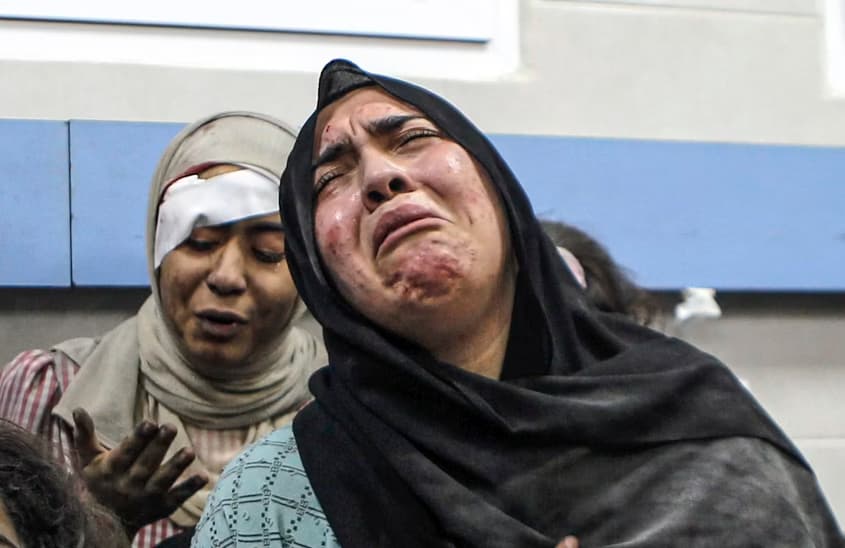
After an attack on the Al-Ahli Arab Hospital in Gaza City killed about 200 Palestinians on October 17 2023, Israeli spokespeople denounced early media accounts that blamed an IDF air strike, releasing a recording purportedly capturing a dialogue between Palestinian militants accepting responsibility for the blast.
Channel 4 quickly debunked the audio as a clumsy fake; the investigative group Forensic Architecture determined that most of Israel’s claims about the hospital attack were demonstrably false.
In the months that followed, the IDF engaged in what UN experts later described as “medicide”: namely, the targeted destruction of Gaza’s healthcare system and the killing of more than 1,500 healthcare workers. In one particularly ghastly incident, the IDF fired on five clearly marked ambulances and a fire truck after they came to the aid of Palestinians wounded in an earlier attack.
A subsequent investigation by Forensic Architecture and Earshot alleged the soldiers fired more than 900 bullets at the convoy, before shooting the survivors at close range. The IDF then deployed bulldozers to crush and cover the vehicles, and bury the dead in an unmarked mass grave.
That was one year and five months after Israeli president Isaac Herzog rejected allegations of Israeli responsibility for the Al-Ahli hospital attack as a “blood libel”.
The pushback by the Israelis led to US news outlets formulating new policies. CNN and the New York Times began instructing employees that attacks could only be attributed to Israel after confirmation from the IDF and GPS coordinate location. Johnson quotes a source at CNN:
Whether it’s in the newsroom or in the field, we couldn’t credit anything to Israel unless we were held to this impossibly high bar of having to call it an “explosion”, until we geolocated the site of the explosion, sent the coordinates to the Israelis and asked them for comment.
Asked about whether the policy was applied in other conflicts, such as the Ukraine
war, Johnson’s source answers: “Never, never, never, never, never.”

Tasnim News Agency, via Wikimedia Commons, CC BY
Terms and conditions
Previously, the World Health Organization, Human Rights Watch and the US State
Department had all used data from the Gaza Health Ministry because of its proven reliability. After the Al-Ahli hospital attack, US news outlets began appending the description “Hamas-controlled” or “Hamas-run” to descriptions of the health ministry. Johnson says:
in our 100-day survey period, CNN used the “Hamas-run” label and related terms 277 times and MSNBC used it 146 times, despite neither using it once between October 7, 2023 and October 17, 2023.
The practice spread, including to Australia. By October 28 2023, the Sydney Morning
Herald was also attributing casualty figures to the “Hamas-controlled Health Ministry”.
While no one has yet studied the liberal media in Australia with the rigour applied by Johnson in the US, the available evidence suggests it followed the patterns he describes. As I noted in a piece for Deep Cut News, the Age published a bold editorial declaring:
There is a genocide happening today […] Our government should urgently, repeatedly and loudly call for international intervention, and lead in imposing sanctions. We should send bountiful aid to the victims, and halt economic and diplomatic relations […] unless and until the savagery is stopped. All of us, as Australians, should shun travel […] for tourism or business.
And our government should, as it did with the Syrian refugee crisis a few years ago, rapidly engineer an intake of […] refugees.
That wasn’t about Gaza. It appeared in 2017, in relation to the persecution of the
Rohingya people in Mynamar.
Some commentators point to the absence of a final judgement by the International Court of Justice in relation to Gaza. But in 2017 the International Court of Justice had not ruled that the killings of the Rohingya were genocidal. It still hasn’t. The glacial pace at which the court moves means genocide allegations brought by Gambia against Myanmar remain unresolved.
Nevertheless, in 2017, the Age saw no problem with using the word “genocide” after studying reports from Medecins Sans Frontieres about “a deliberate, systematic campaign causing death and human suffering”.
Today, Medecins Sans Frontiers describes Israel’s operations in Gaza as genocidal. The Age does not. It has not published an editorial akin to that it issued in respect of Mynamar; it has not called for the government to impose sanctions, nor urged Australians to boycott Israel.
An acquiescent press
How to explain the special treatment of Israel by the liberal press?
The Gaza war focused attention on lobbyists and their influence on politics and the media. In the US, the American Israel Public Affairs Committee devoted the staggering sum of US$100 million in 2024 to unseating candidates it deemed insufficiently supportive of Israel.
In his book Dateline Jerusalem, veteran journalist John Lyons describes a similar process in Australia. Well before the Gaza war, he witnessed the brutal discrimination dished out by Israeli soldiers to 12-year-old Palestinians in the West Bank, but recognised that, if he reported it, “I would be the target of a backlash which would be tough, nasty and prolonged”.
So it proved. His 2014 story Stone Cold Justice won a Walkley, but he was “attacked professionally, personally and relentlessly by the pro-Israel lobby and its supporters”.

Monash University Publishing
Famously, Edward Herman and Noam Chomsky list “flak” from corporate lobbyists as one of the filters that produces an acquiescent press. Dissenting journalists face a barrage of time-consuming complaints so exhausting it induces preemptive self-censorship. Flak from pro-Israel groups aims, as Lyons puts it, “to make journalists decide that, even if they have a legitimate story that may criticise Israel, it’s simply not worth running it as it will cause ‘more trouble than it’s worth’”.
Along with the stick comes various carrots. In Australia, pro-Israel groups regularly provide journalists, editors and other media workers (as well as politicians) with all-expenses-paid “study trips” to the Middle East. Recipients of this largesse include a roll call of conservative media talent, but also include prominent journalists from the liberal press.
To contextualise that record, consider the response when hundreds of media workers
(including me) signed an open letter on the Gaza conflict in 2023, calling on outlets to, among other issues, reject “both sideism”, centre the human casualties, show equal scepticism to IDF and Hamas reports, report credible allegations of “war crimes, genocide, ethnic cleansing and apartheid”, and cover the anti-war movement.
In reply, Nine issued a memo written by Tory Maguire, then executive editor of the Sydney Morning Herald and the Age, and signed by then Age editor Patrick Elligett, SMH editor Bevan Shields and national editor David King. The memo cautioned journalists that “personal agendas” should not influence reporting.
The principle, Maguire wrote, meant that “any newsroom staff who signed this latest industry letter will be unable to participate in any reporting or production relating to the war”.
Guardian staff received a similar message from the editors of its Australian, US and UK organisations: Lenore Taylor, Betsy Reed and Kath Viner. The memo explained that staff “should not sign public petitions or open letters about matters that have, or could be perceived to have, a bearing on [the publication’s] ability to report the news in a fair and fact-based way”.
Maguire, Shields and King had previously travelled to Israel on “study trips”; so had Taylor. A petition calling for fair cover for Palestinians created a perception of “bias” – but accepting free travel and accommodation from Israel or pro-Israel groups did not.
Double standards
Such double standards foster allegations of a media “captured” by pro-Israel lobbyists, a claim that can degenerate into antisemitic conspiracism. Johnson’s book rests on a much better analysis, one that centres US rather than Israeli power.
Three decades ago, secretary of state Alexander Haig provided a simple explanation of why Tel Aviv mattered so much to Washington. “Israel,” he said, “is the largest American aircraft carrier in the world that cannot be sunk, does not carry even one American solider, and is located in a critical region for American national security.”
Since the 1970s, the US has looked to Israel to protect American interests in the oil-rich Middle East. To equip Israel for that function, the US provides more cumulative foreign aid to Israel than any other nation: since 1948, more than US$300 billion (adjusted for inflation) in total.
Most US support, particularly in recent years, pertains to defence. The majority of Israel’s air force and all of its combat aircraft are made in the US. The analyst William D. Hartung estimates that, since the Hamas attack on October 7 2023, the US government has provided Israel with US$21.7 billion of military aid.
If we recognise America’s strategic reliance on Israel, we are better positioned to
understand the liberal response to Gaza, which also needs to be seen in the context of Trumpism. During the first Trump administration, many progressive institutions ostentatiously signalled their opposition to a presidency they considered illegitimate and anomalous.
Johnson notes that, when the killing of George Floyd in 2020 spurred a revival of the Black Lives Matter movement, “media outlets, cultural nonprofits, and colleges issued lofty – if vague – statements of support for racial justice”. These were low-stakes anti-Trump gestures that aligned mainstream liberals with what they saw as the imminent restoration of progressive normality.
Support for Ukraine was equally easy. Unlike Palestinians, Ukrainians were, after all, understood by the Western media as civilised. In the London Telegraph, pundit Daniel Hannon spelled out why Ukrainian suffering resonated in the West: “They seem so like us. That is what makes it so shocking.” In 2022, CBS News foreign correspondent Charlie D’Agata explained (in remarks for which he subsequently apologised) that Ukraine was not “a place, with all due respect, like Iraq or Afghanistan, that has seen conflict raging for decades”; it was “relatively civilized, relatively European”.

Pluto Press
Johnson shows that, in the period he surveyed, the New York Times, the Associated Press, the Washington Post, CNN, Politico, USA Today and Axios collectively used the term “savage” 16 times for the killing of Israelis, but never for the killing of Palestinians.
Likewise, “slaughter” appeared 120 times in relation to the killing of Israelis, but only once for Palestinians. “Massacre” was used 344 times in relation to Palestinians killing Israelis, but never for Israelis killing Palestinians. “Barbaric” was used 14 times to describe the killing of Israelis, but zero times in relation to the deaths of Palestinians.
The cable coverage displayed a similar pattern. Johnson records that on MSNBC, presenters and guests used “massacre” 177 times, “barbaric” 46 times, “savage” 23 times and “slaughter” 102 times in relation to Israeli deaths. They never called the killing of Palestinians “barbaric” or “savage”. In relation to Palestinians, they only used “massacre” eight times and “slaughter” four times.
References to “savagery” and “barbarism” echo the logic of settler colonialism, identifying the uncivilised natives as a problem to be solved.
The sphere of deviancy
By denouncing Putin’s invasion, liberal politicians and institutions were opposing a traditional US adversary. They were siding with the incoming Biden administration and most Western nations. And they were distancing themselves from an increasingly unpopular Trump, widely seen as sympathetic to Russia.

After October 7 2023, the calculus changed. Unlike a stance on Ukraine, opposition to Israel’s war was not cost-free. Hostility to the longstanding foreign policy consensus required a modicum of courage. In the terms established by Daniel Hallin’s famous study of the US media and Vietnam, The “Uncensored War” (1986), those who opposed Israel’s war stepped outside the “sphere of consensus” and the “sphere of legitimate controversy” to inhabit the “sphere of deviancy”.
This is a space occupied, in Hallin’s words, by “those political actors and views which journalists and the political mainstream of the society reject as unworthy of being heard”.
Not surprisingly, as Johnson explains, institutions that had previously backed Black Lives Matter, the people of Ukraine and other popular causes “found both their tongues and hands tied on the subject of social justice as the death toll in Gaza skyrocketed”.
In 2022, Harvard president Lawrence Bacow proclaimed his institution’s solidarity with Ukraine with a rousing speech. “Now is the time for all voices to be raised,” he declared:
The deplorable actions of Vladimir Putin put at risk the lives of millions of people and undermine the concept of sovereignty. Institutions devoted to the perpetuation of democratic ideals and to the articulation of human rights have a responsibility to condemn such wanton aggression […]
Today the Ukrainian flag flies over Harvard Yard. Harvard University stands with the people of Ukraine.
By 2024, Harvard had changed its mind. The time for raising voices had,
apparently, come to an end. In the face of student protests, Harvard announced it would “no longer take positions on matters outside of the university”.
Johnson notes that 50% of the top US colleges – including Johns Hopkins, Northwestern, Yale, Cornell, Columbia, University of Michigan, Stanford, University of Pennsylvania, University of Virginia, Dartmouth and UCLA – issued statements of support either for Ukraine and/or for Israel in February 2022 and October 2023.
Then, as the Gaza crisis intensified, they suddenly explained they couldn’t take stands on political issues.
Third partying
The media, however, had to say something. In 2016, progressive outlets in the US had portrayed Trump as something akin to a fascist. In 2020, they had campaigned, more-or-less openly, for the Democrats. Even sober publications such as the New York Times made clear their preference for Joe Biden: a sensible centrist who would restore decency and democracy. Not surprisingly, in 2023, the Gaza genocide – and Biden’s complicity with the killing – created a tremendous ideological crisis for the liberal media.
Johnson notes that Biden could have stopped the war at any time, citing multiple Israeli sources to that effect. In November 2023, for instance, retired Israeli major general Yitzhak Brick acknowledged that the Gaza operation depended utterly on the US:
All of our missiles, the ammunition, the precision-guided bombs, all the airplanes and bombs, it’s all from the US. The minute they turn off the tap, you can’t keep fighting. You have no capability […] Everyone understands that we can’t fight this war without the United States. Period.
Michael Herzog, the former Israeli ambassador to the US, explained:
God did the State of Israel a favor that Biden was the president during this period, because it could have been much worse. We fought for over a year, and the administration never came to us and said, ‘ceasefire now’. It never did. And that’s not to be taken for granted.
Biden’s agency was rarely acknowledged by the mainstream media. Johnson
describes the emergence of several distinctive styles of reporting that allowed “the average media consumer – and media worker – to cope with the undeniable and untenable war crimes being carried out by their leaders before their eyes”. A common trope involved what he dubs “Third Partying”. This entailed journalists framing the US “as a neutral party – even a humanitarian force – always looking (but, mysteriously, always failing) to end the conflict”.
Liberals depicted Biden as helpless. As the New York Times put it, the most powerful man in the world was supposedly constrained by the “limits of US influence in the Mideast”. They wrote stories about what Johnson calls “Fuming/Deeply Concerned Biden”, in which the president featured as “secretly upset, outraged, having stern words for Netanyahu, or privately sad or anguished about civilian casualties”.
We might think about these tropes in relation to journalism professor Jay Rosen’s work on the professional socialisation of political journalists into what he describes as the “savvy style”. Rosen explains:
In politics, our journalists believe, it is better to be savvy than it is to be honest or correct on the facts. It’s better to be savvy than it is to be just, good, fair, decent, strictly lawful, civilized, sincere, thoughtful or humane. Savviness is what journalists admire in others. Savvy is what they themselves dearly wish to be. (And to be unsavvy is far worse than being wrong.)
Savviness is that quality of being shrewd, practical, hyper-informed, perceptive, ironic, “with it”, and unsentimental in all things political. And what is the truest mark of savviness? Winning, of course! Or knowing who the winners are.
In relation to Gaza, savvy commentators recognised (though not necessary openly) the US reliance on Israel to maintain hegemony in the Middle East. Savviness meant understanding the political consequences of that relationship: namely, that US politicians would back Israel under almost every circumstance.

Moody College of Communication from Austin, USA, via Wikimedia Commons, CC BY-SA
The Australian situation
Though the Australian situation is different, certain parallels can be identified.
The Albanese government came to power in 2022 with considerable support from a liberal media impressed by Labor’s aura of competence, particularly in contrast to the shambolic Morrison administration.
As a backbencher, Anthony Albanese had spoken at rallies to denounce the IDF for meeting “children throwing rocks with helicopters, with tanks and with missiles”. But as prime minister, he and his foreign minister Penny Wong sought, above all else, to strengthen the US alliance as a counter to an increasingly confident China. In relation to Gaza, Australia determinedly followed the US lead.
The tropes identified by Johnson appeared, in slightly modified form, in the
Australian liberal press. For instance, after Greens leader Adam Bandt’s defeat in the seat of Melbourne during the federal election in May 2025, Nine’s David Crowe explained that Bandt had lost in part because he had:
seized on the war in Gaza to accuse Albanese of knowingly aiding Israel in a genocide. There was no such support for genocide; the Australian government wants a ceasefire and a two-state solution. Most importantly, most Australians knew their government did not have the power to stop the war. The Greens leader was eyeless in Gaza, blind to the danger for him and his party.
Crowe was right to say that an Australian prime minister lacked the power of a US president to stop the war. But Bandt had never suggested otherwise. Instead, the Greens – like many others – had insisted that abstract calls for a ceasefire and a two-state solution (an outcome that Israeli Prime Minister Benjamin Netanyahu has repeatedly vowed to oppose) meant nothing unless accompanied by what Bandt called pressure from “real, concrete steps”, such as an end to military trade, the imposition of sanctions and the expulsion of the Israeli ambassador.
Symptomatically, in his condemnation of Bandt, Crowe does not reject his description of the war as genocidal. Instead, he presents Bandt’s response as an electoral misfire by the Greens. “Young voters may be drawn to its exaggerated rhetoric and confected conflict,” he concludes, “but voters trend to drop the party as they age.”
We might again recall Jay Rosen. “Prohibited from joining in political struggles,” he writes,
dedicated to observing what is, regardless of whether it ought to be, the savvy believe that these disciplines afford them a special view of the arena, cured of excess sentiment, useless passion, ideological certitude and other defects of vision that players in the system routinely exhibit. The savvy don’t say: I have a better argument than you. They say: I am closer to reality than you.
Throughout the liberal media in Australia, the question of Gaza often manifested as a tension between employees and management. In November 2023, for instance, the Australian Financial Review reported on a meeting by the staff of Schwartz Media, publisher of the Saturday Paper, at which editor-in-chief Erik Jensen addressed concerns about the paper’s response to the Gaza crisis.
As far back as 2021, Alex McKinnon, the one-time morning editor of the Saturday
Paper, identified what he called “an unofficial but widely known editorial policy of avoiding coverage of Israel and Palestine, especially any coverage that could be perceived as being critical of the Israeli government’s ongoing human rights abuses of Palestinians”. Many staff members, said McKinnon, “expressed discomfort with it, but all seemed resigned to it”.
In response to McKinnon, Jensen rejected claims of a pro-Israel bias. He said the same in the 2023 staff meeting. Yet, as the staff reportedly argued, the Saturday Paper had previously distinguished itself with overt stances on other progressive causes, such as refugee rights and climate; it campaigned, through the dogged reporting of Rick Morton, for justice over the Robodebt scandal.
On May 21 2022, the Saturday Paper called for the defeat of Scott Morrison in the federal election, saying Morrison “will be remembered, if he is remembered at all, as the country’s great torturer”. On April 8 2023, the paper attacked Peter Dutton’s stance on the Indigenous Voice to Parliament, saying his “cynicism is boundless” and calling him an “ugly person who makes true the old joke about politics and show business”. The editorial accused him of dividing the country with his “ghoul politics”.
Elections and Indigenous reconciliation are important issues. But so is genocide. Had the Saturday Paper applied the same editorial focus to Gaza, it might have published something like this:
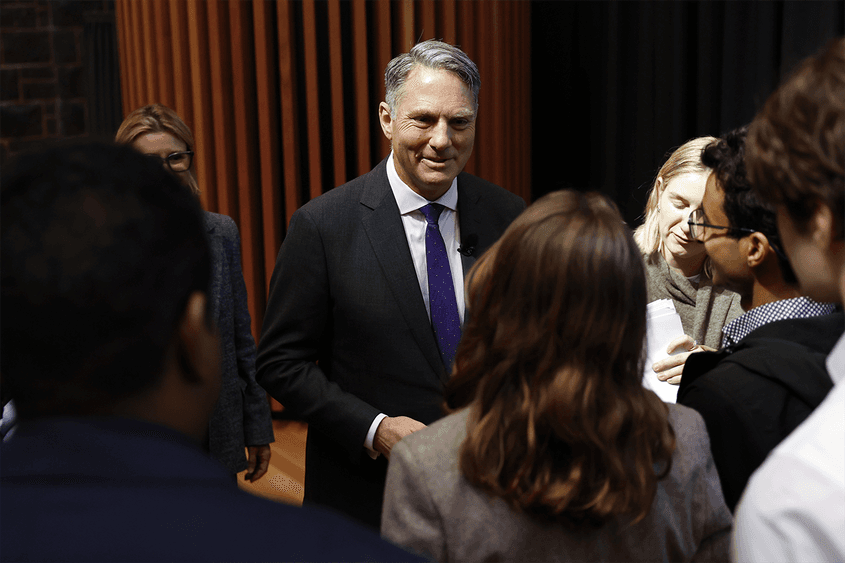
How will history regard the government of Albanese, Chalmers, Marles and Wong? It
will record that after two and half years of genocide by Israel, Australia’s leadership invited Israel’s president for a state visit. Australia refused to condemn the raft of war crimes committed by Israel and supported by the United States, first in Gaza and then in Iran and southern Lebanon. […]Australia has said nothing while Israel has continued to assassinate journalists, medics, aid workers, diplomats, foreign and spiritual leaders across the Middle East. Worse, it has done nothing even to dissuade Israel – no sanctions, no calls for justice or statements of support for the ICC arrest warrants, not even stopping our arms trade to Israel.
This passage was written by Nick Feik, the former editor of Schwartz Media’s magazine the Monthly, but it didn’t run in the Monthly or in the Saturday Paper. It appeared on Feik’s personal Substack.
Alternative platforms
That’s symptomatic of a growing trend in which writers horrified at the genocide are, either by choice or necessity, publishing on alternative platforms rather than the established liberal outlets. Robert Manne has long been acknowledged one of the most important public intellectuals in Australia. Remarkably, if you want to read his thoughtful comments on Gaza, Bondi and antisemitism, you must turn, not to any of the mainstream papers, but to his Substack.
Rick Morton, who spearheaded the Saturday Paper’s coverage of Robodebt, posted his thoughts on Gaza and the Bondi massacre on Ghost, a Substack alternative, in January 2026. He quit his job at the Saturday Paper shortly afterwards.
Alex McKinnon established a Substack to report “what others won’t about Australia’s silence on Palestine”; he later launched Deep Cut News with Antoun Issa, who resigned from the Guardian in 2024 “due to objections over the outlet’s coverage of the Gaza genocide”.
Antoinette Lattouf – who won a high-profile legal case against the ABC after it sacked her for sharing a post from Human Rights Watch about Gaza – now works with Jan Fran making podcasts and YouTube shows for their own Ette Media.
Scott Mitchell and Osman Faruqi, who both worked for Schwartz’s 7am podcast (as well as various other outlets), collaborate on the news platform Lamestream.
The proliferation of new outlets and the rejuvenation of older ones, such as Overland, has led to important interventions. The Klaxon, a project of investigative journalist Anthony Klan, doggedly pursued the ties between John Roth, the husband of antisemitism envoy Jillian Segal, and the far-right Advance project. Deep Cut News published the letter in which a pro-Israel academic group lobbied to exclude Abdel-Fattah from the Bendigo Writers Festival. Lamestream broke the story about UQP’s cancellation of Jazz Money’s book.
Yet good journalism does not, in itself, guarantee the survival of the outlets who
conduct it. The mass street movement in support of Gaza created a new audience for
alternative publications. But with the establishment of a ceasefire (though not a genuine peace) the protests have declined, creating a difficult environment for media projects challenging the liberal consensus.
Legal ramifications
In the US context, Johnson doubts that the progressive outlets that supported the genocide will pay much of a short-term price. On the contrary, he identifies a process of rationalisation and justification already underway. Insofar as liberals apportion blame, they attribute it to Netanyahu and what they see as an unfortunate overreaction by the IDF to the barbarities of Hamas. He concludes:
Mostly, I think the genocide in Gaza will be put into a memory hole, forgotten, dismissed as a lefty ‘obsession’, or hung up, the disproportionate focus of which, it will be heavily implied, is evidence of latent antisemitism. And that will be that.
Nevertheless, the consequences of so much killing cannot be evaded entirely. The precedent set by the genocide will reverberate for generations, in the media and elsewhere. As Johnson notes,
we will likely see versions of Gaza play out in the coming decades across various peripheries […] And the model of deflection, dehumanization, and liberal excuse-making perfected during the Gaza genocide will be the template – the weapons, technological and rhetorical, having been sharpened over late 2023 into 2025.
The Gazafication of south Lebanon provides one immediate and obvious example, but there are others. The indifference to legal norms shown by Donald Trump when he greenlit the US and Israeli war on Iran reflected the experience of Gaza, where nothing said by the International Court or the United Nations or similar bodies made any difference at all.
Discussing Trump’s kidnapping of Venezuela’s president Nicolás Maduro, legal scholars Oona A. Hathaway and Scott J. Shapiro warn:
It is not just the existing international legal system that is in jeopardy now. At risk is the survival of any rules at all – and with them any constraints on the exercise of state power.
In that context, as historian Pankaj Mishra concludes, the
critique of the fourth estate, the so-called pillar of democracy, not only becomes more pertinent. It resonates as a broader analysis of the decay of democratic institutions in the West.
How to Sell a Genocide is part of that critique. But much more remains to be done.
Jeff Sparrow is a writer, broadcaster and Walkley award-winning journalist. He is a former 3RRR Breakfaster and a former editor of Overland literary journal.
His recent books include Provocations: New and Selected Writing, Crimes Against Nature: Capitalism and Global Heating, Trigger Warnings: Political Correctness and the Rise of the Right, and No Way But This: In Search of Paul Robeson. He lectures at the Centre for Advancing Journalism at the University of Melbourne.
This article is republished from The Conversation under a Creative Commons license. Read the original article.


.png)
.jpg)