Here’s a thought experiment. Imagine you’re running late for a flight. Instead of actually leaving for the airport, you pay someone else to leave on time – and then claim you made it.
Absurd, right?
And yet, that’s roughly the logic underpinning Australia’s primary industrial emissions policy, and it’s costing us dearly.
The Safeguard Mechanism was designed to hold Australia’s 200-plus largest industrial polluters to account. Covering around 30% of our national greenhouse gas emissions – mostly from oil and gas extraction – it should be the engine room of Australia’s decarbonisation effort.
But as Australia Institute analysis demonstrates, instead of driving genuine emissions reductions, the Mechanism has become something closer to a very lucrative permission slip for fossil fuels to keep polluting and expanding.
The federal government’s own latest data release declares that “the mechanism continues to work as expected.” And that’s true. It’s just that what it’s been designed to do, and what we need it to do, are very different things.
As Australia Institute Senior Research Associate Ketan Joshi has said of the Safeguard Mechanism: “When the rules of the game allow cheating, everyone just cheats to win.”
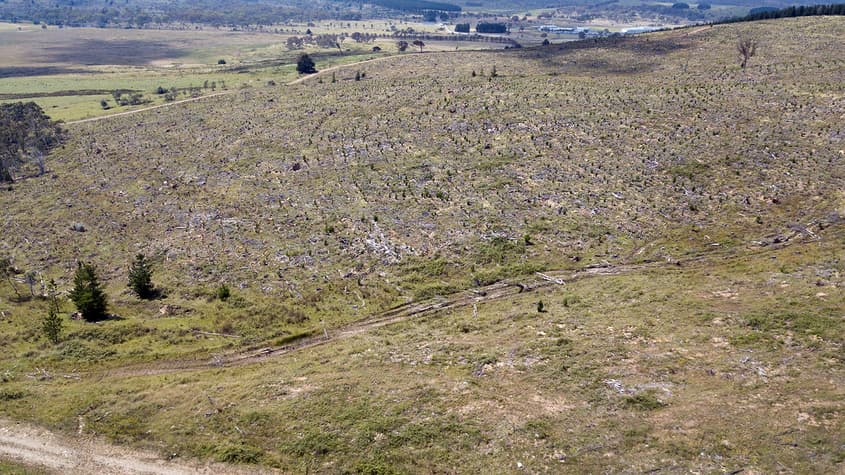
This trick of claiming progress while hiding the reality goes beyond the Safeguard Mechanism alone. This week at Senate estimates , the Department of Climate Change, Energy, the Environment and Water (DCCEEW) was asked about Australia’s emissions since 2005 – and officials pointed to a fall of somewhere between 23% and 28%, depending on which dataset you use. Sounds impressive. But as Chief Economist Greg Jericho shows, almost all of that drop comes down to a single accounting trick: the inclusion of land clearing. Strip out land use emissions, and Australia’s actual emissions are down just 3% compared to 2005. Three per cent. Over two decades.
This ‘quirk’ has a name: the “Australia clause.”
Back when the Kyoto agreement was being negotiated, the Howard government’s Environment Minister Robert Hill secured a special carve-out allowing Australia to count its 1990 and 2005 land clearing and native forest logging boom as part of base year emissions. Which was enormous, especially in Queensland
No other comparable country needed this sleight of hand, bar Russia.
Every Australian government since has quietly kept it. The result is that Australia gets to claim dramatic progress on emissions while actual industrial and energy pollution has barely budged.
The government points to a roughly 5% drop in total Safeguard emissions since its 2023 reforms as proof the scheme itself is working. But dig into the numbers and the story changes fast.
According to researcher Tim Baxter at Naru Research, almost all of that change is attributable to facilities entering and exiting the scheme, not actual decarbonisation.
Strip that out, and emissions across facilities that stayed in the scheme fell just 0.4%. And a significant chunk of the headline reduction came from what Joshi calls “crisis events”. Problems like a fire shutting down the Grosvenor coal mine for a full year, nickel operations suspending due to a global price crash, a gas plant going offline for maintenance. As he notes, “a scheme that records a win every time a facility goes dark is not measuring decarbonisation. It is measuring absence.”
The deeper problem sits at the heart of the scheme’s design. Polluters who exceed their emissions limits aren’t required to cut their pollution. They can simply buy carbon credits to paper over the gap.
And not just a few. They can use unlimited carbon offsets to meet 100% of their obligations.
No other comparable wealthy nation allows this. The EU banned offsetting from its scheme in 2021. The UK allows none. California caps offset use at 6%.
But here in Australia, there’s no ceiling at all. Making us, as EY Net Zero Centre noted, “globally distinctive” in the least flattering sense, on par with Kazakhstan.
So, we are on par with Russia and Kazakhstan for ‘adjusting’ numbers via buying and selling of carbon credits and dodgy offsets.
And the quality of those credits? Deeply questionable. The Australia Institute’s analysis finds that the two most widely used land-based credit methods – Avoided Deforestation and Human Induced Regeneration – account for more than half the Australian Carbon Credit Unit (ACCU) market, and up to 90% of credits issued under each method may be high-risk or low-integrity.
Coal, oil, and gas facilities used almost 6 million so-called offsets in 2023–24. More than double all other covered industries combined.
Woodside’s North West Shelf Project met 100% of its Safeguard target using carbon offsets, including over 23,000 units from the Avoided Deforestation method suspended for lack of integrity. And the Albanese Government approved extending that same project for another four decades – out to 2070, well past when we’re supposed to reach net zero.
Then, there’s the curious case of Safeguard Mechanism Credits (SMC), generated when a facility emits below its own baseline. Because baselines are calculated partly on production volume, a facility can actually increase its absolute emissions and still receive a windfall of tradeable credits.
Chevron’s Gorgon LNG project increased its emissions from 8.1 to 8.8 million tonnes last financial year, and still received almost 400,000 SMCs. Our primary climate policy rewarded a major polluter for polluting more!
Meanwhile, Joshi warns there’s a “massive queue of new fossil fuel extraction projects waiting to be added to the scheme once they come online” – and that more accurate methane measurement could reveal the scheme is in an even worse position than we currently think.
All this matters beyond the spreadsheets. The Safeguard Mechanism is helping fossil fuel companies scramble to expand production at precisely the moment they should be entering a controlled phase out.
The good news – and there is good news – is that the Safeguard Mechanism is up for review in 2026/27 (rumoured to be starting on July 1, 2026), and that’s an opportunity to fix this. The Australia Institute’s submission on Safeguard Mechanism reform back in 2022 sets out some points on what (still) needs attention, including the need to ban new gas and coal entrants, limit the use of carbon credits and develop an alternative fixed price payment to be directed by the Commonwealth to build climate solutions.
The Safeguard Mechanism should be a safeguard for Australians, for our climate, our communities, our future. Right now, it’s functioning more like a safeguard for the fossil fuel industry. The review is our chance to change that. Let’s not waste it.
Louise Morris is an Advocate at the Australia Institute