New research from energy think tank Ember released this week, confirms that gas lost market share in the global electricity mix for the fifth consecutive year in 2025. In 61 out of 124 gas-generating economies, peak gas is already in the rear-view mirror. Renewables now generate almost as much electricity across the G7 as gas does. And in 2025, solar grew 17 times faster than gas.

Fri 12 Jun 2026 16.40 AEST
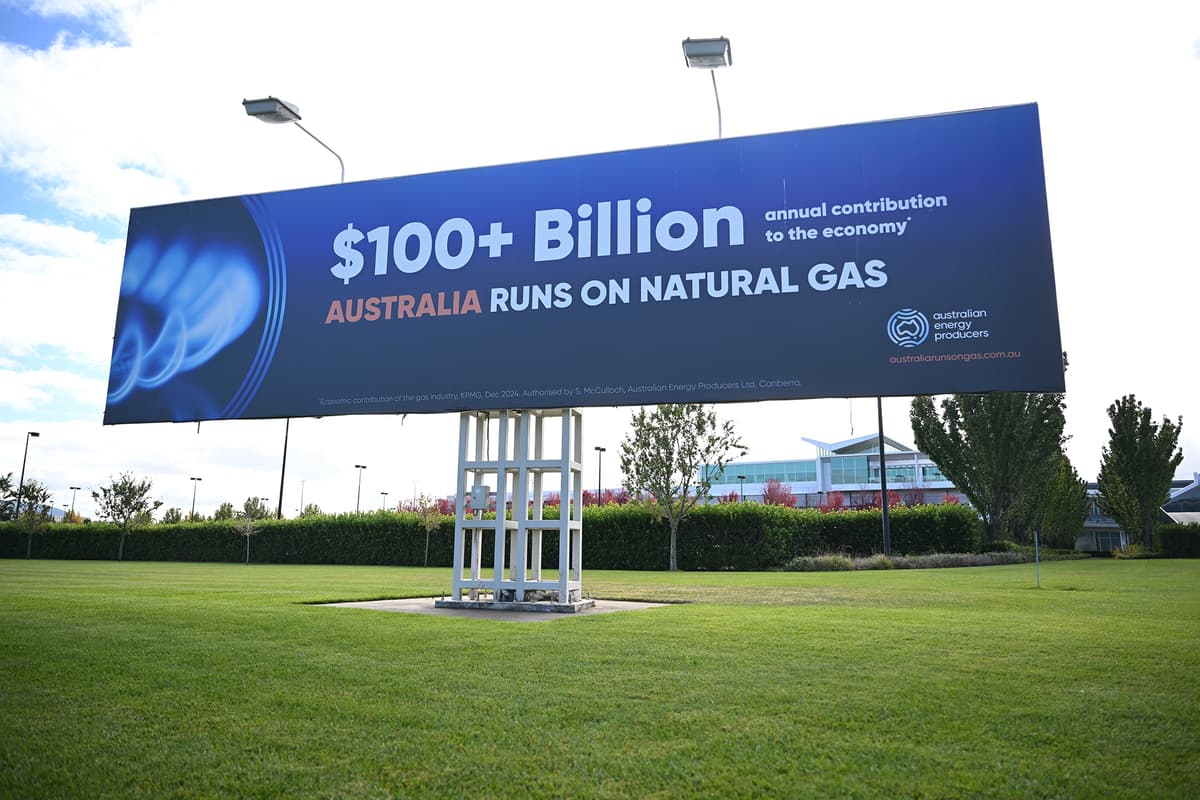
Photo: AAP Image/Lukas Coch


Here is a number to remember: Japan – one of Australia’s biggest gas customers – has cut its gas-fired electricity generation by 127 terawatt hours since its 2017 peak. That is a structural retreat, and it is not slowing down.
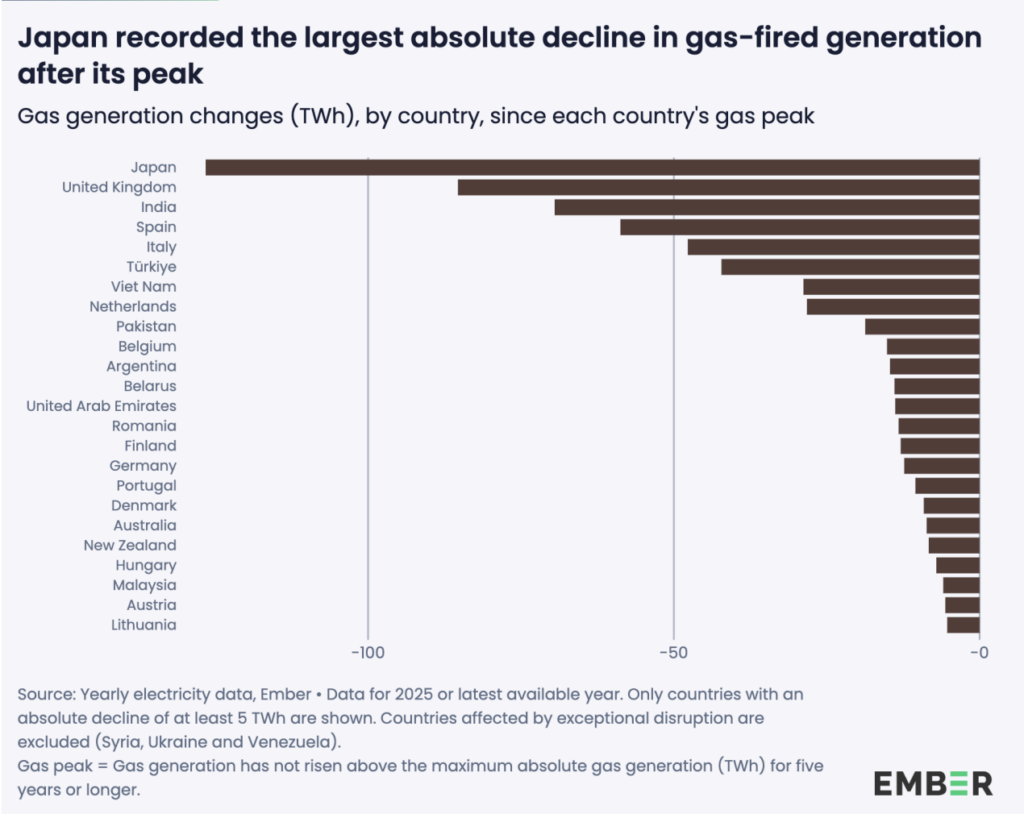
Japan is not alone. New research from energy think tank Ember released this week, confirms that gas lost market share in the global electricity mix for the fifth consecutive year in 2025. In 61 out of 124 gas-generating economies, peak gas is already in the rear-view mirror. Renewables now generate almost as much electricity across the G7 as gas does. And in 2025, solar grew 17 times faster than gas.
That’s the good news.
The not so good news: This is the world our gas industry is demanding Australia drill more gas to export to.
Japan’s retreat is the sharpest in absolute terms. Rapid solar expansion, nuclear restarts, and the price shock of Russia’s invasion of Ukraine all accelerated the shift. The closure of the Strait of Hormuz in 2026 – and the LNG supply disruptions that followed – have only hardened Tokyo’s resolve to get off imported gas.
The IEEFA Australian Gas and LNG tracker shows Asian LNG imports saw their largest half-year fall in 15 years in early 2025. China’s imports alone dropped 21% year-on-year.
This is not a supply problem; it is demand softening as the energy transition takes hold in the countries we sell to.
New gas projects don’t switch on overnight. From approval to first gas typically takes a decade or more, and many never get built at all. The projects being waved through today, if they ever produce a cubic metre, will be selling into an export market in the mid-2030s that already looks very different from the one the industry is banking on.
Economists and financial analysts are increasingly calling these proposals what they are: stranded assets in waiting. Billions of dollars of capital designed for a market that is actively turning away.
Meanwhile, Australians are paying some of the highest gas prices in the developed world for the privilege of sitting atop lots of gas and exporting around 80% of it.
Australia Institute research shows that when LNG export terminals opened in Gladstone in 2015, they linked east coast prices to international spot markets overnight. Wholesale gas prices tripled. Electricity prices on the main grid jumped around 73% in the decade since. East coast gas demand has already dropped around 32% from its 2012-13 peak, driven by households and manufacturers switching to electricity.
The gas was always here. We don’t have a supply problem. We have a gas export problem.
And there is a narrow, closing window to do something about it.
This is the critical insight that cuts through the industry spin: the global gas game is in its last gasps. Demand is declining. Export markets are contracting. Every year that passes, the leverage Australia holds as a major LNG supplier diminishes.
Which makes what the Labor government has failed to do since coming to power in July 2022 all-the-more staggering.
Australia Institute modelling shows that a simple 25% flat tax on the value of gas exports – not profits, which companies have perfected the art of hiding, but the actual export value – would raise about $17 billion a year. Nearly $50 million a day, flowing into Australian schools, hospitals, and housing instead of the accounts of multinational gas companies.
For two terms of ALP government, that tax has not been introduced. According to The Australia Institute Gas Giveaway Tracker, the foregone revenue to this week already sits well over $71 billion and counting. Money that could have funded free childcare, free university, or dental in Medicare for every Australian.
Instead, it went to multinationals. Six of the ten companies that have exported $165 billion worth of LNG from Gladstone since 2015 have paid zero company tax on those exports.
Japan – one of the countries pushing back hardest against an Australian export tax – collected nearly $40 billion in its own taxes on gas and coal imports over the same five years that Australia collected just $7 billion in Petroleum Resource Rent Tax.
To rub salt in the wound; The Japanese government taxes our gas when it arrives. We don’t tax it when it leaves.
The Domestic Gas Reservation Scheme requiring exporters to set aside 15-25% of production for domestic use from 2027, is a step.
The Australia Institute’s 3-Point Plan for Gas and No New Gas and Coal framework goes further: divert uncontracted gas to domestic use, implement a 25% gas export tax, ban new approvals, legislate a phase-out timeline, eliminate the $16.3 billion in annual fossil fuel subsidies, and introduce a Climate Disaster Levy.
But the immediate, straightforward action, the one that could put $17 billion a year into public hands right now, while we still have gas exports worth taxing, is that 25% gas export levy. And the window for it is closing, as export volumes fall and global buyers diversify away.
Domestically, AEMO’s own forecasts show east coast domestic demand falling more than 40% over the next two decades. The transition is not coming. It is here. The question is whether Australia extracts something meaningful for its citizens before it’s all-over red rover.
In November, world leaders gather in Antalya, Turkey for COP31, with Australia’s Climate Minister, Chris Bowen, leading negotiations. Before that, a special leaders’ event will be held in Tuvalu – a nation at genuine risk of disappearing beneath the sea – as a launchpad for the talks. Tuvalu will also co-host the second global summit on Transitioning away from Fossil Fuels, building on the Santa Marta roadmap agreed in April this year.
Australia has a real chance to stand on the right side of this history. But credibility in those rooms depends on what we do at home. It is hard to lead a fossil fuel transition while giving gas companies a free pass on export taxes and fast-tracking new projects for a market that is already turning away and refusing to at least get some revenue while you can.
Louise Morris is an Advocate at the Australia Institute
Advertisement