The Great Koala National Park was supposed to be a promise kept. Instead, it has become a hostage. The NSW government has confirmed that the park's final creation is contingent on federal approval of a new carbon credit method, the Improved Native Forest Management (INFM) method, which would allow the state to sell carbon credits for not logging a forest it had already promised not to log.

Tue 21 Jul 2026 10.37 AEST
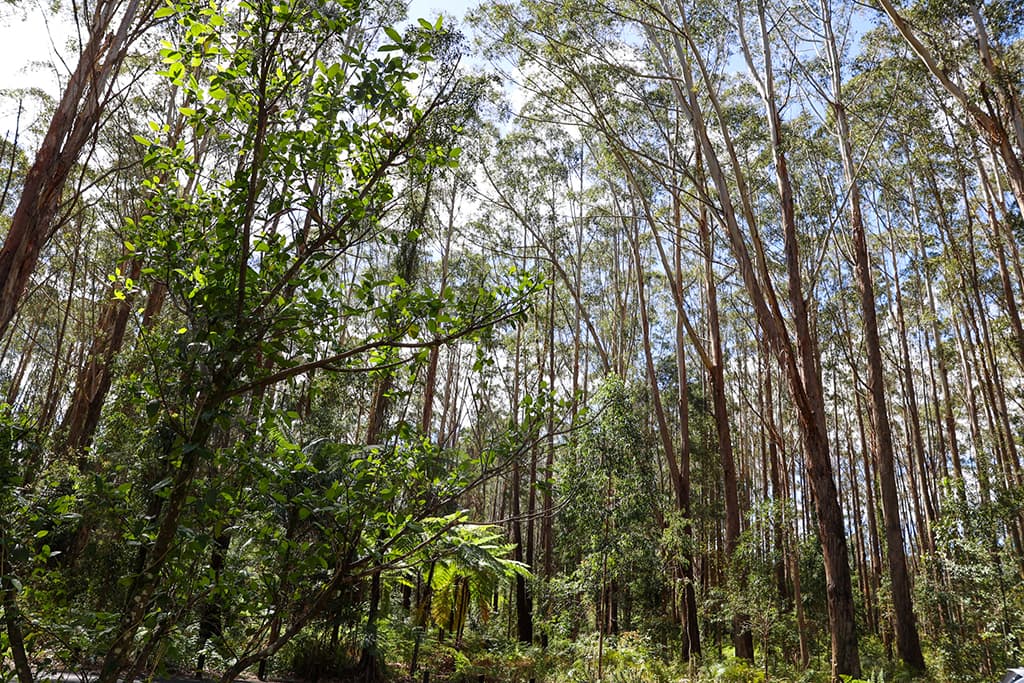
Photo: AAP Image/David Wigley
The Great Koala National Park was supposed to be a promise kept. Instead, it has become a hostage. The NSW government has confirmed that the park’s final creation is contingent on federal approval of a new carbon credit method, the Improved Native Forest Management (INFM) method, which would allow the state to sell carbon credits for not logging a forest it had already promised not to log.
A koala habitat and forest Labor committed to protecting more than a decade ago now needs carbon credits for trading to prove it’s worth saving. Not community will, not species protection, not the 2022 endangered listing. A spreadsheet with some neat accounting tricks.
When Chris Minns announced the park before the 2023 state election, he framed it as a fight against extinction, warning koalas were “on track to become extinct in the wild in NSW by 2050”, with no mention of carbon credits. Even as delays mounted through 2024 and logging continued inside the proposed boundary, the goal cited was always habitat, never revenue.
The carbon credit condition only surfaced in September 2025, when the government quietly tied the park’s final declaration to a carbon project. A decade of commitments about koalas and forests turned, in one announcement, into a commitment about carbon trading.
The Australian Carbon Credit Unit (ACCU) scheme rests on one idea: credits should only be issued for abatement that would not have happened anyway.
Federal MP Alison Penfold put it plainly in parliament this year, arguing that crediting a decision that government had already taken corrupts the scheme, because the policy came first and the methodology came later. She’s right. You cannot claim credit for stopping something you were always going to stop. Timber NSW has accused the government of doing exactly that, delaying gazettal while locking in carbon revenue of up to $1.1 billion over 15 years.
Even if you could wave away additionality, there’s a bigger flaw. A recent Australia Institute report, Safeguarding the Fossil Fuel Industry, explains why land-based carbon credits can never truly cancel out fossil fuel emissions, no matter how well a forest project performs. It comes down to time.
A tonne of CO2 from burning coal or gas persists in the atmosphere for centuries, a fraction of it for over ten thousand years. Carbon stored in a tree, even one that lives its full natural lifespan without burning, drought-stressing or dying early, is only stored for decades, or at most around a century. That’s the best case. There is no equivalence between a temporary sink and a near-permanent emission, so pretending the two cancel out just relocates carbon pollution onto a ledger, not out of the atmosphere. That mismatch is why the report calls forestry offsets inherently non-equivalent to fossil fuel emissions, not merely risky.
Risk compounds it. Forests are complex living ecosystems exposed to the same climate change pressures they are meant to offset, not fixed-term deposits. Canada’s 2025 wildfire season was its second worst on record, with more than 72,000 square kilometres burned. Somewhere in that country was a forest verified for carbon trading, priced and sold as credit stock, permanent until it wasn’t.
Australians know this story well. Victoria’s 2009 Black Saturday fires released an estimated four million tonnes of CO2, and up to a million animals died, koalas among the most visible casualties. Black Summer dwarfed that a decade later. Research published in Nature found 715 million tonnes of CO2 released, with an estimated billion animals lost.
We are not bystanders. The Bureau of Meteorology has confirmed an El Niño arrived in 2026, potentially one of the strongest on record, capable of the same heat, drought and extreme fire weather that fuelled those disasters. Every forest counted as a carbon asset, from Victoria’s regrowth projects, potential future state forest carbon credit trade-offs in Tasmania or Qld, a prospective Great Koala National Park sits inside that risk, while a gas exporter or coal miner keeps polluting and claims to be “on track” for net zero without cutting a tonne at the source.
Picture the park’s credits doing what every forest carbon scheme is doing now: priced, traded, counted against a net zero pledge, while the “asset” is a living ecosystem including koalas and quolls, threatened by the climate change carbon offsetting is meant to address.
If the Albanese and Minns governments believe the Great Koala National Park is worth creating, then they should just do it. They can fund it directly from public revenue; the sort of revenue a 25% tax on gas exports would raise (an estimated $17 billion a year). The same way governments fund national parks everywhere else in this country. Not through a market mechanism built on a temporal mismatch it can never resolve, designed to safeguard fossil fuel polluters with low-integrity carbon credits.
Louise Morris is an advocate at the Australia Institute, with 20 years’ experience encompassing climate, energy, forest protection, and law reform in the not-for-profit sector, and federal politics.
Advertisement

Greens Senator Sarah Hanson-Young said on ABC’s 730 last night that a 25% tax on gas exports would be “bigger and simpler” than Labor’s proposed gas reservation policy. She's right.