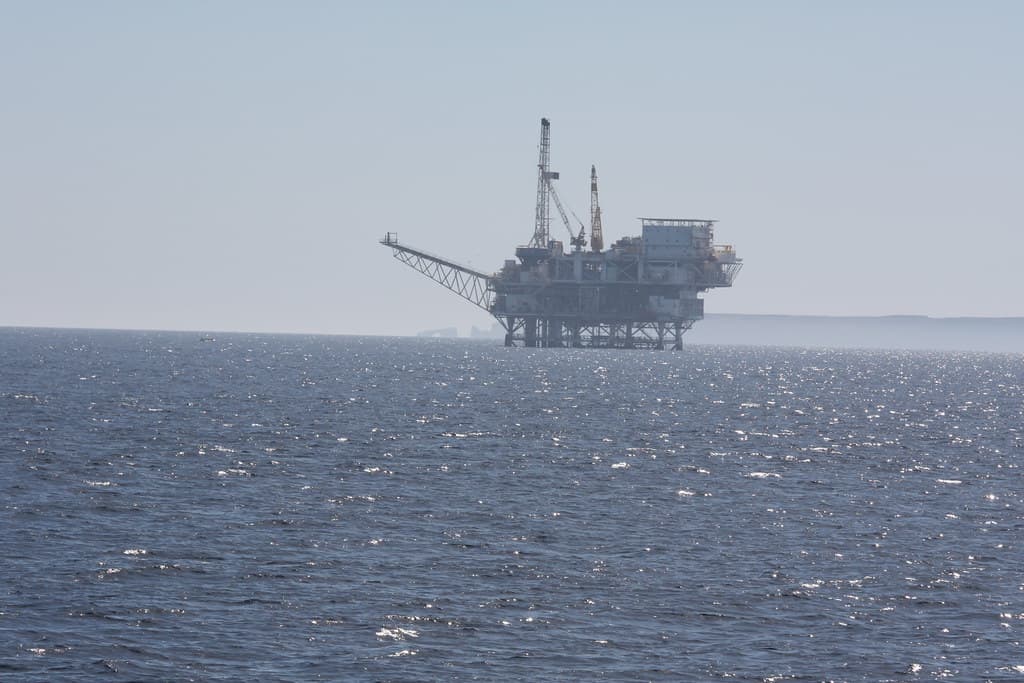
Offshore mining facilities, the industrial equipment, mooring chain links the size of your SUV, and the multitude of support vessels, drill rigs, seismic survey, aircraft and choppers is serious kit and infrastructure. I should know, I worked and lived amongst it for a decade.
But the job is far from complete once the extraction is over. Clustered around the Australian coast, from the Timor Sea, Northwest shelf, Perth Basin and the Bass Strait, there are several millions of tonnes of recyclable metal, and a smaller order of hazardous material, requiring removal – underway now and for decades to come.
The Reindeer gas field off Western Australia has stopped producing, but its platform, wells and 43 kilometres of offshore pipeline remain in place. Santos is keeping that infrastructure preserved while it decides whether to reuse it or decommission it later. That means the physical clean-up has been pushed into the future, along with the question of whether enough money is already secured to pay for it.
That question matters for workers. Offshore decommissioning is not just an environmental obligation; it is a major industrial task that requires skilled labour, and long-term planning. If the money is not secured while the operator is still solvent and responsible, workers and taxpayers can be left carrying the risk later.
The Wilderness Society challenged NOPSEMA’s decision to accept Santos’ Environment Plan for preserving the Reindeer infrastructure. Its argument was straightforward: before the regulator allowed the infrastructure to remain offshore, it should have been satisfied that Santos had proper financial assurance for the eventual clean-up.
NOPSEMA expressly confirmed that its assessment of Santos’ Environment Plan did not extend to financial assurance for the eventual decommissioning liability. That was the issue taken to court.
The Court rejected that argument. In simple terms, it found that Santos only had to show financial assurance for the activity covered by the current Environment Plan: preserving the infrastructure. Because Santos treated decommissioning as a separate future project, NOPSEMA did not have to check whether Santos had money set aside for the eventual clean-up before approving the preservation plan.
That is an important legal finding, and a serious policy problem.
The judgment confirms that, under the current process, the regulator does not need to secure funding for decommissioning at this stage, even though ageing infrastructure remains offshore and will eventually have to be removed or made safe at significant cost.
In practical terms, a company can stop production, keep infrastructure in preservation for years and defer its decommissioning plan, without first having to provide project-specific financial assurance for the clean-up bill.
We have already seen why this is a big problem. The Northern Endeavour debacle left a gargantuan, unfunded liability. At Cliff Head, two oil and gas companies entered administration without dedicated financial assurance for decommissioning. An obligation to clean up is no substitute for secured money when a company fails.
Cliff Head also demonstrates why the issue the Wilderness Society tested is directly in workers’ interests. When funding disappears, workers’ wages, essential staffing, maintenance and operational safety are immediately on the chopping block. Proper financial assurance means money is secured to decommissioning safely and on time, pay the contractors and workers doing the job, and prevent work being deferred while infrastructure deteriorates.
Financial assurance protects workers, communities and taxpayers when an operator collapses. It also creates the predictable pipeline of work needed to support investment, training, domestic capability and secure jobs.
Financial assurance is an industrial and worker-safety safeguard, as well as an environmental safeguard.
It cannot have been an easy decision for the Wilderness Society to take on the federal regulator and a top-tier oil and gas producer. They have taken on an issue that deeply affects working people, and deserve absolute credit for mounting the challenge.
Public-interest litigation should be encouraged, not attacked. Offshore petroleum regulation is complex, technical and largely conducted beyond ordinary public view. Most people do not have the money, legal expertise or institutional capacity to challenge decisions made within it.
Cases like this strengthen the public voice. They test whether regulators are applying the law as Parliament intended, force hidden assumptions into the open and provide an independent avenue of accountability where ordinary public participation is limited.
The Wilderness Society brought this case in the public interest. In exposing the weakness of Australia’s financial-assurance framework, it also advanced a question of fundamental importance to workers: will the money actually be there to carry out decommissioning safely, pay the workforce and finish the job?
So, what now?
The Commonwealth must require enforceable, project-specific decommissioning security, progressively funded and regularly reassessed throughout the life of every offshore project, and fully secured before production ends, assets are transferred or infrastructure enters preservation.
The polluter-pays principle cannot remain a theoretical obligation. It must be backed by real, enforceable funding arrangements while the polluter is still there to pay.
Angie Moore is the MUA’s Offshore Oil and Gas Decommissioning Policy Analyst and Campaigner. She is also the union’s elected, honorary National Women’s Representative and a member of the MUA National Council.