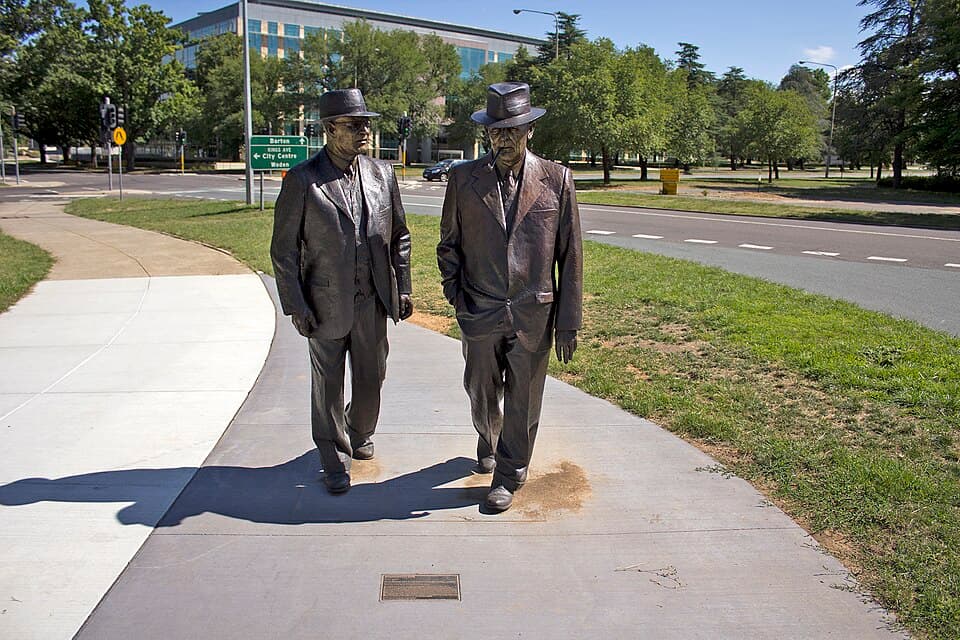
One of the best sculptures in Canberra depicts John Curtin and Ben Chifley mid-stroll on their way to Old Parliament House.
The pair would walk from the Hotel Kurrrajong to Parliament and talk about the day ahead, and the sculpture captures one of those moments. Curtin has just finished speaking, and Chifley, pipe in mouth, is considering his response.
It’s a tiny piece of history captured in bronze. It represents not just the strong relationship between Curtin, Australia’s wartime prime minister, and his treasurer and confidant, Chifley, who would go on to lead Australia’s post-war reconstruction following Curtin’s death, but another time.
The Kurrajong, started life as Hostel No.2. It was the Labor MP accommodation of choice, while conservative MPs stayed in Hostel No.1, now known as the Hotel Hyatt. Both places were considered informal party rooms for their corresponding residents.
Chifley stayed at Hostel No.2 as prime minister, instead of The Lodge, in the same room he had lived (and died) in as treasurer and opposition leader. This period in politics is considered the stuff of Canberra legend.
Labor MPs and the few conservatives who also stayed at Hostel No.2, instead of the sister building on the other side of the triangle where their colleagues stayed, would get into arguments over breakfast, and debates over post-parliament dinner and drinks.
It was Curtin who began Australia’s pivot to America – not because of an unquestioning love of the United States, but because of the simple truth that Australia’s trust and faith in the British empire was a fool’s errand and lopsided, especially given Winston Churchill’s disgraceful attitude towards Australian troops during the war.
As leaders, Curtin and Chifley were pragmatic for Australia’s sake, not necessarily their own. And perhaps, more importantly, unquestionably led by their values.
Curtin instigated the background briefings that are now ubiquitous in corporate politics – he’d started them because he wanted a direct conduit to the nation’s media, during the war, about Australia’s military strategy and official thinking from the highest level, to reduce misinformation finding its way into the media and to maintain trust with the public and media proprietors during the war (and to restrict the information that newspapers were publishing about Australian troop movements, to protect the troops’ lives).
The statue of Curtin and Chifley encapsulates everything about that era, and it is so life-like that it often prompts double takes from passers-by.
And driving past the sculpture of the two men forever in conversation, engaging in the most ordinary of tasks – walking to work – you can’t help but think about their modern counterparts.
And the very different path they have chosen.