


The transformative opportunities for “middle power” economies may instead lie in the application of AI to physical products and systems as a basis for new forms of competitive, high value manufacturing. This is being termed “industrial AI”, and it provides a mechanism for addressing Australia’s productivity slowdown.
Here is an annotated version of the Reserve Bank’s statement to make sure you understand what the RBA is really saying:
Number 2026-27
Date 29 September 2026
At its meeting today, the Board decided to increase the cash rate target by 25 basis points to 4.60 per cent.
Inflation remains elevated and some of the upside risks flagged in August are materialising. The conflict in the Middle East has broadened and global energy prices are now much higher than had been assumed in the August forecasts.
All of which is outside of our control, but please ignore that.
AI-related demand is driving rapid growth in global prices for technology-related goods. And there remains pressure on domestic capacity.
Again, interest rates going up won’t affect data centre building; all it will do is make it harder for households to borrow to build a home or for small business to operate. But, sorry, we need data centres… and the rest of you need to suffer because… well look, it’s not like there are any actual benefits of the data centres, but hey smell that investment!
Liaison indicates that firms are experiencing cost pressures and are either increasing the prices of their goods and services or looking to do so.
Yes, we know inflation in July fell from 3.8% to 3.5%, and the latest CPI, which comes out tomorrow, will be driven by petrol prices, which rose around 15% in August. The increased cost of 34 cents/litre in petrol prices since the last RBA meeting is equivalent to the cost of one rate rise, so in effect households have now had 2 rate rises. Cool, eh? But look, businesses tell us they need to raise prices or their profits might fall.
Short-term measures of inflation expectations remain elevated. And recent inflation outcomes in Australia were stronger than expected at the previous meeting.
Yes, this is because the Iran War has not finished as hoped and oil prices are now back over US$100/pbl, but surely oil buyers look at the Australian cash rate to determine oil prices?
Growth in output has slowed but, at the margin, was stronger than expected in the June quarter.
We have decided that even though growth in the first 6 months of this year was just 0.7% and as a rule, we aim for around 1.5% growth every 6 months, we would like it slower. Also, you need to realise the reality is not what matters; it is what we expected to be the reality that matters! Reality was not as bad as we expected; therefore, we need to do what we can to make reality conform to our expectation.
There are signs that growth in consumer spending is easing gradually as expected, although housing prices have fallen in most capital cities and new housing loans have declined noticeably.
Easing consumer spending, but hey, smash then again! In August, household spending was flat, and if you take away the increased spending on petrol, overall spending fell. We spent less on food, less on furniture and household stuff, less on health, less on recreation and culture. But we think you could all spend even less.
Labour market conditions have eased broadly as expected in recent months,
i.e. unemployment has risen from 4.4% to 4.6% since the RBA last met and from 4.1% since the start of the year – that’s around 87.000 more people unemployed. And you wonder why we say “eased broadly” instead?
And labour market leading indicators are broadly stable
Things should not get too much worse… we hope.
Quality research, analysis, explainers and factchecks from experts you can trust.
Meanwhile, growth in business investment and debt is strong.
There’s a lot of investment in datacentres.
There continue to be heightened uncertainties about the outlook for domestic economic activity and inflation. The Middle East conflict remains unresolved, and there are scenarios where inflation is higher and activity lower than forecast. Global oil supply disruptions are maintaining upward pressure on global and domestic energy prices and inflation. A period of prolonged uncertainty may also cause growth to be lower overseas and in Australia. To date, however, growth in Australia’s major trading partners has been stronger than expected, as the boost from AI-related investment has outweighed the adverse effects of the Middle East conflict.
A whole lot of words to say things are happening that we have no control over and which interest rates will not affect one jot.
In Australia, weak productivity growth continues to constrain potential growth and there are uncertainties about the economic effects of the downturn in the housing market.
Productivity is a poorly measured and understood item, but it is a good excuse. Rate rises don’t affect it, but it sounds like a reasonable reason. Uncertainty is usually a reason to keep rates on hold but not today.
Since the previous meeting, some of the upside risks to inflation are materialising. There have been further disruptions to global oil supply and recent data suggest that growth and inflation in Australia have been higher than expected. Higher fuel prices have partially been passed through to prices of other goods and services. This inflation impulse is in addition to the effect of capacity pressures in the economy.
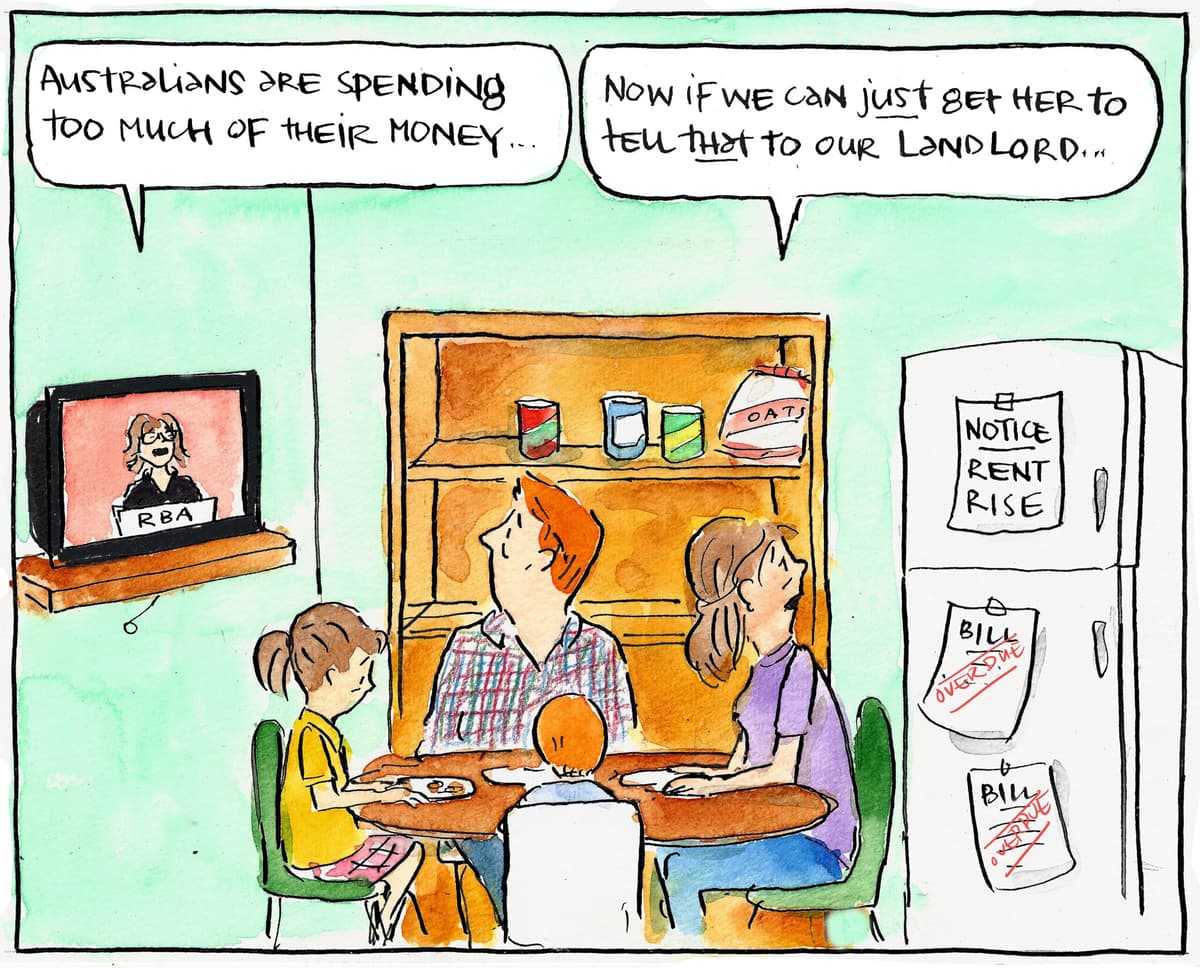
We can’t do anything about what is causing inflation, but we want to look like we can. Mostly, we are worried about people thinking we don’t care about inflation anymore, so we need to look tough and that we are keeping down inflation expectations
The Board remains focused on ensuring that high inflation does not become embedded. To achieve this, growth in aggregate demand needs to remain subdued for a period to reduce capacity pressures and bring inflation back to target.
Because inflation right now is 3.5%, and not below 3.0%, we need more people to be unemployed, and if we need to go close to a recession to get inflation below 3% even if prices are rising because of oil prices, then so be it.
The three increases in the cash rate target since the beginning of the year have tightened financial conditions and the economy appears to be slowing. But inflation is still too high and the Board judged that, in light of recent developments, a further tightening in financial conditions is warranted to support a return of inflation to target in a reasonable period.
Everything is a nail when all you have is a hammer. Also, we like hammering
The Board will continue to do what it considers necessary to bring inflation sustainably back to target, including increasing the cash rate target further if needed.
We might need to make sure a few more of you are out of work.
Accordingly, the Board will be attentive to the data and the evolving assessment of the outlook and risks to guide its decisions. Monetary policy is well placed to respond to developments, and the Board is focused on its mandate to deliver price stability and full employment.
If we stuffed up, we will cut rates ASAP and hope like hell we haven’t sent the economy into a recession.
Today’s policy decision was unanimous.
When the market thinks there’s a 90% chance of a rate rise, then who are we to disagree?
Greg Jericho is Chief Economist at the Australia Institute.


