Would you expect a forest to grow and remain permanently in the Outback? Me neither. Yet this is exactly where most of Australia’s 400+ “forest regeneration” (or “human induced regeneration, HIR) carbon offset projects are located, covering a total area bigger than Japan (38 million hectares).

Fri 30 Oct 2026 13.00 AEDT
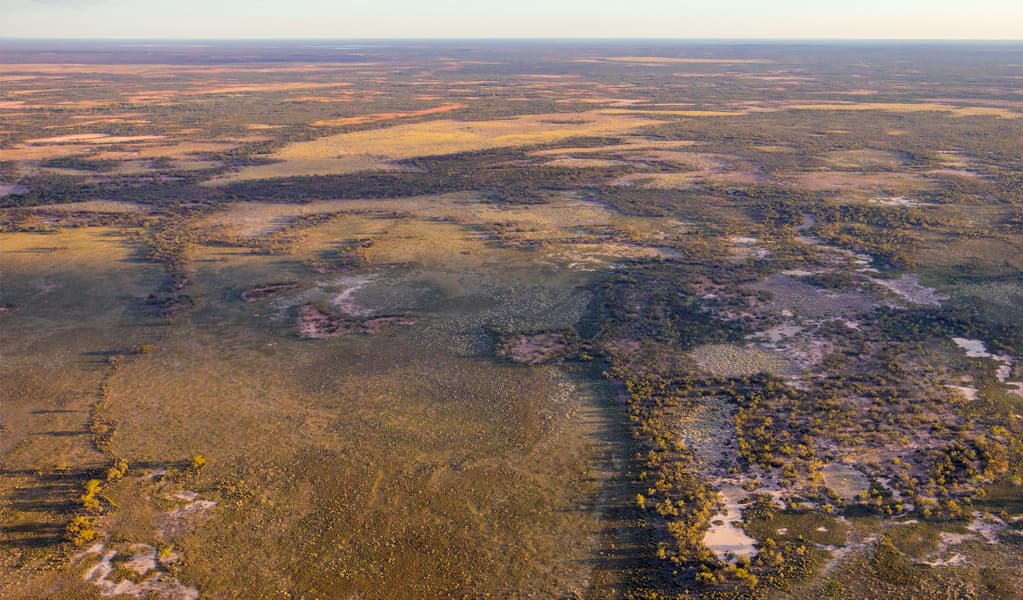
Aerial view of Brindingabba National Park, 175km from Bourke. Brindinggabba contains a forest regeneration (HIR) carbon project. Photo: Joshua Smith, © DCCEEW


I want you to picture the Australian Outback: vast arid and semi-arid landscapes where the environment is shaped largely by the availability of water. When the rain falls, these landscapes are known to come alive with wildflowers and flushes of growth in native trees and shrubs. But in times of drought, widespread tree death occurs. In the Outback and other rangeland ecosystems, there are natural cycles of “build-up” and “collapse”.
Now picture a forest: one that you would expect to remain a forest permanently. The permanent bit is important, because this particular forest is meant to absorb carbon dioxide emissions so that it offsets the release of carbon emissions. Put aside for now the impossibility of truly undoing the climate harm of burning fossil fuels by increasing biological carbon stocks, and consider what a forest may need to grow and lock up carbon for decades at least (reliable water is one).
Would you expect a forest to grow and remain permanently in the Outback? Me neither.
Yet this is exactly where most of Australia’s 400+ “forest regeneration” (or “human induced regeneration, HIR) carbon offset projects are located, covering a total area bigger than Japan (38 million hectares).
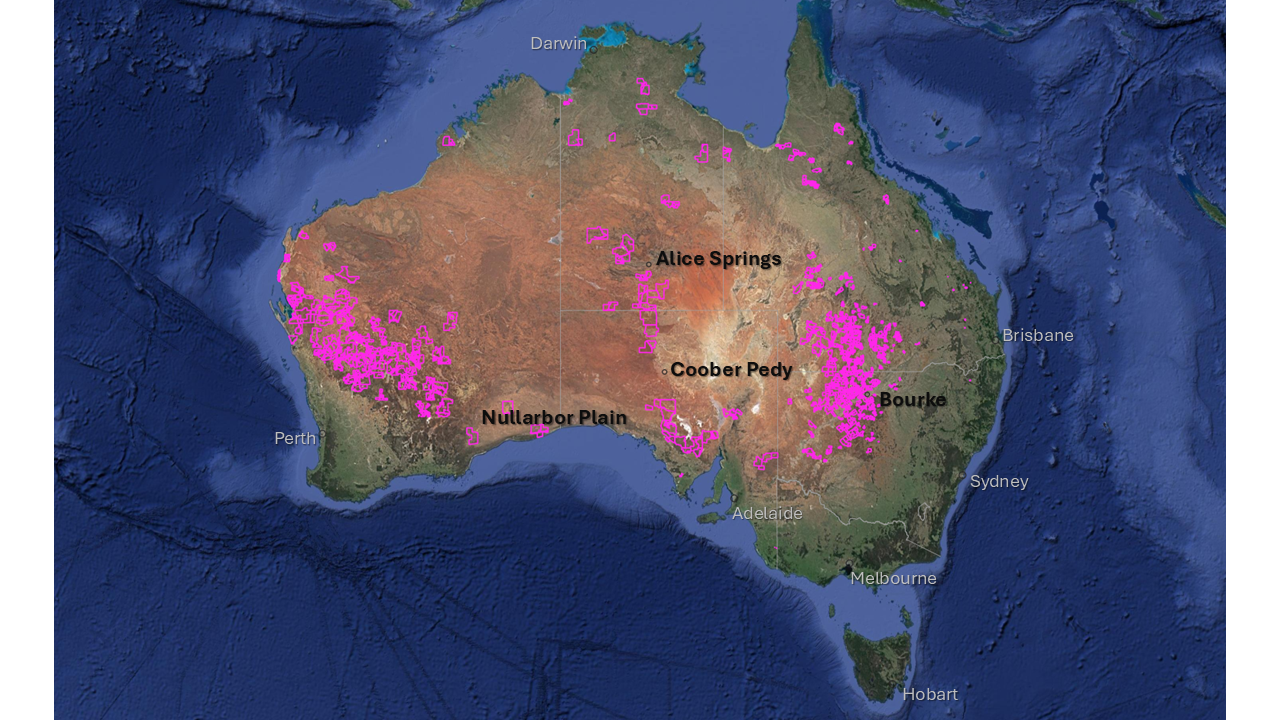
Human-induced regeneration of permanent even-aged native forest (HIR) projects. Data as of August 2024. Satellite imagery: Google. Map credit: Don Butler
These projects have earned over 60 million carbon credits to date, worth between $1.5 and $2 billion. The Australian Government has itself already spent $300 million buying these carbon credits (under the previous Coalition government’s Emissions Reduction Fund).
To put this figure in context, Australia’s central climate policy, the Safeguard Mechanism, aims to achieve 200 million tonnes of emissions abatement by 2030. Since government policy allows Safeguard entities to meet their 100% of their emissions obligations (baselines) using carbon credits, it’s likely that a large chunk of Australia’s climate targets will be achieved via these fake carbon forests in the Outback.
In 2024-25, about 80% of the 13 million tonnes of emissions that exceeded Safeguard baselines were addressed by surrendering ACCUs, and 30% of these were from HIR projects.
There is a clear financial and political interest in protecting this scheme.
This helps to explain why, despite multiple peer–reviewed studies finding that most of HIR projects are failing, the government and carbon industry continues to insist that they are doing just fine. Various defences have been put forward, ranging from suggestions that the research is flawed, the data used is incorrect (but the correct data is secret), and that researchers and others concerned about the substantial evidence of the failures of carbon offsets are ideologically motivated, are “activists”, or are unreasonably seeking “perfection”.
Quality research, analysis, explainers and factchecks from experts you can trust.
The problem is that the failures of these supposedly “good” projects are becoming increasingly obvious. By law, HIR projects must be 90% forest after 15 years, and time is nearly up. Failure to meet this requirement should technically trigger the Clean Energy Regulator to “claw back” tens of millions of carbon credits issued to HIR projects in uncleared, Outback areas. No one with a financial or political interest in carbon credits wants this to happen.
The solution is the Carbon Credit “Integrity and Transparency” Bill currently tabled in Parliament that would technically allow the government to stop carbon credits being issued to projects that are failing to remove emissions from the atmosphere via a “method transition declaration” process.
But the devil is in the detail.
The Bill contains various provisions that mean the Minister can only stop issuing carbon credits to “low integrity” carbon projects if all of projects of the same type (method) can be moved over to a new, presumably “high integrity” method, or can be “reasonably capable of being changed to meet” the requirements of the new method.
This means that if the Minister decides to act on evidence that, say, 80% of HIR projects are experiencing negligible or negative regeneration, they can only stop issuing carbon credits to these projects if both the failing and the effective projects can meet new method requirements and thus continue to be issued carbon credits.
The logic of this process makes absolutely no sense, until you realise that the purpose is not to stop dodgy offset projects at all, but rather to allow them to continue under a new, shiny “high-integrity” label (have you noticed that carbon and biodiversity credits are all “high-integrity” lately?).
The likely “new” requirements are set out in the planned Integrated Farm and Land Management (IFLM) method. IFLM has been described by industry using grandiose terms such as “modular” “whole-of-farm” and “scale”, but it’s actually just HIR and environmental plantings slapped together. IFLM has been years in development, and government and industry alike are eager for the method to be approved to ensure a large future supply of carbon credits.
The “method transition declaration” would enable government to move HIR projects over to the IFLM method under the guise of improving the integrity of Australia’s carbon credit scheme, while quietly ensuring forest regeneration projects would no longer need to meet the 15 year forest cover rule, or the requirement to occur only on cleared land.
If the government has no plans to use the method transition declaration to relieve forest regeneration projects of their current legal obligations, then they should have no concerns in supporting amendments put forward to address the issue.
Dr Megan Evans is a Senior Lecturer in the School of Business, UNSW Canberra, and a Chief Investigator with the UNSW Institute for Climate Risk & Response. She is an interdisciplinary social scientist whose work aims to inform the design, implementation and evaluation of environmental laws, policies and tools.

