If the government wants to pursue significant spending cuts, this piece proposes six options that help achieve short term equity and long run efficiency goals. Together, they could save between $14 billion and $62 billion.


Fri 6 Nov 2026 15.24 AEDT
Photo: AAP Image/Lukas Coch


Trump’s war, not government spending, is driving Australia’s inflation
Australia’s moderate level of inflation is being driven by the increase in the world price of oil, which was caused by the closure of the Strait of Hormuz after the United States and Israel attacked Iran. More recently, the boom in data centres has been pushing up prices of construction and energy.
Higher interest rates will do nothing to slow either of these causes of inflation, and nor will cuts in spending.
Despite the obvious causes of Australia’s current inflation, there is a growing belief from political pundits that government spending is somehow adding to inflation. This belief persists despite ABS data showing that as inflation has increased, government spending’s contribution to demand has been decreasing. This data suggests that spending is having no impact on inflation.
Despite the fact that reductions in government spending will do nothing to reduce global energy prices or slow the pace of data centre construction, if the Albanese government decides to cut spending, then the impact on equity and economic efficiency of any cuts needs to be carefully considered.
Significantly, middle- and low-income earners have been hit hardest by the recent increase in prices and interest rates. Cuts to spending should be designed to limit any further impact on these groups.
If the government wants to pursue significant spending cuts, this piece proposes six options that help achieve short term equity and long run efficiency goals. Together, they could save between $14 billion and $62 billion.
At the last budget, the Albanese government proposed cutting the private health insurance rebate. Currently, people aged 65 and over get a larger rebate for private health insurance than younger Australians. This means that two people on the same income and with the same circumstances get different rebates if one is aged 64 and the other is aged 65.
The Government proposed abolishing this concession which would save $1 billion per year. To date, the Coalition and Greens have blocked this proposed budget saving in the Senate.
There is little empirical evidence that the private health insurance rebate takes pressure off the public system. Private health insurance is also far more likely to be used by more affluent households, and it costs $7.9 billion per year, or $30.3 billion over the next four years.
While the government’s existing proposal would save around $1 billion per year, much larger savings could be made by reducing the generosity of this measure that flows overwhelmingly to high income earners and has failed in its objective of taking pressure off of the public health system.
The Commonwealth Government spends $21.4 billion per year, or $91.8 billion over the next four years, on subsidies to private schools. Australian governments provide all students the opportunity to go to a public school. There is no public policy justification for the government to subsidise private schools and Australian families spend more on high school education per student than in any other developed country because fees are so high.
If the government did not want to cut the private school subsidies entirely it could choose instead to cease subsidies to the most expensive private schools, some of which charge over $50,000 per year. Australia Institute research shows cutting subsidies to elite private schools could save $1 billion per year.
Fuel tax credits hand back the excise paid on diesel for some users, with the mining industry as the biggest beneficiary.
Between 2026-27 and 2029-30, the Commonwealth Budget projects the government will spend just under $47 billion on fuel tax credits. Of that, based on its average share from 2021-22 to 2024-25, the mining industry is set to receive $22 billion, or around $5 billion per year.
Both the OECD and the International Energy Agency regard Australia’s fuel tax credits as a fossil fuel subsidy. At a time when Australian families are paying high prices for energy, while facing high interest rates and high mortgages, it is clear that a government seeking to equitably and efficiently pursue spending cuts could start by reducing the cost of a subsidy for the use of a pollutant that delivers most of its benefits to the wealthiest companies in Australia.
Capping fuel tax credits to $50 million per year per company would only impact the largest 18 mining companies but would save $2.5 billion per year. Even Fortescue, one of Australia’s largest iron ore miners and in turn one of the major beneficiaries of this subsidy, has advocated for this change.
Quality research, analysis, explainers and factchecks from experts you can trust.
Australia’s superannuation scheme provides generous tax breaks notionally designed to encourage people to save more for their retirement and take pressure off the cost of the Commonwealth age pension.
Each year these concessions cost the budget around $65 billion in forgone revenue.
While there are good public policy reasons to encourage people to be less reliant on the age pension, the vast majority of these concessions go to Australia’s most wealthy citizens. In this current financial year around $22.5 billion in superannuation tax concessions will go to the top 10% of income earners. Significantly, people earning above $162,000 are highly unlikely to become eligible for the Age Pension. As a result, the government is effectively providing $22.5 billion in tax cuts without a realistic expectation of a public policy outcome.
Wealthy retirees, many of whom pay zero income tax, are far more likely to benefit from high interest rates. Those who have paid off their home loan and have significant savings will also see their incomes rise as the RBA lifts rates.
A number of changes should be made to superannuation to cut the tax concessions going to the top 10%. This includes:
These changes could save $4.2 billion per year.
The Albanese Government’s decision to raise defence spending from 2.03% of GDP to 2.4% by 2033-34 will cost $61.6 billion and likely deliver little increase in national security. A wide range of analysts, including former Liberal PM Malcolm Turnbull, have argued that despite the $37.6 billion already spent on AUKUS, Australia is unlikely to ever actually receive any submarines. Mr Turnbull has said “It’s a submarine deal with no submarines … It was a terribly bad deal, a really stupid deal”. He also suggested it was a “huge wealth transfer from the Australian government to the US and the UK”.
Holding defence spending steady at its current level would save $4.8 billion per year or $29.7 billion over the four years from 2028-29.
A loophole in Australia’s tax law effectively subsidises large utes such as Ram and Chevrolet pick-up trucks by exempting them from the Luxury Car Tax (LCT) on the basis that they are not cars but rather light commercial vehicles. Significantly, this exemption applies regardless of who buys these vehicles or what the driver uses them for. The cost of this loophole is $250 million per year.
Large vehicles impose considerable costs on society, from their higher carbon emissions and rates of road damage to serious safety concerns. The Australian Government can ensure that these costs are accounted for by properly taxing and regulating these vehicles, starting with removing the LCT exemption for utes.
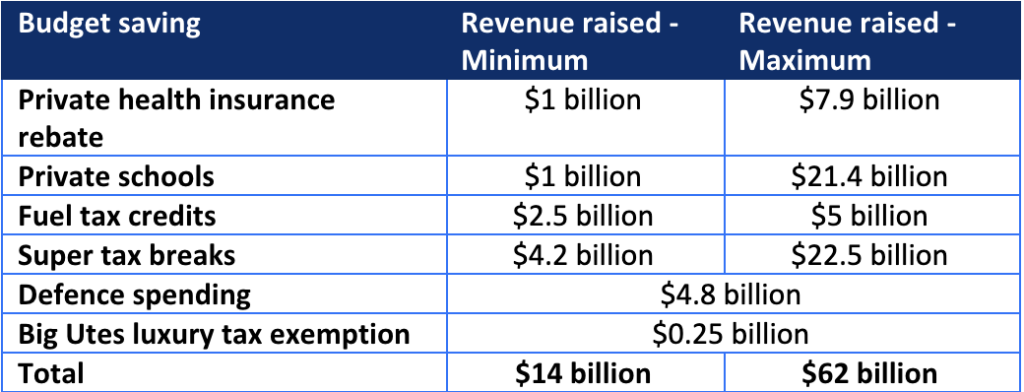
The six savings described above are summarised in the table below.
Four of the savings have included a smaller and a larger saving. Added together, the government could save between $14 billion and $62 billion per year.
Inflation has been caused by the increase in the world price of oil and the growing roll-out of data centres. Lifting rates and cutting spending won’t do anything to bring inflation down.
But if the Government wants to cut spending, then there are lots of options that are fair in the short-term and will make the economy more efficient in the long term.
Matt Grudnoff is senior economist at the Australia Institute.
Greg Jericho is the Chief Economist at The Australia Institute.

