Australia is entering a “New Partnership for a New Era” with Timor-Leste. It should not be a “New Era” for fossil fuels.

Fri 30 Jan 2026 15.00
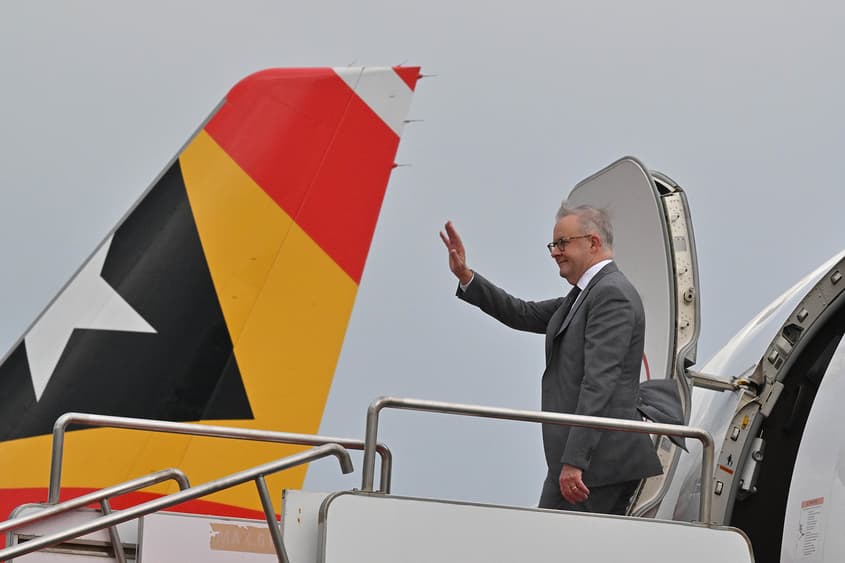
Photo: AAP Image/Mick Tsikas


During his first state visit to Timor-Leste, Prime Minister Anthony Albanese affirmed his government’s commitment to Greater Sunrise – a contentious undeveloped gas project in the Timor Sea. Albanese described how the actions of previous Australian governments “did not honour, and were not worthy, of the close friendship between our nations”. This diplomatic platitude belies the grim reality: that friendship with Timor-Leste has always come second to Australia’s hunger for oil and gas.
The history is unsettling. Australia’s pursuit of oil and gas reserves in the Timor Sea informed the Whitlam government’s decision to support Indonesia’s 1975 invasion and occupation of Timor-Leste: disputed maritime boundaries between Australia and Indonesia were viewed as being more favourably resolved without an independent Timor. This was clearly spelled out in a cable from Australia’s then-ambassador to Indonesia, who noted he was “recommending a pragmatic rather than a principled stand but this is what national interest and foreign policy is all about”.
Australia’s national interest (read: fossil fuel interests) continued to shape its engagement over the subsequent years. In 1989, the Timor Gap Treaty was signed, with Indonesia conceding almost 80% of Greater Sunrise to Australia. In the lead up to Timor-Leste’s independence in 2002, Australia lobbied the UN Transitional Administration to accept the terms of the Timor Gap Treaty. During subsequent maritime boundary negotiations between Australia and the newly formed Timor-Leste, Australia was accused of negotiating in bad faith, famously going so far as to spy on the Timorese negotiating team.
Albanese’s rhetoric suggests he is trying to right these historic wrongs, committing at least a third of Australia’s future revenue from Greater Sunrise to an infrastructure fund for Timor-Leste, and acknowledging Timor-Leste’s commitment to onshore processing. The latter has been a sticking point for the joint venture partners, who argue it would be cheaper and more feasible to process the gas in Darwin.
This week’s Joint Declaration establishing a Parseria Foun ba Era Foun (a New Partnership for a New Era) states that “Australia will support any commercially viable solution to develop Greater Sunrise”, claiming the project will support economic diversification in Timor-Leste and deliver long-term sustainable socioeconomic benefits for its people. But is this massive gas project truly the best option for Timor’s development?
Timor-Leste’s government budget has relied on its sovereign wealth Petroleum Fund, which in 2023 equalled 88% of the country’s GDP. The country’s most valuable oil and gas field, Bayu-Undan, has now been depleted, with the Petroleum Fund correspondingly on track for depletion. The Timorese Government looks to Greater Sunrise as its new key source of revenue, claiming that onshore processing will power industrialisation and diversification of the country’s economy.
As outlined in a paper from Timorese civil society research organization La’o Hamutuk, Timor-Leste had hoped to avoid the “resource curse” typical with other countries dependent on natural resource extraction, which experience higher poverty rates and less stable democracies than countries without large resource reserves. A notable impact of oil and gas money is the tendency to import goods and services rather than source them domestically, resulting in the neglect of other economic sectors which could create more long-lasting revenue and jobs. The Petroleum Fund is viewed as an inexhaustible resource, with the view that undeveloped petroleum resources, of which Greater Sunrise is the only large verified reserve, will provide money “even when geology, research, corporate reports to regulators, and potential investors say otherwise”.
The life of Bayu-Undan was prolonged by its Australian operator, Santos, who also operates its processing plant Darwin LNG – a plant found to have spent years secretly leaking methane. Extending Bayu-Undan’s production was not done for the sake of the Timorese economy, but to keep the LNG plant active until new supply from the Barossa gas field came online. Santos is now planning to turn Bayu-Undan into a carbon-capture and storage project to offset its emissions from Barossa; this dumping of Australian carbon pollution in Timorese waters has been labelled “carbon colonialism” by Timorese civil society.
Fossil fuel companies operate in the interests of profits, not people. Petroleum extraction and processing has involved hardly any Timorese workers or subcontractors, with major components fabricated overseas and few permanent positions for medium- and low-skilled workers. Using the readily available money from the Petroleum Fund, it is easier for the Timorese government to hire foreign companies for large infrastructure projects than developing local capacity to meet community needs, and government spending has disproportionately benefited the small upper and middle classes than the rural poor majority.
Governments cannot continue to bet on fossil fuels in an increasingly decarbonising world. Greater Sunrise holds 5.1 trillion cubic feet of gas and would take tens of billions of dollars to develop. Where would this gas go? Into an already oversupplied Asian market, as we careen into an unprecedented global gas supply glut? This will drive down economic returns, while requiring new fossil gas demand which is already derailing the energy transition.
How can Australia deliver “long-term sustainable socio-economic benefits” to Timor-Leste’s people by accelerating the climate crisis and increasing the country’s vulnerability to floods, cyclones, crop failures and sea level rise? This is in addition to the direct harms caused by offshore gas projects to the marine environment, coastal community livelihoods and cultures.
Timor-Leste signed onto the Fossil Fuel Non-Proliferation Treaty in 2023. President José Ramos-Horta described how blame for climate change is not shared equally among nations, with Timor-Leste and fellow developing nations contributing the least yet bearing the brunt of the impacts. Developing countries urgently need finance and support from the wealthy nations that have reaped the rewards of fossil fuel industrialisation, in order to manage their energy transitions and climate impacts.
Ramos-Horta has described this as a crisis of inequality, stating that he “would be happy to leave [Greater Sunrise] in the ground, but if we did, we would forego our sovereign development benefits. What if, instead, high-income countries began to finance a transition so we could build a sustainable society based on renewable energy?”
This point was put to DFAT during senate estimates in December, with a question around whether the Australian government has engaged with Timor-Leste on renewable energy, which they had to take on notice.
Australia could support Timor-Leste in developing sustainable industries, powered by renewable energy and led by communities. For example, coffee is the country’s largest non-fossil fuel export, and 38% of households rely on it as key source of income. The Australian government is already supporting the establishment of solar-powered coffee processing hubs, with the aim of reducing emissions and improving the productivity of the coffee sector. Processing sites are being established as multi-functional hubs offering energy services for local households, contributing to long-term sustainability and economic growth.
Colombia, another country with a fossil fuel-dependent economy, is in April due to host the First International Conference on the Just Transition Away from Fossil Fuels, “to explore viable, fair, and equitable pathways for transitioning to sustainable, diversified, and accessible energy”. This was formally announced at COP30, accompanied by the launch of the “Belém Declaration on the Just Transition Away from Fossil Fuels”, which Australia signed on to.
As Timor Leste’s largest development partner, Australia can only truly support Timorese people and our shared region by embarking together on a New Fossil Free Era.
Dr Suhailah Ali is the Director of Climate Justice at Jubilee Australia Research Centre. She is originally from Fiji and currently based on unceded Bidjigal country.
Advertisement

The Federal Government is facing calls to intervene and stop the expansion of a central Queensland coal mine that environmental groups have labeled a “carbon bomb”.
Australia’s poisons regulator shows how hard it is to rebuild an institution after it is damaged. As it rebuilds, Australian native animals are dying.

Last week, Senator David Pocock proposed a Senate inquiry into the “extraordinarily low rates of revenue Australians receive from the export of our gas resources.”
We’ve just had an epic win for our native animals, such as owls, goannas and eagles. And after years contributing to the scientific evidence on the wildlife impact of rodent poisons, it’s a day scientists like myself feared would never come.