Documents obtained by Peter Milne in Boiling Cold and reported by The Guardian show, for the first time, what WA’s Environmental Protection Authority (EPA) really thinks of Woodside’s plan to drill for gas at Scott Reef. They are damning.

Tue 27 Oct 2026 10.33 AEDT
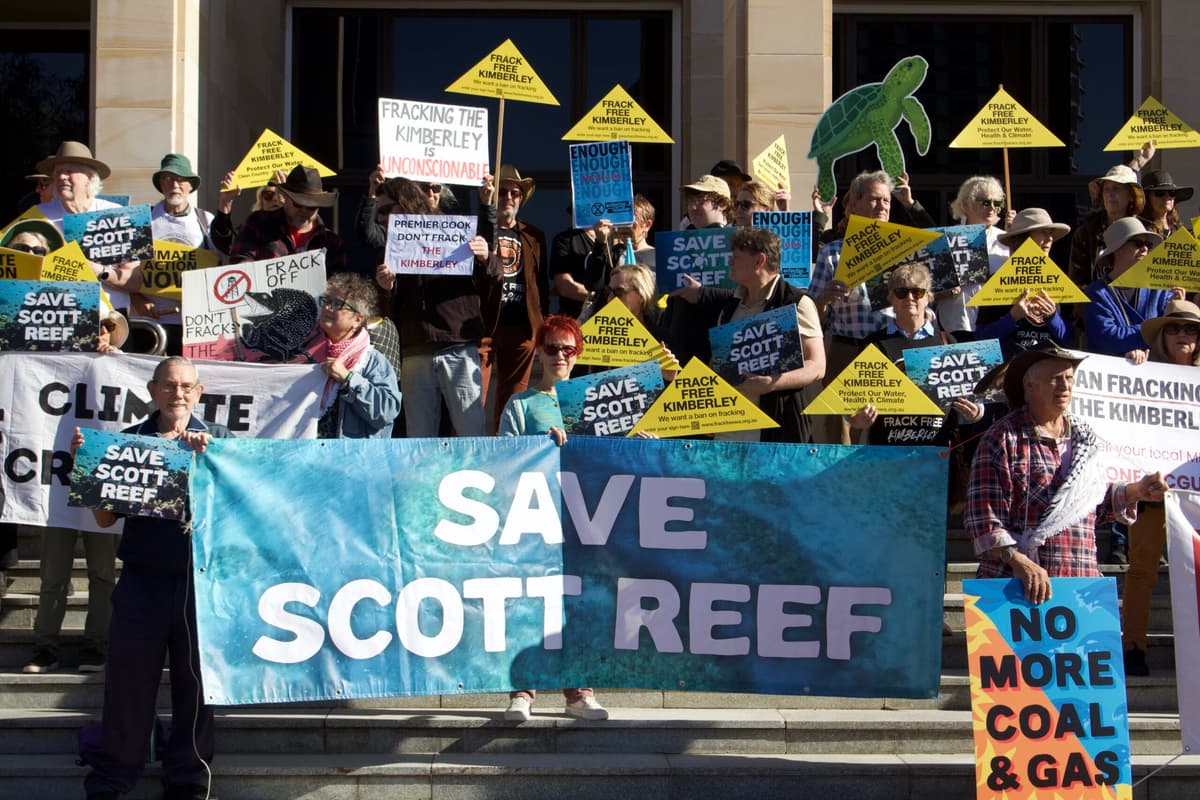
Photo: Conservation Council WA (CCWA)


Imagine the independent environmental regulator tells a gas giant its project is likely to cause “significant, serious and irreversible harm” to one of the most precious reef systems on Earth. Now imagine the public never hears about it.
That is what has happened with Woodside’s Browse gas proposal off the coast of WA. Documents obtained by Peter Milne in Boiling Cold and reported by The Guardian show, for the first time, what WA’s Environmental Protection Authority (EPA) really thinks of Woodside’s plan to drill for gas at Scott Reef. They are damning.
The draft letter was presented to the EPA Board in December 2023, after years of assessment and expert peer review. The EPA’s preliminary view is that Browse is inconsistent with several principles of the Environmental Protection Act 1986. It found the project “likely to be significant, serious and irreversible harm” to Scott Reef, Rowley Shoals and the surrounding marine environment.
Then came the line every decision-maker should have taped to their desk. The EPA was “not satisfied that any measures have been proposed to date could address this harm.”
Woodside will say an oil spill is unlikely, yet the consequences are not small. Even in the best case, with a ‘capping stack’ deployed within 13 days of a spill or, in industry speak, ‘loss of well control’, the EPA could not establish “with any degree of certainty” that irreversible consequences would not occur. In the worst case, a 77-day spill, it found “considerable uncertainty for a full recovery of Scott Reef.” It also noted that Woodside had declined to propose contemporary world’s best practice measures.
The WA Government’s own departments were deeply worried too.
The then Department of Mining, Industry Regulation and Safety told the EPA it was “not clear” the environmental risks could be reduced to acceptable levels. The Department of Biodiversity, Conservation and Attractions said the proposal “appears to present a high risk” to the threatened green turtle and its nesting habitat. The regulators were worried. The public was not told.
Green turtles nest on Sandy Islet, a tiny and fragile sand island. The EPA found the project could significantly harm these turtles through subsidence and rock compaction and flagged added risks from disorientation of adults and hatchlings, vessel strike, noise and an unplanned ‘hydrocarbon release’ – yet another industry term for oil spill.
Woodside predicted about 2 cm of subsidence over 40 years and said it would not change the islet’s fate. The EPA’s independent reviewer, Dr Eliot, disagreed, saying Woodside had read the impacts through the lens of coral reef atolls, and that Sandy Islet is built and behaves quite differently. Woodside offered ‘beach renourishment’, adaptive lighting and vessel restrictions. The EPA was “not satisfied these measures will be successful.”
Scott Reef is, on current evidence, the only identified foraging area between Timor and southern Australia that is productive during the pygmy blue whale’s southern migration. Browse would add underwater noise and vessel traffic to that spot, and blue whales are among the species most likely to die from vessel strike.
The EPA’s independent expert, Dr Nowacek, thought injury was highly unlikely and that timing restrictions should help. But whale numbers and movements are so poorly mapped that one could easily be present when it is “not supposed to be there.” His conclusion was clear. The only way to guarantee no disturbance “is for the activities not to proceed.”
In 2024, after the Sydney Morning Herald revealed the EPA had told Woodside its preliminary view was that Browse was unacceptable, Premier Roger Cook was asked a simple question. Should the project go ahead if the EPA finds an unacceptable risk to whales and turtles, or of an oil spill?
Quality research, analysis, explainers and factchecks from experts you can trust.
“No, it certainly shouldn’t,” he answered immediately.
Then came the walk back
This July, with the EPA still deliberating, the WA Government granted Browse “State Significant Project” status.
That designation has no legal weight. It is political theatre, and its only real function is to pile pressure on the regulator. It came in the fortnight after more than 70,000 Australians made submissions to the federal government demanding greater scrutiny of Browse.
The risks the Premier was asked about are exactly what the EPA’s letter describes. He gave the right answer once. He should stick to it and mean it.
Scott Reef is also a climate story. Drilling around 50 new gas wells would lock in decades of extraction, and burning that gas would produce enormous pollution.
Woodside’s answer is carbon capture and storage (CCS). But, we need to call it what it is.
At Browse, CCS is not a climate solution. It is an offsetting trick. The gas still comes out of the ground, and the pollution still gets made, but CCS lets the company claim on paper that some of it has been dumped under the ocean and offset.
It generates the credits and offsets that a project like Browse needs to look compliant under the Safeguard Mechanism, the scheme meant to force big polluters to cut emissions. As Australia Institute analysis shows, the Safeguard Mechanism lets gas companies buy their way out of genuine reductions by allowing 100% offsets.
Governments are helping Browse along. Status upgrades like the one granted by WA greenwash legitimacy before assessment is complete, and they help projects access the $16.3 billion in fossil fuel subsidies Australian governments spent in 2025-26. Meanwhile, the gas industry continues to refuse a 25% tax on gas exports, which already cost the public well over $78 billion since 2022.
Australia is the incoming COP31 President of Negotiations. We cannot ask the world to transition away from fossil fuels while approving a gas field our own regulator said would cause irreversible harm; hiding its emissions behind dodgy offsets.
The EPA’s final decision is expected later this year. It deserves congratulations for standing up to Woodside, and we expect it to stick to its guns and reject Browse.
Premier Cook should say, plainly, that he will respect that decision. If the EPA finds Browse unacceptable, it does not go ahead. Scott Reef has survived for millennia. It should not be sacrificed for a gas field that the regulator, two government departments and independent experts have all warned about.
Louise Morris is Head of Fossil Fuel Transition at the Australia Institute, with 20 years’ experience encompassing climate, energy, forest protection, and law reform in the not-for-profit sector, and federal politics.

