The Australian Government lets foreign owned gas companies export vast amounts of gas above and beyond what they need to fulfil their export contracts, while leaving Australians short.
Thu 5 Mar 2026 01.00
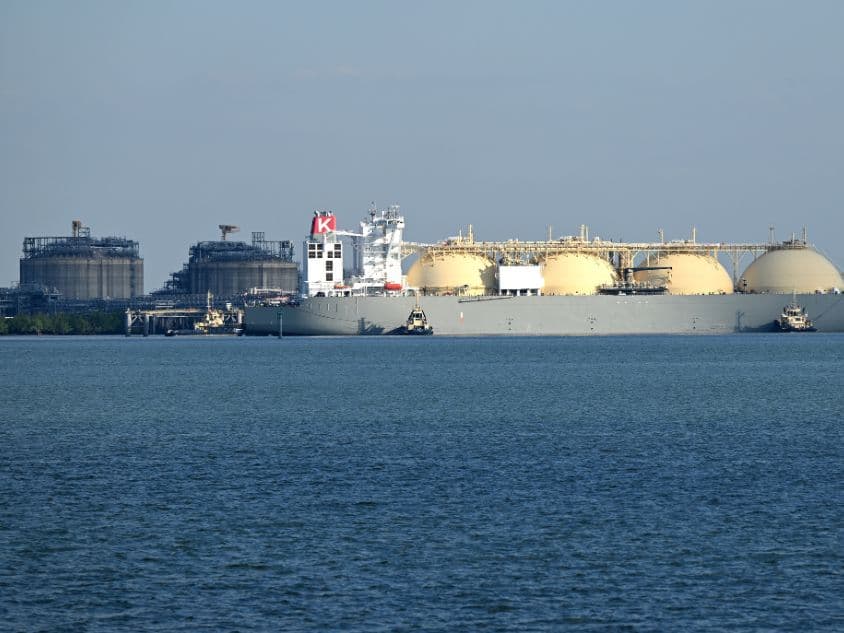
AAP Image/Darren England


The Australian Government lets foreign owned gas companies export vast amounts of gas above and beyond what they need to fulfil their export contracts, while leaving Australians short.
For decades, Australians enjoyed abundant gas at low prices. But that ended as Australian Governments allowed virtually unlimited gas exports by a handful of largely foreign owned gas companies via large gas export terminals in Queensland, Western Australia and the Northern Territory.
These gas companies now export four times more gas than Australians use. In fact, in the last five years they have exported enough gas to supply Australians for 20 years at current levels. All this while Australians are told the reason we have to pay through the nose for our own gas is because there isn’t enough to go around!
Because these exporters control so much of Australia’s gas, they can force Australians to compete with international buyers. This has caused Australian wholesale gas prices to triple and electricity prices, which are largely set by the gas price, to double, driving household energy bills through the roof.
Most of the gas exported from Australia is sold to big energy companies in Asia through long-term contracts that last 10-20 years. But because the gas companies’ greed knows no bounds, they drill much more than they need to meet their obligations under those contracts, and export that gas too.
The Government’s main excuse for not requiring gas exporters to supply more gas for Australians, is to protect the gas companies’ long-term export contracts.
Even if we accept the questionable argument that such contracts should be sacrosanct, this ignores the reality that 30% of the gas exported from Australia, is not needed to meet the commitments made under long term contracts (in the chart this is shown in orange). Gas companies instead sell this leftover gas on the short-term international “spot market” market, where they get a much higher price than they would get if they sold it to Australians.
The short-term international “spot market” is a bit like Airbnb. When a landlord rents out their investment property for short stays instead of long-term rentals, they make a lot more money, but a family misses out on being able to rent a home. Similarly, the gas companies selling gas on the short term global “spot market” are making large profits, but Australians are missing out on a reliable, affordable supply of gas.
In fact, the amount of excess gas exported from Australia, not needed to fulfill long term contracts, is eight times the amount of gas needed to meet the worst-case scenario identified by the Australian Energy Market Operator (AEMO) for a potential “shortfall” of 153 petajoules (PJ) of gas on the east coast of Australia. AEMO also said the “shortfall” in that year could be as little as 5 PJ.
These gas companies are deliberately exporting enough gas to ensure the amount of gas available Australians remains tight in order to keep domestic prices high.
Then they use the threat of these engineered “shortages” to pressure Australian governments to approve new gas projects, but since these projects are almost entirely for export, they wreck the environment but do nothing to help lower the prices paid by Australian households and businesses.
There is no need for endless reviews and reports. The ACCC’s Gas Inquiry has published no less than 27 reports, most of which are over 100 pages. But, in their own words, the net result is that “gas policy measures have not made a material difference for local users.” These reports and reviews are a form of avoidance and distraction from the simple fact that too much gas is being exported.
The solution is just as simple: The Australian Government can fix this problem tomorrow simply by requiring these companies to supply this excess gas Australians instead of exporting it.
A great way to make companies do this is to implement the 25% tax on gas exports proposed by the ACTU and supported by voters across the political spectrum. This would provide an incentive to supply gas to Australians before it is exported. As an added bonus, it would raise $17 billion annually, which is enough to increase federal government spending on housing fourfold, or to double the childcare subsidy.
Advertisement

A permanent ban on fracking is back on the agenda in Tasmania with the Tasmanian Greens planning to introduce a bill to ban the harmful practice in the opening days of parliament.

The greenhouse gas data is one of those rare data sets where you want the figures to go down – less is better. And the problem for any efforts to limit the impact of climate change is that Australia’s emissions have not been going down anywhere near as fast as they need to be.
The Australian Government is quietly reshaping national climate policy so that Australia can become a global dumping ground for carbon dioxide under the banner of “Sequestration Nation” and keep using and exporting gas.