The Government is positioning Australia as a global dumping ground for CO₂ and it's taxpayers who carry the risk
The Australian Government is quietly reshaping national climate policy so that Australia can become a global dumping ground for carbon dioxide under the banner of “Sequestration Nation” and keep using and exporting gas.

Tue 24 Feb 2026 13.00
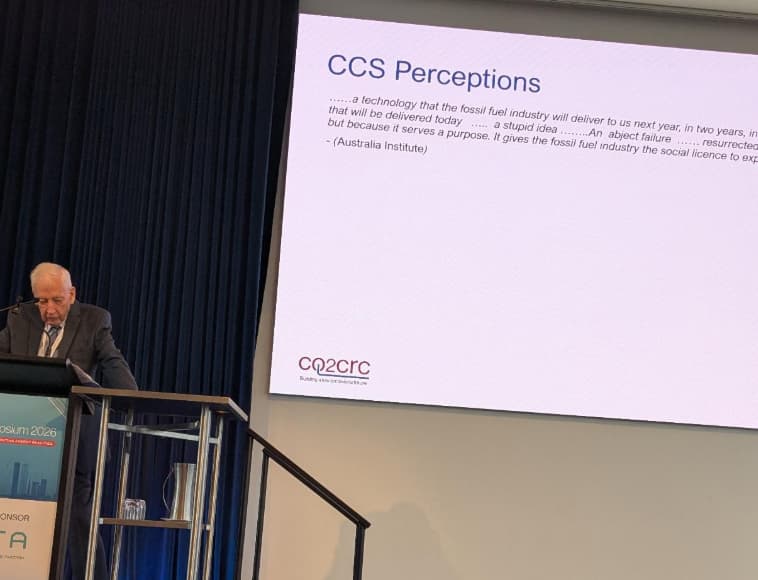
Photo: Peter Cook OAM, opening address to CO2CRC Symposium on poor public perception of CCS.


The Australian Government is quietly reshaping national climate policy so that Australia can become a global dumping ground for carbon dioxide under the banner of “Sequestration Nation” and keep using and exporting gas.
That rhyming vision comes from a report by Low Emissions Technology Australia (LETA), Beneath the Surface: The Economic Potential for Carbon Capture and Storage in Australia’s Eastern States, launched by Resources Minister Madeleine King in July 2025. The report outlines a future in which Australia captures and stores tens of millions of tonnes of CO₂ each year through carbon capture and storage (CCS) hubs. Effectively building a large-scale carbon dumping trade industry as core national infrastructure.
With this scaling up of carbon dumping ambition, the fossil fuel industry conversation has shifted in tone.
The Melbourne-based CO2CRC Symposium, held from 23–25 February by CO2CRC, was framed around “The role of CCS in confronting energy realities.” That is not the language of climate leadership. It is the language of retreat.
The conference promoted an online viewing portal to ‘Watch Live’ keynote speeches and workshop presentations. However, the live stream failed to function for those logged in.
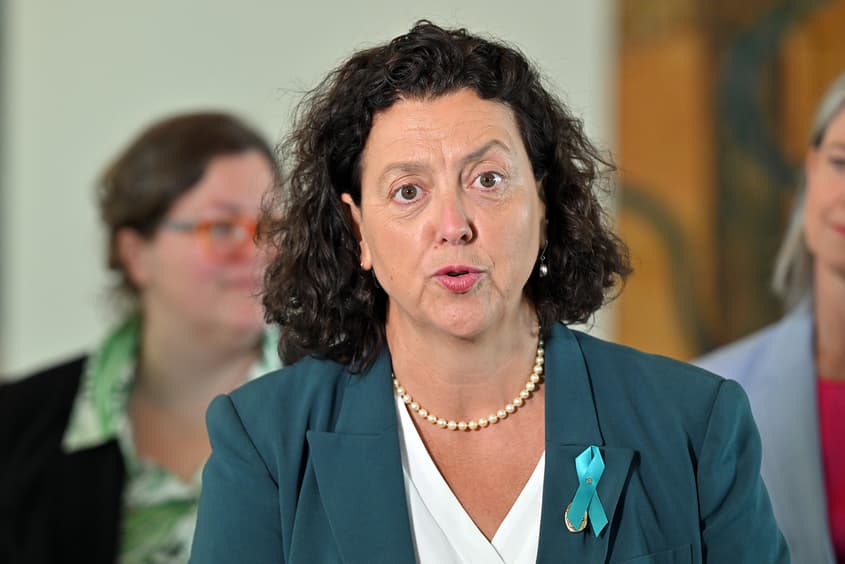
Those not in the room could not hear former Minister for Resources, now chair of CO2CRC, Martin Ferguson open the symposium, nor current Minister for Resources Madeleine King as keynote speaker promote CCS and reassure industry that ‘The Albanese Government is working to ensure we have right settings in place to encourage investment in CCS’.
Instead, viewers were left staring at a blank screen.
It would seem CCS is staying on brand: not working as promised.
CCS: From “Breakthrough” to Last Resort
CCS is no longer being sold as a climate breakthrough. It is being reframed as a desperate last resort. The implication is clear: Government climate ambition has collapsed.
Fossil fuels are resurgent in current politics with new acreage releases, new exploration permits and new approvals. CCS is presented as the pragmatic tool that allows governments to keep approving and exporting fossil fuels, while claiming carbon offsets and that they will manage the emissions consequences… later.
In a roundabout way, industry and government are admitting something important: they are not focused on cutting emissions at the source and transitioning away from fossil fuels.
They are looking for ways to offset emissions on spreadsheets, create a new trade in CO2 hubs, and prolong and expand fossil fuel extraction under narrative of “realities.” Energy, climate or political – they seem interchangeable.
Beneath the rhetoric lies an even more troubling fact. Under Australian law, when CCS fails, it is the Australian public that carries the risk and picks up the bill.
When CCS fails, Australians pay the price
CCS has had decades of political backing and billions in global investment and has repeatedly failed to deliver emissions reductions at the promised scale.
As Ketan Joshi has demonstrated in numerous pieces of analysis, flagship Australian projects such as Gorgon Gas Project and Moomba Carbon Capture and Storage Project have failed to capture carbon in line with targets and have experienced constant cost blowouts and technical setbacks that are now treated as routine.
Despite that record, the Albanese Government is positioning Australia as a leader in global CCS trade and dumping. Minister King has described Australia as having the “right geology and regulatory framework” to become a global CCS hub.
The “Sequestration Nation” scenario envisions dumping up to 50 million tonnes of CO₂ pollution annually, including carbon shipped from countries such as Japan and South Korea, both major buyers of Australia’s export gas.
The Transfer of Risk
Under the Offshore Petroleum and Greenhouse Gas Storage Act 2006 (Cth), sections 386–398, responsibility for CCS sites evolves over time.
After carbon pollution injection ceases and a closing certificate is issued, the former titleholder remains responsible for monitoring and managing stored CO₂ for at least 15 years. During that period, the Commonwealth can recover monitoring costs.
After 15 years, if the Minister is satisfied the liquefied carbon dioxide is behaving as predicted and poses no significant risk, long-term liability for the structural integrity of the storage formation transfers to the Commonwealth.
At that point, the Government must indemnify the former operator indefinitely against future claims — including those arising from actions during operations.
In practical terms, once liability transfers, any seismic blasting to monitor the site, leakage decades later, environmental remediation, or compensation claims become the responsibility of Australian taxpayers. There is no statutory cap. No sunset clause. The indemnity is indefinite.
While industry and government speak about “realities,” the legal reality is that the public becomes the insurer of last resort for carbon pollution dumped beneath our land and seabeds.
Subsidising Risk While Socialising Failure
Proponents argue CCS requires public funding to scale. But the public is already underwriting the sector through the liability framework embedded in federal law. Fossil fuel corporations are granted a pathway to walk away from long-term structural responsibility after 15 years. After this the taxpayer assumes enduring risk.
This is not climate pragmatism. It is (political) risk transfer.
Positioning Australia as a “Sequestration Nation” may appeal to industry and to governments reluctant to confront fossil fuel dependence. But turning the country into a dumping ground for domestic, and potentially foreign, carbon pollution while legally transferring long-term liability to the public, is bad and dangerous policy.
This coming Federal Budget is an opportunity to end taxpayer funds being used to prop up a technology that has failed to deliver.
If the Albanese Government were serious about climate action, it would focus on reducing emissions at source by phasing out fossil fuels. Not dumping climate pollution out of sight, claiming dodgy offsets, and letting the public carry the risk forever.
Advertisement

Related Articles
Japanese climate coalition joins growing push for 25% gas export tax
Calls for Australia to impose a 25 per cent gas export tax have gained international backing, with a coalition of Japanese climate and advocacy groups urging the Albanese government to act.