What a missed opportunity.
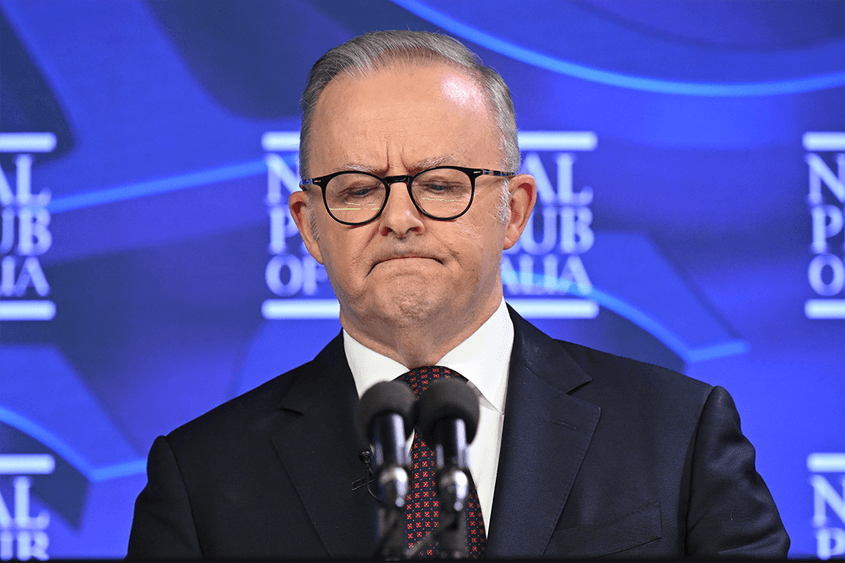
Last night, the Australian Prime Minister had the chance to face reality. His address to the nation was a recognition that Australians are deeply worried about the state of the world – as they should be. Our world is in real trouble, and there is every indication that the trouble is going to get worse.
What the prime minister did not say is that this trouble lies at the feet of the President of the United States.
Why are there “uncertain times ahead”? Why are there “economic shocks” that “will be with us for months”? Why are we staring down “the biggest spike in petrol and diesel prices in history”? Why are we “doing it tough”?
Because of Donald Trump. Because Donald Trump started a war with no plan, that has spiralled well and truly out of his control.
Because Australia’s most important security ally is led by an incoherent wrecker who governs by season finale.
Trump delivered his own address to the nation today. He described the war on Iran as “necessary for the security of the free world”. He said the United States’ “core strategic objectives are nearing completion.” He said that could be “another two, three weeks”.
He said a lot of things. None of it had any real meaning.
Trump always says some nebulous, shifting goal is about “two weeks” away. The reality is that there is no end in sight for this war. Even if Trump does withdraw the United States in two weeks, or tomorrow, none of this can be put back in the box.
In his way, Trump made that clear. He is entirely willing to leave his mess for others to deal with.
In his address, he said that the Strait of Hormuz was not his problem. In his words: “we don’t need it”. Trump said “to those countries that can’t get fuel, many of which refused to get involved…I have some suggestions, number one: buy oil from the United States of America. And number two, build up some delayed courage…go to the Strait and just take it…”
Or is it that “the Strait will just open up naturally”?
None of these are realistic options for the rest of the world. Trump does not care.
The Iranian regime has no incentive to negotiate or walk back its control of the Strait. In fact, the incentives all go the other way. Trump has made sure of that. He said today that the United States and Israel will “hit [Iran] extremely hard over the next two, three weeks”. It will send Iran, he said, “back to the stone age”.
It will do that, we know, with no regard for international law.
Thousands of people have already died. Humanitarian crises are escalating. This is a war of catastrophic proportions.
The Australian Prime Minister said yesterday that “Australia is not an active participant in this war. But all Australians are paying higher prices because of it.”
Australians are also facing the grief and the indignity caused by this illegal war, and our government’s refusal to engage with its causes and its consequences.
While the government has certainly made it clear that Australia will not be further drawn into a conflict on the ground, and has quietly walked back its initial support, it remains staunch in its refusal to go any further.
That is in stark contrast to some of our more principled allies. Under immense pressure from a President threatening to “withdraw” the United States from NATO, the French, Spanish and Italian governments have all closed their airspaces to US military operations.
The Australian government has ready allies when it comes to opposing the illegal actions of the United States. Today, the Australian Foreign Minister will be talking with 35 of her counterparts about a strategy for the Strait of Hormuz. With our allies, Australia can begin to build bridges out of this crisis.
There is so much the government can do, in principle and in substance, to build peace in the region and genuine security and prosperity at home. As this war has made clear, the two are inextricably linked.
In the Prime Minister’s own words: “this is a very different world. And Australia has to respond to that.”