Part One: The history of opposition to coal in the Central Coast and the global impact of the local campaign
Local activism really can drive nationally and globally significant change – which is exactly why powerful people try to dissuade communities from engaging in it.
Wed 7 Jan 2026 13.00
Image: Supplied


Local activism really can drive nationally and globally significant change – which is exactly why powerful people try to dissuade communities from engaging in it.
While leaders like Climate Minister Chris Bowen like to say that calls for no new coal mines is a “slogan not a policy”, in reality it can be both – as shown by anti-coal activism on the NSW Central Coast, between Sydney and Newcastle.
The global impact of activism on the Central Coast was recently highlighted by South Korea’s decision to phase out coal use by 2040. This would likely have been impossible had Korean-owned mines on the Central Coast and elsewhere in New South Wales not been stopped by strong community opposition.
I caught up with long-time Wyong activist Mike Campbell (no relation) to talk about the history of opposition to coal in the area and the global impact of the local campaign.
This is part one of our discussion, covering the impact of Central Coast coal activism on the NSW 2011 election and the plans from the 1970s to turn the region into an extension of the Hunter Valley coal industry.
Rod Campbell (RC): Mike, can you briefly recap the story of the mine proposed by the South Korean mining company, Kores, and why it was so important to the community around Wyong?
Mike Campbell (MC): This mine called “Wallarah 2” was slated to go right under our drinking water catchments, so it was a very big deal for everyone in the community. It was also strongly opposed by the Darkinjung people, as it would have affected their traditional lands and their access to the area.
RC: And this became a very hot political issue in NSW, right?
MC: Yep. Leading up to the 2011 election, the election that ended 16 years of Labor Government, the water issues here were so serious that, in the words of a former NSW Government Minister, “no candidate would have been elected had they not opposed the Wallarah 2 coal mine”.
And so, just before the election, Liberal leader, and subsequent premier Barry O’Farrell and a bunch of other politicians all put on our “Water not Coal” t-shirts and, infamously, had their photo taken with local community leader Alan Hayes.
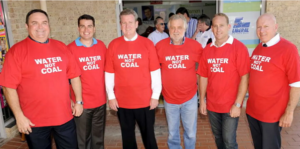
O’Farrell promised “no ifs, no buts” that a Liberal Government would oppose this mine, but they backflipped as soon as they were in office. After that, it was a gloves-off fight for the local community.
Of course, O’Farrell only lasted a couple of years, and the legend now is that he resigned over a bottle of wine. What people forget is that the bottle of wine was given to him by a lobbyist that represented Kores, the proponents of the Wallarah 2 mine among other clients.
RC: The history of local opposition to coal on the Central Coast goes back further than the O’Farrell era though, doesn’t it?
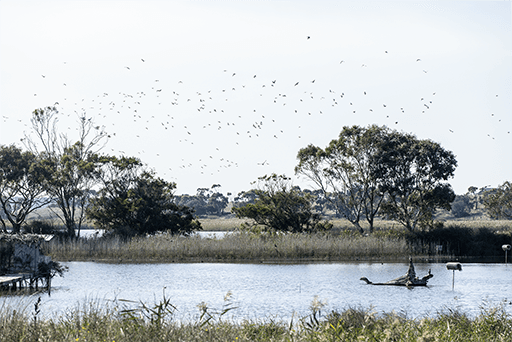
MC: Absolutely. It’s summer holidays now and I encourage any visitors to the Central Coast over the break to look out from Wyong Station beyond the river to the Tuggerah Lake and Nature Reserve. In the foreground they’ll see the sprawling Central Coast Wetlands known as the old Pioneer Dairy complex, that has been managed by a communitytrust for 20 years now.
That scene could have been vastly different. The whole area, the wetlands, the nature reserve, and the Central Coast Sporting Complex, some 300 hectares, was destined to be coal mines, coal dumps and conveyers feeding a coal-fired power station complex nearby on the western edge of Wyong township.
In a nutshell, the whole area of Wyong, Tuggerah, Wyong Creek and Jilliby were to be swallowed up as the southern extension of the Hunter/Central Coast coal and power industry.
RC: Why isn’t this better known? Unlike the O’Farrell era controversy, this victory by your area’s community activists isn’t a well-known story, or at least I had never heard of it. Other environmental wins of the same era have gone down in history – the protection of the Great Barrier Reef or the Franklin campaign in Tasmania – why isn’t the battle against coal on the NSW Central Coast as well remembered?
MC: I think because it was such monumental embarrassment for the state’s very powerful Electricity Commission, Elcom, and therefore the Governments of the era. The state opposition briefly revelled in the early part of the fight, but realised that if they returned to government, they would have to deal with the Elcom bureaucracy too.
So most official material was quickly withdrawn from circulation, and Elcom never told the story outside their inner circle. Rather than acknowledging defeat by the community, they said that they “downgraded their ambitions at the time”.
Of course, now, in times of climate knowledge, and the rapid transition to renewables, we realise the importance of that fight. When I, with the help of others at Lake Munmorah, set about to gather the material on air pollution in 1985, our community groups had no inkling that the outcome would have been so dramatic then, and continue to be so today.
RC: So how far back does local opposition to coal developments go on the Central Coast, Mike?
MC: In the late 1970’s a power station was proposed at Chittaway. This would have transformed Wyong itself into a polluted, heavy industrial site.
Fortunately, even at that time the community saw the problem of future pollution issues and held meetings including a large gathering at Wyong racecourse to subsequently fight the proposal off.
Part two of this discussion covers the 1980s and Mike’s show-stopping intervention in the Commission of Inquiry into Electricity Generation Planning in New South Wales, the Inquiry that shaped electricity planning for decades over much of Australia. You can read it here.
Related Articles
Japanese climate coalition joins growing push for 25% gas export tax
Calls for Australia to impose a 25 per cent gas export tax have gained international backing, with a coalition of Japanese climate and advocacy groups urging the Albanese government to act.