A major report by Oxfam released today has found that the average Australian billionaire increased their wealth by almost $600,000 a day over the past year, or more than $10.5 billion altogether.
Tue 20 Jan 2026 09.00
Photo: AAP Image/Dean Lewins


A major report by Oxfam released today has found that the average Australian billionaire increased their wealth by almost $600,000 a day over the past year, or more than $10.5 billion altogether.
The Oxfam report, Resisting the Rule of the Rich: Protecting freedom from billionaire power, reveals the growing level inequality over the past decades and has been released at the start of the annual World Economic Forum in Davos, which this week will see billionaires and companies meet in Switzerland. Their goal: to drive economic policy across the world.
The report notes that while the past decade has been a good one for billionaires, 2025 was especially propitious.
Oxfam reports that “in 2025, billionaire wealth increased three times faster than the average annual rate over the previous five years”.
One particular jaw-dropping statistics the report highlights is that the world’s 12 richest billionaires have more wealth than the poorest half of humanity, or more than four billion people.
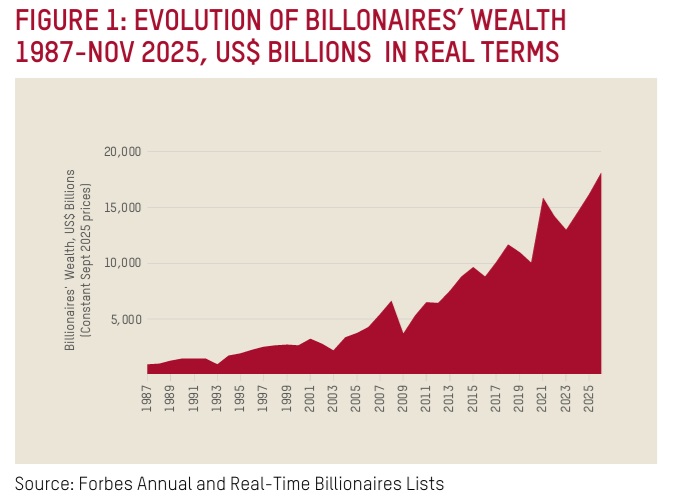
One of the common responses to growing inequality has been to downplay how rich the very richest were getting, because overall wealth and incomes were growing and so poverty was reducing. But the report notes that “the reduction in poverty has largely ground to a halt, with poverty rising again in Africa. In 2022, nearly half of the world population (48%), or 3.83 billion people, lived in poverty.”
Billionaires’ rising wealth has also increased their political power.
This is most clearly the case in the United States, where the report found in the 2024 federal election “just 100 billionaire families spent a record breaking US$2.6bn – or 1 in every 6 dollars spent by all candidates, parties and committees”.
This money is not just being spent for fun – it is spent to elect politicians who will pass laws which favour the wealthy, block progressive tax reforms and profit from privatization.
An example of the relationship between billionaires’ power and policy is clear in the new area of AI.
The report found that 8 of the top 10 AI companies – which overlap with media companies – are billionaire-run, with just three commanding nearly 90% of the generative AI chatbot market. Little wonder that governments around the world – especially in the USA – have been slow to prevent AI companies plagiarising books and other works without recompense.
The report also links the rising inequality with a decline in democratic institutions.
It also notes the growing use by “far-right parties and media platforms, many of which are owned by the super-rich” to “systematically stigmatize and scapegoat minorities”.
It found that economic inequality is linked with political inequality erosion which “included the undermining of checks and balances such as the judiciary or legislature; the restriction of civil liberties; the manipulation of elections; and the normalization of authoritarian practices such as concentrating power in the hands of a political leader”.
The report noted that “the most unequal countries are as much as seven times more likely to see this democratic erosion happen than more equal countries”.
This report echoes research by the Australia Institute’s David Richardson, who in 2024 found that “the wealth of Australia’s richest 200 people nearly tripled over the last two decades”.
Oxfam argues for radical measures. It recommends that all countries put in place realistic and time-bound National Inequality Reduction Plans. Specially it argues for:
The Australia Institute has proposed limiting the 50% capital gains tax discount, given 80% of the around $20bn benefit goes to the richest 10%:
And to raise the rate of the unemployment benefit which is now further below the poverty line than it was prior to John Howard’s Prime Ministership.
Obscene wealth and ongoing poverty are not the natural order of things – they are policy choices.
The Oxfam report highlights that governments around the world are either allowing or introducing polices that entrench growing inequality. The cost, the report notes, is not just economic, but also to society, where civil liberties are reduced in order to foster ever more wealth for the few.
Advertisement
A fresh political battle is brewing over how Australia should fix the housing crisis, with Shadow Treasurer Tim Wilson arguing against changes to the capital gains tax (CGT) despite criticising the scheme in the past.
The claim that half of voters rely on the Government for 'most of their income' that has been repeated across the media and by politicians, simply isn't true.
The health of the economy was revealed this week with the release of economic growth figures showing the economy grew at a better-than-expected rate of 2.6% for 2025. This compared to the forecast of just 2.2%.