The Albanese Government is being accused of prioritising Japanese gas industry profits over Australian households and climate goals, with a new report lifting the curtain on corporate Japan’s influence over Australia’s liquefied natural gas (LNG) policy.
Tue 10 Feb 2026 00.00
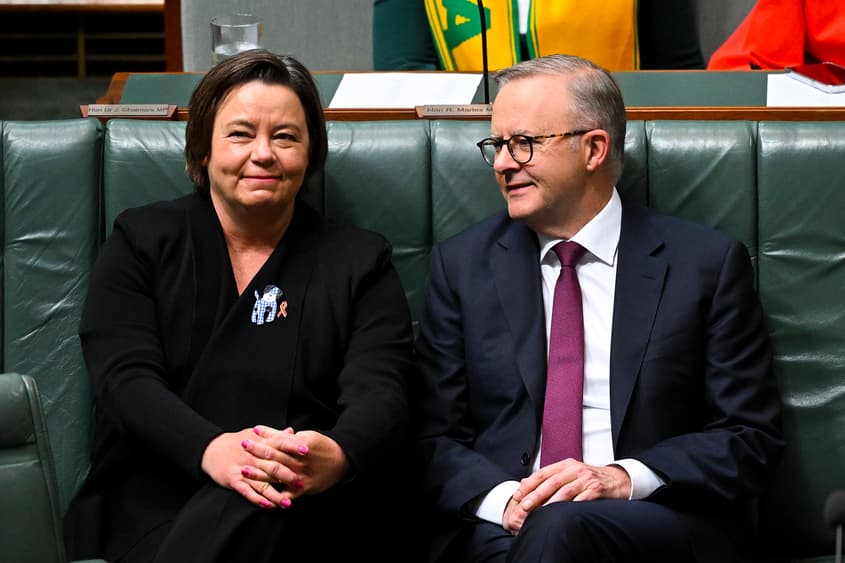
Photo: AAP Image/Lukas Coch


The Albanese Government is being accused of prioritising Japanese gas industry profits over Australian households and climate goals, with a new report lifting the curtain on corporate Japan’s influence over Australia’s liquefied natural gas (LNG) policy.
The analysis, released by climate think tank InfluenceMap, shows Japanese fossil fuel companies – with billions invested in Australia’s LNG industry – have met privately with Australian cabinet ministers and officials at least 24 times since Labor’s 2022 election win.
Over that same period, it estimates their Australian industry associations have issued more than 350 public-facing pro-gas outputs.
“This report shows that while Australian households face record energy bills, Japanese gas companies and their industry associations in Japan and Australia are using their financial clout and political access to influence climate policies in ways that promote the expansion of fossil gas at the expense of Australian consumers, businesses, and the climate,” said Jack Herring, Australia Program Manager at InfluenceMap.
The analysis highlights the scale of Japanese investment in Australia’s LNG industry, with firms INPEX, JERA, Mitsubishi, and Mitsui alone holding a combined US$50 billion ($71b AUD) in equity across 13 export projects.
Independent Member for Kooyong Dr Monique Ryan MP said it explains why the Albanese Government “continues to act as an enabler”.
“The Australian Government’s ongoing support for fossil gas expansion reflects its susceptibility to the relentless lobbying of Japanese gas interests,” she said.
If those 13 projects are fully utilised, the report asserts “they would produce annual CO₂ emissions of approximately 290 million tonnes”.
That’s the equivalent to operating nearly 50 large coal‑fired power stations or releasing emissions similar to that of several southeast Asian countries such as Malaysia, Taiwan, and the Philippines.
Greens Member of the Legislative Council in Western Australia Sophie McNeill described Japan’s influence as “significant” and “insidious”.
“Decades of corporate lobbying have sabotaged climate action and delayed the transition to a sustainable, green future both here in Australia and across Asia,” she said.
Jusen Asuka, Specially Appointed Professor, Professor Emeritus, at Tohoku University, added the operations “make it almost impossible to achieve the Paris Agreement’s 1.5°C target”.
The report found that a “cross-border network… is exerting sustained influence on government policy, prolonging the use of fossil gas across the Asia-Pacific region”.
Of concern, major trading houses, utilities, and gas associations – that stand to benefit from expansion – have “privileged access” to the decision-making process.
Analysis found companies such as Mitsubishi, Tokyo Gas, and Japan Gas Association hold at least 69 positions on key Japanese government climate and energy policy committees.
“We have seen a steady campaign of misinformation from the fossil fuel industry, promoted blindly by the Australian and Japanese governments, claiming that gas will help the region decarbonise,” said Ms McNeill.
Documents accessed by Freedom of Information (FOI) requests also show pro-gas industry narratives “have filtered into policymaker language in both countries”.
Previously unseen briefing notes prepared for Australian Resource Minister Madeleine King’s October 2024 visit to Japan reportedly “echo these arguments directly” and reveal her main objective was “to provide assurances on continued LNG supply”.
Emeritus Professor Asuka said the “greenwashing” narrative was helping to “drown out” criticism of the projects.
“With support from the Japanese government, Japanese fossil fuel companies and trading houses have invested large sums not only in coal but also in the exploration, development, and production of natural gas, generating substantial profits, including through resale to other countries,” Professor Asuka said.
And, as the Australia Institute’s Principal Advisor Mark Ogge points out – it’s free.
“INPEX exports vast amounts of Australian gas to Japan every year, and the Australian Government gives them all that gas for free,” said Mr Ogge.
“They also pay little if any corporate or petroleum tax on billions of dollars’ worth of sales of Australian gas and face virtually no consequences for serious pollution breaches.”
Meanwhile, Australians are facing record-high gas prices – a 50% rise in gas bills nationwide over the last five years.
“In spite of the clear scientific consensus to reduce climate pollution, we’re constantly told we need new gas development because of shortages in Australia’s east coast gas market,” said Dr Ryan.
“The reality is that over 80% of Australia’s gas is directed overseas. We don’t have a gas supply problem; we have a gas export and corporate lobbying problem.
Critics say it’s time the Australian Government put its own people and environment first.
“Our elected representatives should remember their job is to represent the interests of Australians, not give our resources away to ingratiate themselves with foreign gas corporations,” said Mr Ogge.
Mr Herring added, “It is increasingly important that the Australian Government works towards a just, orderly, and equitable transition away from fossil fuels”.
The oil crisis has not only causes petrol prices to soar it has revealed just how little competition there is among the big oil companies. A couple weeks ago the ACCC announced that it would be looking into uncompetitive behaviour by petrol companies in the rural areas.
Advertisement

Combined with the 50 basis points rise in February and March in less than 2 months households are paying the equivalent of a 90 basis point rise in interest rates.
News has come out today that the Government’s submission to the Fair Work Commission for the annual wage review will recommend an “economically sustainable real wage increase” for the National Minimum Wage and the Modern Awards.