The Senate inquiry into taxing gas exports has begun its public hearings in Canberra, with The Australia Institute revealing the Japanese Government collects more revenue from taxing imports of Australian gas than Canberra earns from exporting it.
Giving evidence on the first day, The Australia Institute’s co-CEO Dr Richard Denniss pointed out that Japan raises $8 billion a year, on average, through its Petroleum and Coal tax – introduced in the wake of the 1973 OPEC oil shock.
“Well done to Japan. I have no criticism of the Japanese government whatsoever,” he said.
He told the committee that the tax was designed to help manage fuel insecurity and meet international commitments to maintain at least 90 days’ worth of liquid fuel reserves.
“Japan understood that maintaining those reserves was expensive, so it imposed a tax on imported energy to fund it,” Dr Denniss said.
“The Japanese tax gets more interesting when you realise that it was modified around October 2012, to not just help them with liquid fuel security and energy efficiency … [but] to help them prepare for the costs of climate change,” he said.
The Australia Institute’s analysis showed that while Japan is a country with no gas, oil, or coal reserves of its own, it collected almost $40 billion over the last five years, while the Australian PRRT provided only $7 billion to Australians.
It also highlighted how the Japanese Government is opposed to Australia putting a tax on its gas and coal exports, but has been raking in billions of dollars per year via its own tax on gas and coal imports.
The Senate inquiry is holding three public hearings this week into the taxing of Australia’s gas exports, with climate groups, economists and advocacy organisations lining up to give evidence.
The ACTU’s proposed 25 per cent tax on gas exports has been gaining momentum ahead of the May budget, but has drawn fierce backlash from industry, which claims a levy would deter investment.
“The idea that we’re kind of passive and weak in this situation, to be clear, is pathetic,” said Dr Denniss.
“It is pathetic, and we should be able to stand up to these companies.”
He said the argument is hard to reconcile, given Australia’s gas industry has long prided itself on being a reliable exporter.
“Are they saying we haven’t earned any respect for decades of exporting free gas? Are they telling us that Australians, having given away all of this gas for all of these years, that these countries are now actually threatening us, rather than saying thanks for being the reliable partner the gas industry says we’ve always been?” he asked.
“Apparently, no, no, we’re exposed with no friends in the world, unless we suck up to them and offer some more free gas.”
Dr Denniss said it was time Australia stood its ground and stopped allowing global gas giants, such as British Petroleum, American Chevron, and Japan’s INPEX, to “negotiate gas contracts in the Australian national interest”.
“This is our gas, and we’re the ones being threatened, whether it’s by foreign gas companies or foreign governments,” he said.
“You really want to pick a fight with us after being a reliable exporter for decades? Bring it on.”
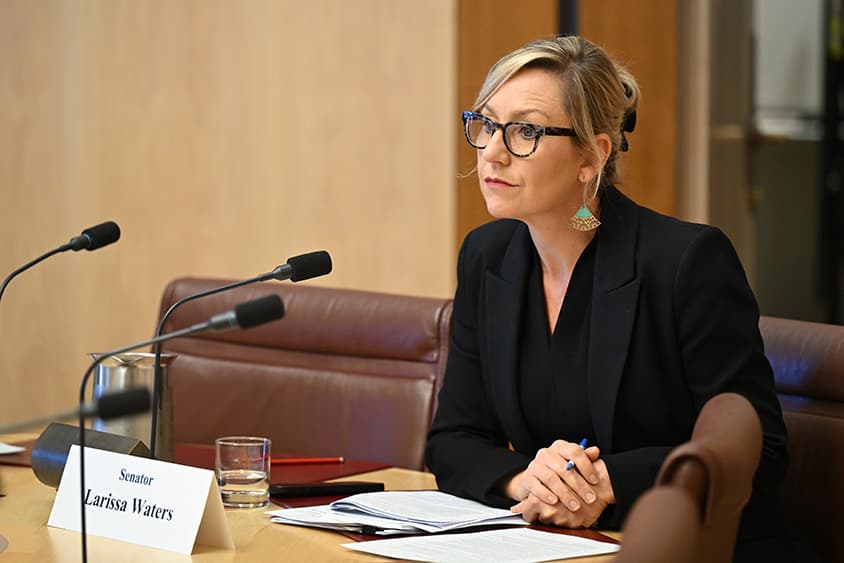
Greens Senator Larissa Waters described the industry’s argument as “laughable”.
Founder of Punter’s Politics, Konrad Benjamin, revealed that he’s hired “the world’s first crowdfunded people’s lobbyist” to pursue a gas tax.
“I have raised close to $200,000 from people,” he said of his broader funding efforts.
“We are so desperate to get paid what we are owed, we are throwing our own money to get a lobbyist. We feel like we have to send in a lobbyist.”
The former economics teacher said the popularity of his grassroots campaign shows “how little faith regular punters have in our politicians at the moment to stand up for us”.
“We have a very monopolistically driven economy where certain industries have exorbitant power.
“I think politicians ignore just how much we’re paying attention to this at their own peril,” said Mr Benjamin.