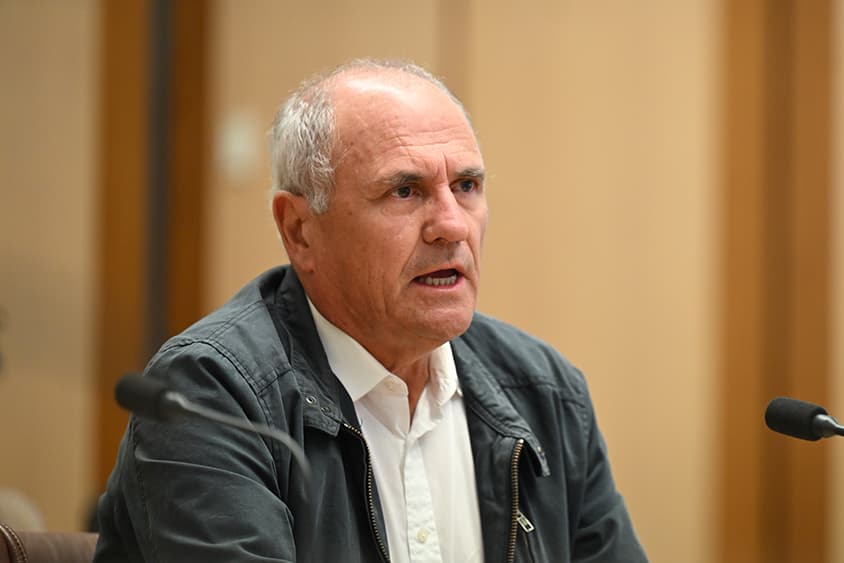
Former Treasury secretary Dr Ken Henry has delivered blunt advice to a Senate inquiry examining the taxation of gas exports.
“Just do it.”
“In the national interest, just do it and stop the crap the Australian public has put up with for decades now in respect of the taxation of Australia’s finite resources.”
Dr Henry urged Canberra to overhaul its tax regime, criticising decades of policy settings that have delivered limited public returns.
“I think that this committee can play a very useful role in putting some steel in the spine and in the legs of those who will have to take this rather important decision in the national interest,” he said.
He said a 25 per cent flat tax on gas exports was “a pretty small taxation burden relative to the price increases that have occurred recently.”
Dr Henry also argued the “socially optimal tax rate” on windfall gains from gas exports should be significantly higher, at a “fairer figure” of 100 per cent.
“There is no reason that I can understand as to why Australians should not receive 100 per cent of the windfall gains,” he said.
“There’s no reason in economics, and there’s no reason, I would suggest, in moral philosophy either.”
Industry and business groups have warned that the tax would deter investment and threaten supply.
In its written submission to the inquiry, the Business Council of Australia (BCA) argued: “if Australia becomes less competitive for any reason, investment goes elsewhere”.
It argued that regulatory changes would undermine investor confidence in Australia and could jeopardise future LNG projects.
“We are competing in a global race for investment that underpins jobs, wages and living standards,” it wrote.
Dr Henry rejected the argument, telling the committee he would “expect the impact on trade relations would be negligible.”
“I mean, honestly, we’re going to design our taxation system on the basis of the possibility that we’re going to upset somebody outside of Australia?
“For heaven’s sake, there’s more than one means of a government dealing with foreign relations.”
The economist also noted that much of Australia’s gas is under long-term contracts, making it unlikely exports would be disrupted.
Dr Henry said Australians are increasingly unconvinced by such arguments.
“I think the Australian public is getting increasingly fed up with hearing those things, particularly because their lived experience is of things getting tougher.
“There are people who are shareholders in multinational gas companies who are making out like bandits. I think the Australian public can see through this stuff.”
The hearing also saw a sharp exchange between Dr Henry and Senator McDonald over investment concerns.
Dr Henry said he supports investment in Australia when it creates jobs and supports small businesses, but questioned why Senator McDonald was so focused on attracting investment into the fossil fuel industry.
“I would like to see the investment in Australia, for capital expenditure (CapEx), the investment in small businesses, the employment of Australians who pay their own taxes,” she said.
“Sure, but I mean, you could say that about any industry, right?” said Dr Henry.
“Yes, but this is our second biggest industry,” shot back Senator MacDonald.
“It employs less than 2 per cent of the Australian labour force,” pointed out Dr Henry. “And, as I’ve explained, it doesn’t pay nearly enough tax.”
Senator McDonald said she feared no sensitivity analysis had been done on the potential impact on investment in Australia.
“There are other jurisdictions who have been down this road of introducing a greater taxation then have missed out on the investment, which they’ve then had to unwind,” she said.
“OK, but I don’t understand why the level of investment in this industry, per se, is of policy significance, or why it should be a policy goal. I don’t get that at all,” replied Dr Henry.
Treasury last reviewed the PRRT in 2023, with a deductions cap and other changes implemented the following year.
Senator McDonald asked for his view on the government revisiting the PRRT within such a short timeframe.
“Honestly, I’d tear it up and start again,” he said bluntly.
Dr Henry said a loss of confidence in the political system presents a “big risk” and is creating more urgency around the issue.
“I think we have a moment. Of course, it’s being opportunistic, but the opportunity is enormous, and we should be opportunistic. We should take this moment,” he said.
“I would counsel you to take this opportunity to make an emphatic statement to the people of Australia, that this democracy is functional.”
The Senate inquiry will hold its last public hearing in Perth on Thursday.