The State Library of Victoria (SLV) conceded it had “created unintended concerns” with its proposal to cut 39 jobs and reduce services to focus on more “digital experiences”.
Tue 30 Dec 2025 06.00
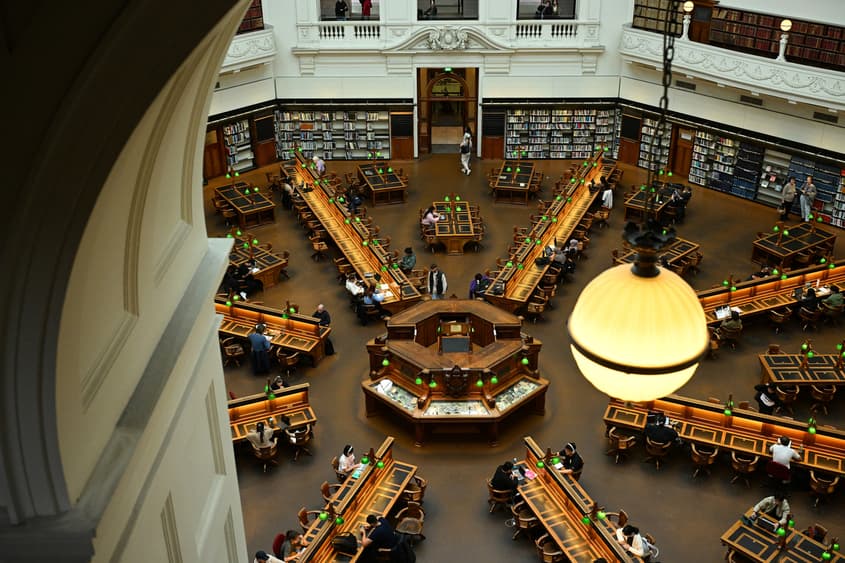
Image: AAP Image/James Ross


Australia’s oldest public library has axed its controversial restructure plan following public outcry from hundreds of the country’s most prominent writers, researchers and artists.
The State Library of Victoria (SLV) conceded it had “created unintended concerns” with its proposal to cut 39 jobs and reduce services to focus on more “digital experiences”.
Musician Nick Cave was among 220 distinguished names to sign an open letter calling for the board to explain the restructure, which would have halved the number of reference librarians, from 25 to 10.
In a statement, board president Christine Christian said the library had “decided to withdraw” the proposal after “careful consideration of feedback”.
“Our focus will remain on strengthening services, modernising operations and ensuring the library continues to thrive as a leading home for history, arts, culture and knowledge for the next generation,” she said.
Acclaimed writer Helen Garner was one to voice her objection, saying the State Library of Victoria had been turned into “party central” and the proposed restructure would “bring disgrace on the name of our city”.
SLV denies the proposal was a “cost-cutting exercise”.
Australia has a long-standing record of underfunding the arts with the National Library of Australia and other public institutions chronically under-resourced.
“If we brought it (government funding) into line with the average, we’d have an extra $5 billion a year to spend on the arts in Australia,” says Australia Institute Research Manager Morgan Harrington.
The average developed nation spends 0.5% of GDP on arts funding.
Australia’s arts funding ranks 24th out of the 30 countries ranked by the OECD, with recent funding hovering around $8 billion a year. Only five countries ranked lower than Australia in terms of portion of government spending on cultural services.
Worse still, the OECD notes that it is the state and local governments that provide the majority of public support for cultural services in Australia. But state governments are largely reliant on Commonwealth Government revenue to fund these initiatives.
Research by the Australia Institute has found that if GST revenue had grown at the same rate as Australia’s overall economy, then the states would have received an additional $22 billion in 2023-24, around $76 million of which would have been spend on arts and culture in New South Wales alone.
However, the Australia Institute’s Co-CEO Richard Denniss said there’s no need for public institutions to go wanting.
“Australia is one of the richest countries in the world and while we can’t afford to do everything we want; we can afford to do anything we want,” he said.
“If we were to collect the average amount of tax collected by OECD countries then this year, we would have to collect more than an extra $100 billion. Per year.
“The problem is we under collect taxes on resources, pollution and wealth.”
At a national level, the National Library of Australia received $4.5 million in Treasurer Jim Chalmers’ Mid-Year Economic and Fiscal Outlook (MYEFO) for 2025/26.
The money will go towards completing the replacement of its heritage windows, doors, and facade.
In contrast, earlier in December the State Library Victoria launched a campaign to raise $45 million through philanthropy to refurbish its iconic dome.
“This dome is our crown jewel: an architectural masterpiece, a cultural icon and a symbol of knowledge and societal advancement,” Ms Christian told The Australian.
“This library is the third busiest in the world already; we will have three million visitors this year by the end of December.”
It plans to start the works in 2027 and finish by 2030.
The oil crisis has not only caused petrol prices to soar, it has revealed just how little competition there is among the big oil companies. A couple weeks ago the ACCC announced that it would be looking into uncompetitive behaviour by petrol companies in the rural areas.
Australia’s shrinking local media landscape has fuelled growth in independent news outlets, with publishers gathering in rural South Australia to discuss the challenges facing community journalism. The Local and Independent News Association (LINA) summit in Murray Bridge comes amid growing concerns about the sustainability of regional news.

Combined with the 50 basis points rise in February and March in less than 2 months households are paying the equivalent of a 90 basis point rise in interest rates.