

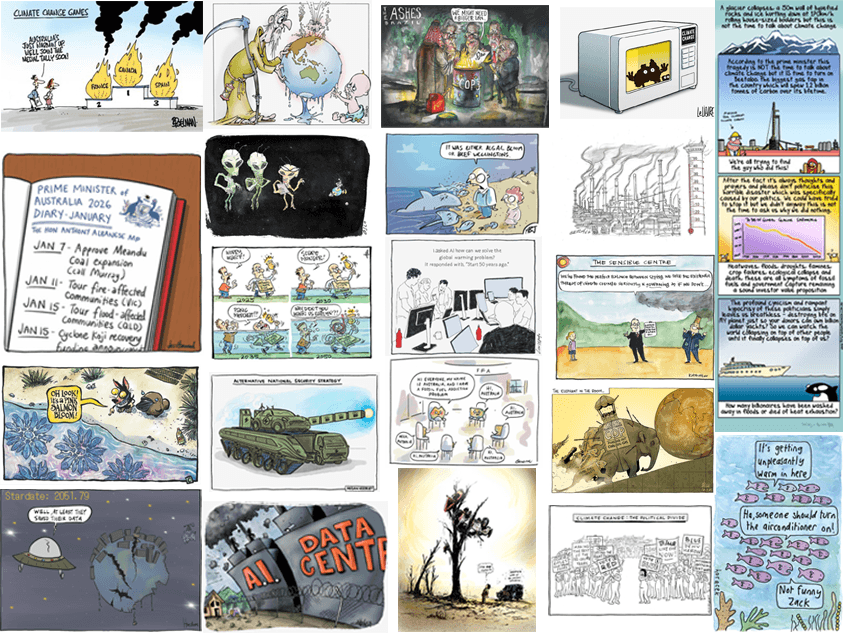
Kudelka Climate Cartoon Award Longlist
View the cartoons longlisted for the Kudelka Climate Cartoon Award
Wed 26 Nov 2025 12.02 AEDT
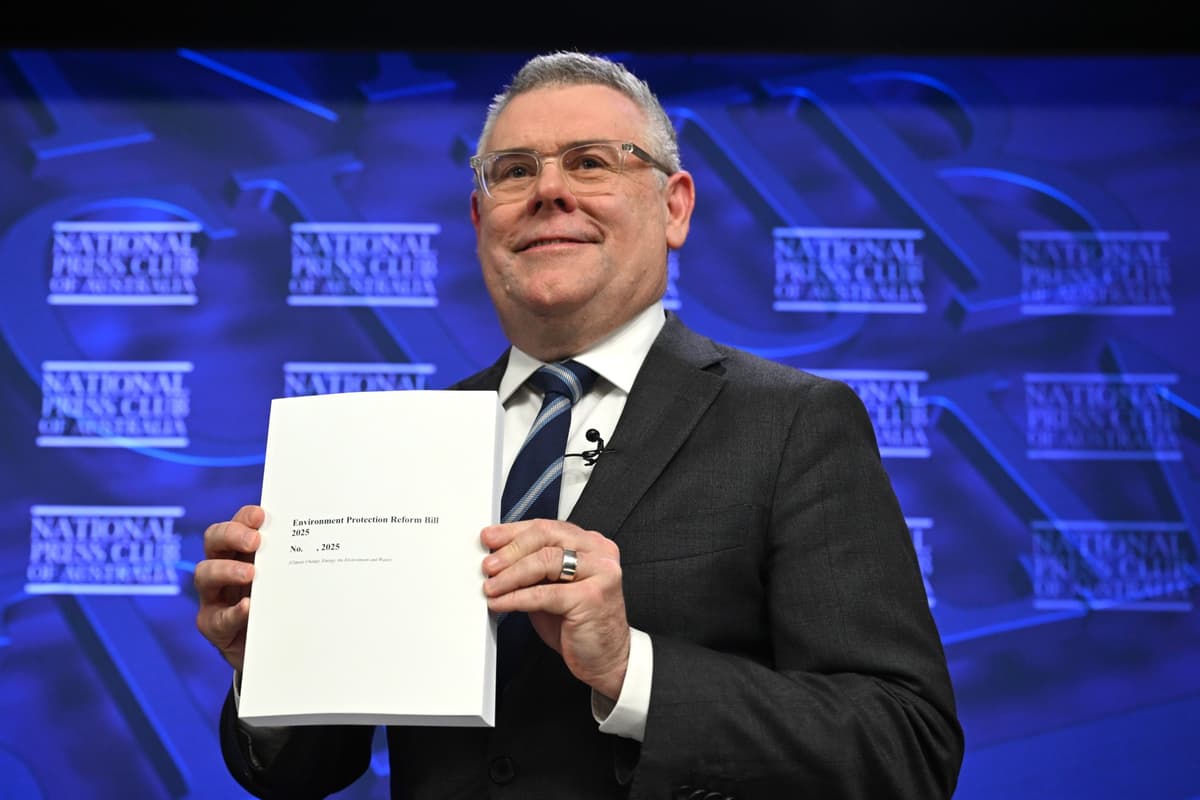
Photo: AAP Image/Lukas Coch
When a developer wants to clear land to build a warehouse, or a mining company wants to build a coal mine, Australian law typically requires that they ‘offset’ the damage they cause to nature as a condition of the planning approval. The concept of an offset relies on the idea that an approved harm to the environment and an environmental benefit secured elsewhere are interchangeable. If you destroy koala habitat in one place, then you must secure safe koala habitat elsewhere.
This is called ‘like-for-like’, and it is essential to the idea of what an ‘offset’ is and does. Of course, as carbon offsetting has taught us, rarely does this logic translate to good outcomes for the environment.
In practice, there are deep problems with the integrity of the nature ‘credits’ that are used to offset damage done by developers. This includes time lags between when the damage occurs and the offset is secured, which increases the risk of exacerbated or unanticipated harm to the impacted species; failure to protect sites in perpetuity even though the impact is permanent, resulting in a net loss; and a failure to effectively and transparently manage and monitor sites. These problems mean national biodiversity offset arrangements under Australia’s flagship federal environment law, the Environment Protection and Biodiversity Conservation Act 1999 (EPBC Act), are leading to worse overall environmental outcomes. As noted by former Environment Minister Tanya Plibersek in the early days of the first Albanese Government, Australia is a world leader in species extinction, and holds the dubious record of sending more mammal species extinct than any other continent.
Departmental audits have found that offsetting requirements under the EPBC Act are simply not being complied with, that projects are going ahead without first securing the necessary offsets, or that sites supposedly secured for habitat protection are in a worse condition than they were before. The damage is being done, but the commensurate protection isn’t being secured.
All of this contributes to the general outlook for Australia’s unique and precious environment: poor, deteriorating, and under increasing threat. As much was recognised by Professor Graeme Samuel AC in his review of the EPBC Act, provided to the Federal Government five years ago.
So, what is the Albanese Government doing about this problem? Our new paper shows that they’re promising to make it worse.
The Environment Protection Reform Bill 2025, introduced to Parliament in late October, will, among other things, amend the EPBC Act to expand and further weaken the national biodiversity offsetting arrangements that are already failing so badly.
Most troublingly, under the changes, developers won’t even need to pretend to secure a ‘like-for-like’ offset for the nature they destroy. Instead, the Environment Minister can simply decide that the developer need merely pay a ‘Restoration Contribution’ into a centralised fund as a condition of approving their project. The ‘Restoration Contribution Holder’, a new statutory appointment, will spend the money with the purpose of compensating for the specific damage and achieving a ‘net gain’ in nature protection—but with plenty of leeway should that prove to be not ‘feasible’.
Essentially, this means developers may simply be able to ‘pay to destroy.’
Intuitively, this seems far removed from the like-for-like logic underpinning the concept of offsetting. It is also a tacit admission of what many in biodiversity conservation have long known: biodiversity offset ‘markets’ are perennially short of supply. There will always be a pipeline of proposed developments that will have a harmful impact on nature, but for which the corresponding environmental protections aren’t available, or aren’t even possible.
Advertisement

What will the new arrangement look like? A similar scheme, operating in NSW, gives us a glimpse of what we could expect.
Under the NSW Biodiversity Conservation Act 2016 (BC Act), developers that incur offset obligations when they obtain approval to destroy some nature can satisfy those obligations by making payments into a fund managed by the Biodiversity Conservation Trust. The Trust must then acquit the developer’s offset obligation. But the developer can proceed to build their project before the Trust secures offsets for the ensuing damage to nature, and the offsets the Trust eventually secures need not be ‘like-for-like’.
Unsurprisingly, developers have been paying into the fund much faster than the Trust is able to find required offsets or credits: of the 80,000 offset obligations taken on by the Trust since the scheme began, only 23% have been fully acquitted. And the proportion of these that are ‘like-for-like’ has declined in recent years. Moreover, a chronic undersupply of biodiversity credits means that environmental losses may simply not be offset at all.
Overall, it’s been widely acknowledged that the NSW scheme has failed to prevent biodiversity loss across the state. Requiring recent significant amendment, and with the NSW Government taking steps to impose guardrails and limit use of the fund, the BC Act seems a poor model for changes to an already-failing federal scheme.
Hypothetically, a like-for-like biodiversity offset should look like ‘net zero’ harm to nature – the harm is cancelled out by the benefit. In practice, as is the case in the carbon market, this simply isn’t working, and nature is paying the price. Weakening offset rules even further by allowing payments to destroy will make the problem worse.
Everyone agrees the current laws are failing, but that doesn’t mean any change is an improvement. When it comes to offsets, it’s clear things are going to get worse not better.
Read the full background paper ‘Payments to destroy and lessons not learned: Report on the Environment Protection Reform Bill 2025’ here.
Frances Medlock is a policy and law reform lawyer currently undertaking a Masters in Climate Change Policy & Politics in the Department of Political Science and School of Public Policy, University College London.
Dr Fergus Green is an Associate Professor in the Department of Political Science and School of Public Policy, University College London.
Advertisement
View the cartoons longlisted for the Kudelka Climate Cartoon Award
The annual Stanley Awards, Australia’s premier awards for cartoonists, has announced its long list for best climate cartoon honours. Born out of a boycott of fossil fuel sponsorship, from this year the prize is named in honour of Jon Kudelka, whose principled stand in 2023 inspired fellow cartoonists to withdraw from the Walkley Awards.


