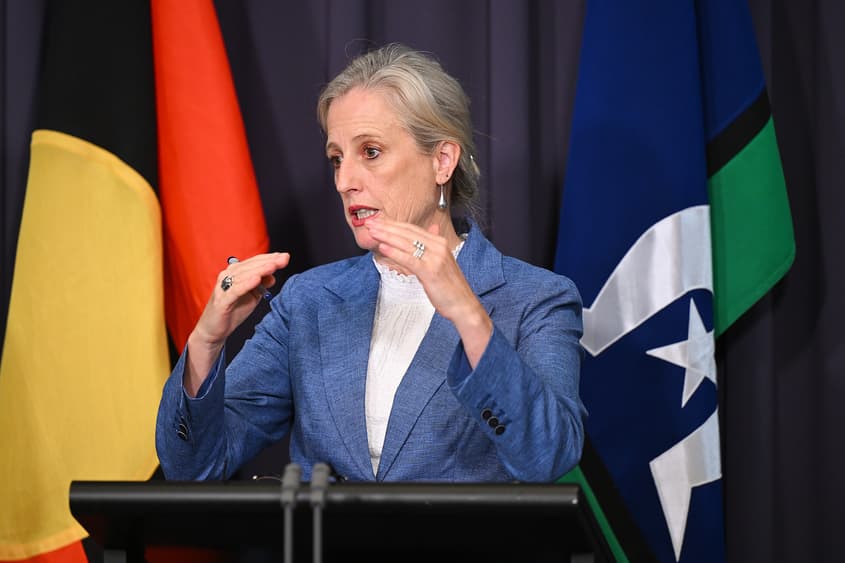
The greatest trick neoliberalism ever pulled was convincing people government intervention shouldn’t exist. And yet, governments know we will accept it without question when it comes to taking from the most vulnerable.

Thu 4 Dec 2025 06.00

Photo: AAP Image/Lukas Coch


The greatest trick neoliberalism ever pulled was convincing people government intervention shouldn’t exist. And yet, governments know we will accept it without question when it comes to taking from the most vulnerable.
How else to explain the ease with which the Labor government is not just cutting NDIS entitlements (cleverly marketed as “controls on future growth”) and now, the revelations from The Guardian’s Kate Lyons that not only will AI determine need and plans, but there will be almost no way for a human to intervene and make adjustments when, invariably, human needs and nuances aren’t accounted for by software.
This will no doubt be celebrated by those who think “government can’t pay for everything” and it is “common sense” to put spending caps on care. Those same people never really think that spending caps ought apply to subsidies that just help people make money.
“NDIS costs soar as children flock to scheme” is a headline people accept. But we wouldn’t see those same papers of note report on “capital gains tax discount costs soar as investors flock to housing” – because that’s just the cost of doing business.
Take the event that fund manager Geoff Wilson recently held to celebrate knocking off the very modest superannuation reforms Jim Chalmers had floated.
A small reform, affecting only the richest. But suddenly it was news everywhere. Independent MPs began a campaign on behalf of their rich constituents (which is, of course, their right) while aligned media stepped up their campaigns. Suddenly, it was not just the “unfair” changes to an established tax break that mattered, but the potential impact on more modest earners decades into the future that dictated the urgency.
The poor “farmers” who had placed their properties into superannuation to avoid tax would now have to *gasp* pay a little more tax on earnings above $3 million! This was seen as such an outrage that the federal government folded to avoid upsetting a small, but very noisy-when-aggravated cohort (whinge and win in action!)
But then cutting the future funding of the NDIS, and removing people who have been given access to early interventions and therapies for neurodivergent children – which has empirical benefits, not just to the children, but communities, cutting down on costs in later life – is something which just “has” to be done.
The government leaks out the “costs” – $1.1 billion in delayed savings to the budget! – to build social acceptance of a measure that is going to place untold burden on some of our most vulnerable people and families, the already underresourced public health and education systems and future generations, let alone the cost to those who will fall through the cracks.
This, we are told, and accept, is necessary to pay for things like defence – an area that takes billions and billions, despite its numerous failures and non-deliverables. So, to pay for a $360 billion (and counting) deal that does not guarantee Australia submarines, technology or even a reliable ally, governments will cut what is left of the social contract, and call that “common sense”.
Having privatised the care industry, including disability care, to save money, the government is now cutting the subsidies that made that privatised care affordable, and convincing people it’s responsible budgeting. But to reform any other sector of our economy – such as landlord subsidies like the capital gains tax discount and negative gearing, or putting a flat tax on gas exports, or cutting the $14.9 billion in fossil fuel subsidies – all of which could pay for the things we are told governments can’t be expected to pay for – would be “unfair”.
We accept government intervention in the market all the time, but we get upset only when that intervention is for the benefit of the people government is supposed to serve. The same people who made a fortune in blowing up the costs of the NDIS by inflating prices – or in early education care, or any other public service that receives subsidies so people who need the services can actually access them – are usually the ones arguing the loudest against superannuation reforms or anything else that puts a small curtail on their wealth building.
There has been a lot of commentary about the growth of One Nation’s vote and that of far-right and fascist groups and yet fascism is always in fashion when the economy stops serving the worker.
But we never seem to pull up or change direction. Our government will continue to tell us this is common sense, until something breaks.
The problem is – it already has.
Governments need to handle social contracts with care. That they haven’t speaks volumes about how we ended up here. That so many people are convinced that it’s normal to expect people to suffer while industry and the rich get a free ride makes the job harder, but not impossible.
Eventually, reality comes to slap everyone in the face. Even governments with historically large majorities, a wilted opposition and lingering hope for better.
Amy Remeikis is a contributing editor for The New Daily and chief political analyst for The Australia Institute.
This piece was originally published on The New Daily.
Today, the Albanese Government pulled its “friendless” Freedom of Information Amendment Bill.
The claim that half of voters rely on the Government for 'most of their income' that has been repeated across the media and by politicians, simply isn't true.
The Workplace Gender Equality Agency (WGEA) has released their gender pay gap data today and while we took a tiny step closer to pay equity, men are still almost twice as likely to be in the highest earning quartile – earning more than $220,000.