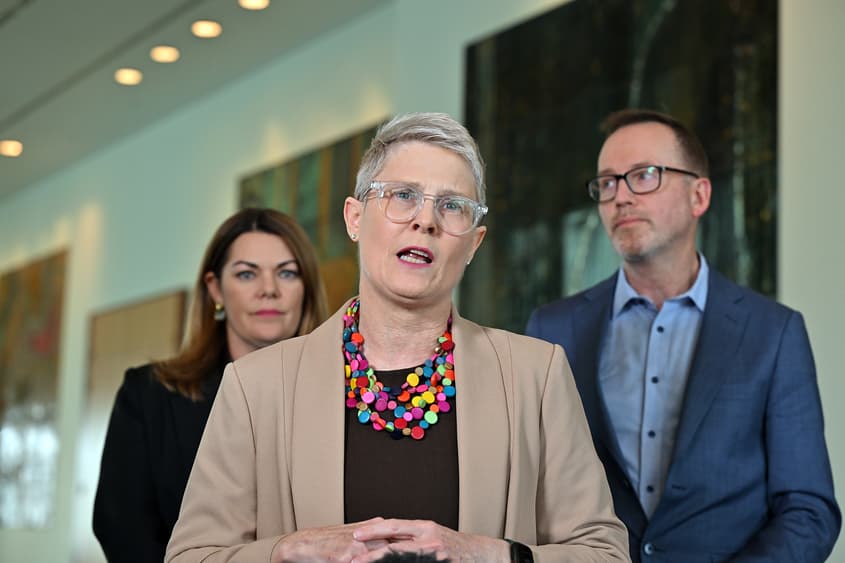
Is protecting freedom of speech a left wing issue or a right wing issue? And if you aren’t sure, how on earth can the press gallery or anyone else talk about what a ‘centre right’ political party's stance on such a point of principle should be.

Thu 5 Feb 2026 01.00
Photo: AAP Image/Mick Tsikas


Is protecting freedom of speech a left wing issue or a right wing issue? And if you aren’t sure, how on earth can the press gallery or anyone else talk about what a ‘centre right’ political party’s stance on such a point of principle should be.
While using the traditional ‘left-right’ lens makes some sense for some policy issues, for most of the big issues paralysing our current federal parliament it is the left-right frame that is causing much of the confusion and paralysis.
30 years ago, few journalists, political scientists or MPs would have asked whether a belief in science was a left or right-wing issue, but to the extent there was any concern about the politicisation of science it was more likely to come from sections of ‘the left’ who were concerned that pharmaceutical companies and the producers of genetically modified crops were buying scientific support for their profits.
Fast forward to the ‘climate wars’ and the ‘vaccination wars’ and now it is often the ‘right-wing’ that are openly mistrusting of science — except, of course, when it comes to nuclear energy.
Many of the ‘right-wing’ voices who don’t trust the science of climate change or even the safety record of wind turbines, are often the loudest voices urging Australians to trust the science and the safety of nuclear power. So is support for science a left or right-wing issue? And which scientists is it the ‘centre right’ to trust?
To be clear, there are no smart answers to some dumb questions.
Things aren’t any clearer when it comes to trust in the Government. Most Australian commentators insist on pretending that support for government spending is ‘left-wing’ while support for smaller government is ‘right-wing’. But while such shorthand makes for tidy opinion pieces, in reality ‘the right’ love nothing more than a nice big publicly funded boondoggle.
While it may be easy to forget Scott ‘Small Government’ Morrison’s insistence of using colour coded spreadsheets to help spray public spending on car parks and sporting ground upgrades around marginal seats, Australia’s budget papers will never forget his enthusiasm for spending enormous amounts of public money on AUKUS or the inland rail line.
Somehow the Australian political class has convinced itself that defence spending ‘doesn’t count’ when it comes to analysis of ideology and political identity. It’s as if defence involves the expenditure of some form of magical money that doesn’t cause deficits, increase debt or cause inflation. As a result of this wilful blindness to the budgetary consequences of spending billions on defence equipment when Peter Dutton and Sussan Ley demand a big increase in spending on defence, no one needs to ask them why they are shifting to ‘the left’ on public finance or fiscal policy.
While it’s apparently obvious that the National Party are ‘to the right’ of their former Coalition colleagues in the Liberal Party, in reality nobody loves to use public money to solve political problems more than the Nats, who are often referred to by the ‘not-very-right-wing’ descriptor of ‘agrarian socialists’.
Whether it is the $30 billion (and growing) cost of Barnaby’s inland rail line, the $7 Billion Northern Australian Infrastructure Facility (NAIF) or the $10 billion cyclone reinsurance pool for Northern Australia, it is rare to hear anyone criticise the Nationals for being ‘left-wing’ in their love of public spending.
And then things get really weird when it comes to our national resources.
Both the Labor and Liberal Parties have long defended the uniquely Australian approach of giving enormous amounts of our gas away, for free, to multinational gas companies. Indeed, we give so much free gas to the Japanese owned INPEX that in turn, they make a fortune on selling our free gas to the rest of Asia. Who says Australia isn’t generous to foreigners.
Built while successive Labor and Liberal Governments have defended the generosity of our gas give away and the abject failure of our PRRT to collect any significant revenue (HECS provides more to the Federal Budget) both the Greens and One Nation have demanded a better deal for Australians.
And now that the ACTU is calling for a 25% tax on gas exports, and the Nationals are free to make up their own minds, who knows what changes we might see.
But is making foreign gas companies pay for our gas a left-wing issue or a right-wing issue? And if the Greens, One Nation and climate independents all agree Australians should get a better deal, is that an ‘irony’, an ‘unusual alliance’ or just common sense that exposes the absurdity of the Labor and Liberal positions.
The short hand of left and right obviously makes some sense for some long standing issues like industrial relations and progressive income tax systems. But the idea that freedom of speech, belief in science or support for public spending can be meaningfully described as ‘left-wing’ or ‘right-wing’ is just absurd.
Likewise, the idea that the Liberal Party, or voters, can decide where all other parties are on some form of ‘left-right spectrum’ and then decide where to sit on the policy issues before them is so simplistic as to be silly.
The collapse of the longstanding coalition agreement between the Liberal and National parties is obviously a boon for Labor and One Nation, but what’s far less clear is what it means for policy and political debate in the years ahead.
If One Nation propose a ‘populist’ gas export tax and a big increase in spending on infrastructure in regional areas would that mean Labor was shifting to the right or the left?
Labels might make political commentary easy but they make parliamentary politics much harder than it needs to be. Of all the things to come out of the collapse of the Coalition, parliamentarians feeling free to vote on the substance of legislation, not the symbolism of who else is voting for it, could be one of the biggest benefits of all.
Richard Denniss is the co-chief executive of the Australia Institute. Richard Denniss’ latest Vantage Point essay, Dead Centre: How political pragmatism is killing us, is out now.
Advertisement
With South Australia in its final week of campaigning ahead of the state election, you may have noticed while there’s been a few scandals around mistaken identity of hospital patients and controversial candidates’ opinions, accusations of politicians lying are muted.
Behind the closed doors of a consultation room, or concealed by impenetrable medical jargon, wrongdoing in the healthcare sector impacts the lives of every Australian.
An investigation into the illegal Robodebt scheme has found two senior public officials engaged in corrupt conduct, but the Greens say the political and bureaucratic “architects” have “walked away scot-free”.