Caucus solidarity – the rule that once Labor’s political arm has made a decision, all caucus members are bound to it regardless of personal views – has been treated as both a threat and novelty by party outsiders. It has always been thus.

Tue 10 Feb 2026 01.00
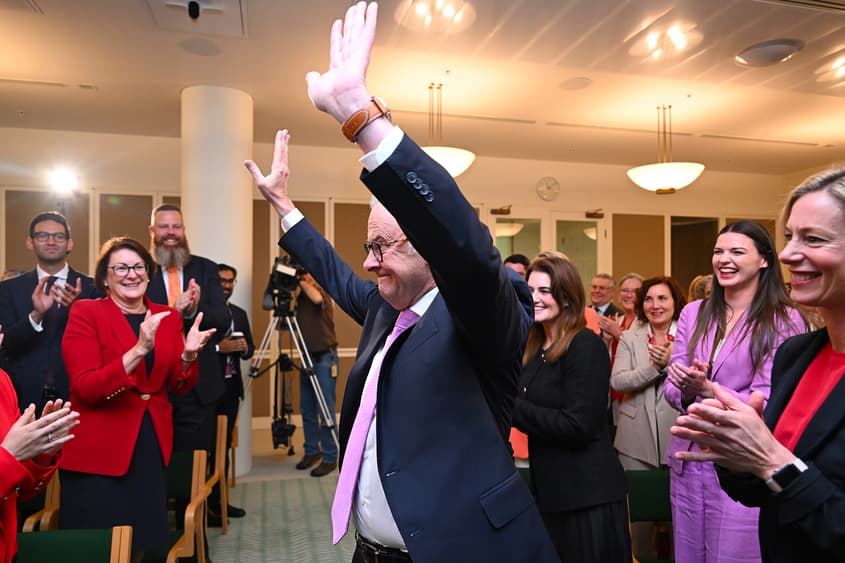
Photo: AAP Image/Lukas Coch


The first Labor national government anywhere in the world was elected in Australia in April 1904. It was 13 years from the formation of the Australian Labor Party to when then-leader Chris Watson was invited to form government.
His four months as prime minister was spent at the helm of the first democratic socialist government in the world. But his impact on modern Labor looms large, having helped establish the solidarity pledge for Labor caucus members, which ultimately forced his own exit during the 1916 conscription split.
Since then, caucus solidarity – the rule that once Labor’s political arm has made a decision, all caucus members are bound to it regardless of personal views – has been treated as both a threat and novelty by party outsiders. It has always been thus.
Another future Labor “rat” Hector Lamond, wrote of the caucus system in 1914:
“Most electoral contests are determined by that large body of more or less intelligent voters who do not attach themselves permanently to any political party. For the most part they are patriotic citizens, striving earnestly to approve what is best in the programs of rival candidates for their electoral favours.
“A large body of these electors has naturally been attracted by the progressive and national character of the Labor platform, and in increasing numbers have given the Labor Party a qualified support.
“But in the minds of many such there is misgiving that the caucus system of that party may become a ready instrument of tyranny in the hands of able and ambitious men.”
Two years later, he became a Billy Hughes’ Nationalist, one of the early branches of the modern Liberal Party’s family tree.
One of the key differences between Labor and the modern Liberals is solidarity. For Labor, it remains unity or expulsion. For the Liberals, every MP is their own (theoretically – it’s incredible how often the individual conscience of Liberal MPs marries up with the hive). Both parties hold their special unicorn rule as the superior.
But in 2026 we have a situation where solidarity has become almost sacrosanct within the Labor Party, creating what appears to be the most cowed caucus in modern ALP history, despite its historic size, and a Liberal Party begging for the adherence to at least the bare minimum of solidarity around leadership decisions.
(It’s always been a furphy that the Liberals and Nationals were able to independently make up their minds on policies on the backbench. Coalition MPs have faced losing preselection or being frozen out for exercising what is supposed to be the key difference in the major parties’ make-up.)
But as Australian politics has become more corporate, so too has Labor. And, despite having a historically large caucus – and a majority left-leaning one at that – this caucus could also be considered one of the quietest.
As Lamond wrote in 1914 (before he was kicked out of caucus for breaking solidarity with the rest of the conscription supporters):
“The caucus system is not an end, but a means to an end. The end is to secure to the people themselves the fullest measure of control over their own political destinies.”
What then, is the destiny of these 94 MPs who represent Labor’s biggest majority in the parliament, but seem unwilling to use their power to even question the party’s direction, let alone speak up against it?
How is it that it is left to a Muslim MP to stand and say in the Federation Chamber that an entire faith should not be repeatedly made to answer for the abhorrent actions of unhinged terrorists, as Ed Husic did last week, in the absence of a public pushback from his own colleagues?
How is it that only Husic, and a handful of state Labor MPs and members, have the gumption to publicly demand their party uphold its own platform and international law and stand against this week’s visit by Israeli president Isaac Herzog? How is it that so few are willing to step across the party leadership’s “red line” on criticising Herzog (as it was described by many Labor MPs), even though it is what their own members and voters want?
How is it that Labor’s backbench, among the most powerful institutions in this country in terms of effecting change, lacks so much bravery in speaking up? And if it doesn’t, then it must agree with the direction of the party on every policy, issue and social flashpoint.
You could feel the discomfort from independent MPs Andrew Wilkie, Sophie Scamps and Zali Steggall as they spoke last week of their reasons for disagreeing with the decision to host Herzog, and how carefully they chose their words when explaining the discomfort with inviting the head of a state credibly accused of genocide.
It was not a comfortable press conference for any of the three, which is what made it all the more notable. They stood up, they said, because they said they believed in social cohesion, international law and doing what was right, even when it was hard.
And because they had heard from many in their communities who expected them to.
The Labor caucus represents more Australians than any other group in parliament. They are hearing about all sorts of expectations for government action – on climate, inequality, housing. They tell us about it every week in parliament as they deliver speeches on policies that will do nothing to fundamentally address any of those issues.
“Disunity is death” is a phrase often used in Labor circles, but it’s rarely discussed how government unity at all costs, on all things, fragments society.
The Coalition is not an effective opposition. There are no tests to the government to be found there, at least not when it comes to anything of substance.
But there are 94 MPs who have the power to make the government answerable for how it’s handling its own power, and “become a ready instrument” of the people they represent, rather than the party they belong to.
Amy Remeikis is a contributing editor for The New Daily and chief political analyst for The Australia Institute.
This piece was originally published on The New Daily.
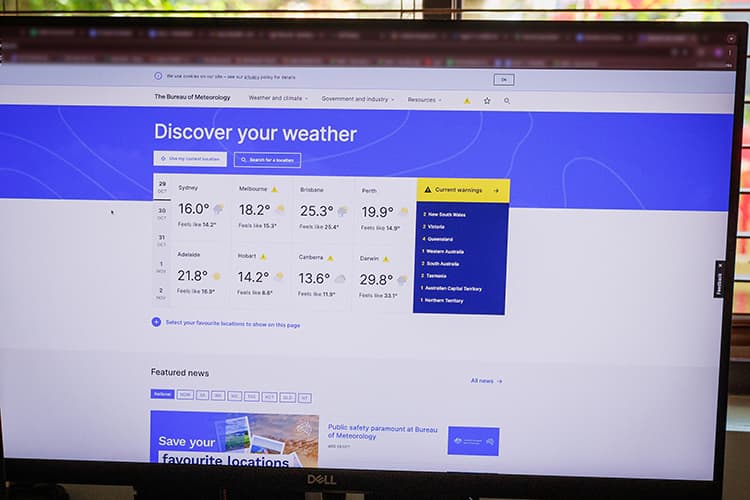
The consulting firm behind the Bureau of Meteorology’s (BoM) heavily criticised website has been awarded another multi-million-dollar government contract to build a new climate platform.

The easiest way to understand the structural shift taking place in Australian politics is to understand that you can now win a landslide majority of seats in parliament even when your primary vote declines.
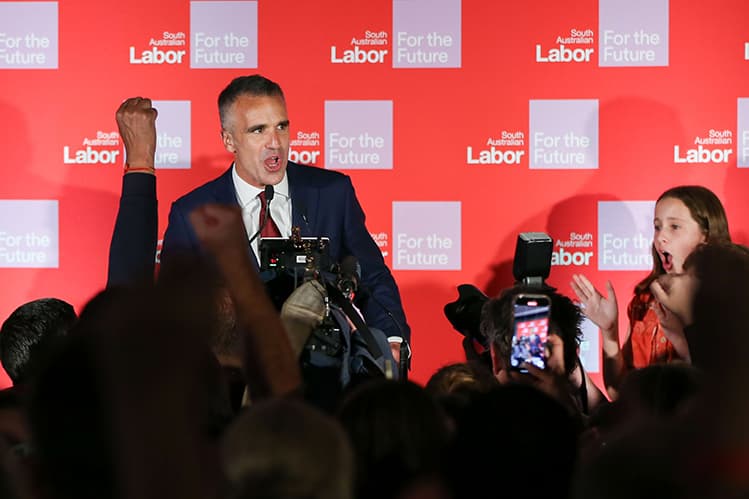
On Saturday, South Australians voted decisively to re-elect the first-term Malinauskas Labor Government. While we don’t know exactly how the 47 lower house seats will fall, Labor will have a super-majority having won about 35 seats.