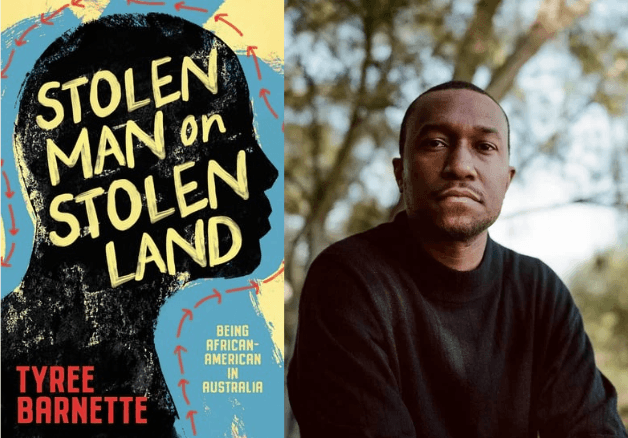
Stolen man on stolen land: being African-American in Australia
An excerpt from Stolen Man on Stolen Land: Being African-American in Australia by Tyree Barnette (Simon & Schuster), out now via all good bookstores and online.
Sat 21 Feb 2026 01.00


Nia stopped at a series of tables with baby clothes, blankets and wraps at the end of a row of vendors.
‘Hey loves, after anything in particular?’ the stallholder, who had a piercing near her cheekbone, asked from behind a table.
‘I could buy everything here,’ Nia gushed. ‘All of these clothes are adorable!’
‘And she absolutely would!’ I joked.
A second woman behind the stall laughed. She was the taller of the two, standing a little over six feet. They confirmed they were sisters when I asked. Both had the same round faces, copper-coloured skin and curly dark hair.
‘Everything here is sewn by our family.’
The business was called Wrapped. They sold hand-made infant clothing and accessories along with maternity wear especially for Indigenous women. Upon hearing our accents, the conversation transitioned into the usual chat of how we got to Australia, how long we’d been here, and what we thought of it. The taller woman excitedly recalled a trip to the USA they’d made last year.
‘And we spent some time in Bulbancha, or what you’d call New Orleans—’
‘Oooh! We loooove New Orleans. But what’d you just call it?’ an excited Nia interrupted.
‘Bulbancha – the Indigenous name for New Orleans. Means “place of many tongues”.’
She kept talking about what she learned of the city’s history and converging cultures. But I remained stunned that it never occurred to me that anywhere in the USA had another name and other stories before colonialisation. I could name Christopher Columbus’ three ships that he sailed to the New World, but I knew nothing about the people who were already there. Surely, they had their own religion, social system and customs – an entire existence before Columbus.
These sisters, foreigners to my home country, had more insight about First Nations Americans than I did. A shared dispossession of land with Native Americans made these Indigenous women more conscious of the world they encountered. Meanwhile, my ancestors were stolen, leaving me untethered to both countries that had a hand in making me, and miseducated about how those countries had formed.
The sisters continued with naming the original inhabitants of the lands within all the cities that they visited.
‘The Tequesta Native American tribe inhabited present-day Miami …’
‘The Lenape people lived in what’s now New York City.’
‘Probably not something you learned about in school, hey?’
An education on Native American history was not something I expected to encounter while looking for baby clothing. Eventually, the conversation returned to the clothing they had for sale.
‘Wrapped’s mission is to help our Indigenous mums wear clothing that brings them pride for their culture. We’ve got pieces for the babies too, ‘cause we want our children growing up knowing and loving who they are.’
Nia nonchalantly wiped a tear from her eye, but another tumbled out. Then she laughed and cried with embarrassment.
‘You’re not our first tears today, love. We work in an emotional trade.’ The taller sister’s round face was full of reassurance.
‘Sorry!’ Nia responded between sobs and laughter. ‘I’m pregnant. All these hormones! Dunno if you can tell through these clothes. I don’t broadcast it or anything … but I am excited!’
‘We know, love. It’s in your walk,’ the shorter sister confirmed with a grin.
‘Well … hearing you talk about kids having pride, knowledge on where they come from really struck me. It’s been hard to find community out here with Black people … Black Americans, I mean.’
‘People come and go all the time. Doesn’t seem to be enough of us that stay out here to raise a family,’ I chimed in.
Since finding out she was pregnant, Nia had tried a few mothers’ groups around Ryde for support. While there were African Australian mothers’ groups, they often met in Western Sydney, which was too far for Nia to comfortably travel on public transit. And in the online discussion groups that these mothers had, Nia didn’t share their same concerns. She was worried about keeping our son’s connection to North Carolina and our culture there, whereas many of the African Australian mothers had family in Sydney to provide those direct links.
Nia had nothing in common with the North Shore mums she met at our birthing classes, either. She found their conversations and insulated lifestyles bizarre. One woman told her that she’d grown up in Sydney but had never been to Cronulla, a beach we both loved, because it was full of dangerous Lebanese people.
‘They attacked people, ya know … those angry Lebs,’ Nia recalled one woman’s claims during a meet-up at a café after our class.
Nia later did her own reading up on what was known as the 2005 Cronulla riots. She learned that it was thousands of mostly White locals that scoured the suburb attacking anyone who looked Middle Eastern. This hunt followed an earlier fight between three lifesavers and a group of Middle Eastern men. For about two days, White and Middle Eastern residents traded attacks as the police tried to quell the violence. Some in the media called the riots ‘nationalism at its worst’ as White Cronulla residents accused the Middle Eastern community there of trying to take over the beach. ‘We grew here, you flew here,’ was a common refrain doled upon Middle Eastern Australians.
Nia finally found a few African-American mothers around Sydney to connect with. And while some had proudly divorced themselves from Black American culture, American politics and current events, there were a couple of people that she carried enough in common with. For those women, while Australia became their perfect escape either for love, their career, or adventure, they still valued keeping the connection to Black American culture and history for their children.
For me, however, it was more difficult. Black men didn’t seek to forge dads’ groups for support. When I did meet a dad or two that I connected with in Sydney, they often lived far away from me, or worked demanding jobs that didn’t leave them much time to socialise. Others moved back to America to have more support from family there. And some just never followed up on promises for a drink or further connection.
‘You’ll be all the community your baby needs,’ the taller sister reassured us. ‘Don’t stress. As time goes on, you’ll attract the right people to build with.’
The sisters exchanged a glance of their soft brown eyes. The younger one reached her tatted arm across a table beside her and grabbed a crocheted blanket. It was infant-sized with patches of navy blue, emerald, gold and deep red on it.
‘Wrap him in this when he comes out.’
‘From our community to you.’
Nia froze, her mouth hanging open, I reached out for the blanket. The price tag on it said $110. Shocked, I showed it to Nia.
‘We can pay you for it!’ she offered.
‘Won’t take your money for that one, loves. It’s a gift.’
Excerpt from Stolen Man on Stolen Land: Being African-American in Australia by Tyree Barnette (Simon & Schuster), out now via all good bookstores and online.
Advertisement
Related Articles
See What You Made Me Do: Foreword
This is the new foreword, written by Clare Wright, for the new updated edition of 'See What You Made Do' by Jess Hill