Australia’s protections for NDIS whistleblowers are lagging - and people are paying the price
In recent years, the media has played a critical role in exposing abuse, exploitation, corruption and fraud within the National Disability Insurance Scheme (NDIS). Often this wrongdoing is left unaddressed until it reaches a crisis point – further undermining public confidence.


Thu 26 Feb 2026 01.00
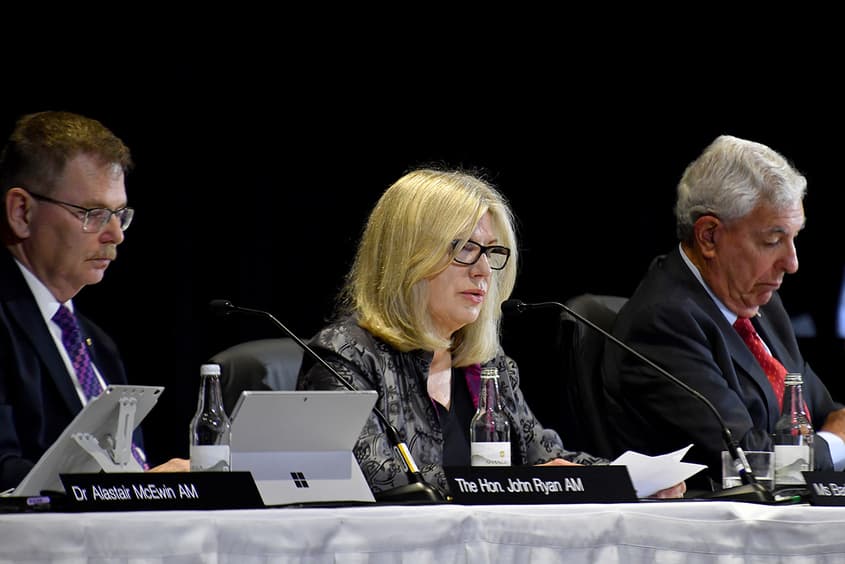
Photo: Commissioner Barbara Bennett (centre) addresses attendees during the Disability Royal Commission’s Ceremonial Closing Sitting in Sydney, Friday, September 15, 2023. (AAP Image/Bianca De Marchi)


In recent years, the media has played a critical role in exposing abuse, exploitation, corruption and fraud within the National Disability Insurance Scheme (NDIS). Often this wrongdoing is left unaddressed until it reaches a crisis point – further undermining public confidence.
The Federal Government is looking to implement reforms but are missing the opportunity to strengthen protections for the people who expose wrongdoing within the scheme. That is a critical omission – especially considering that NDIS whistleblower protections are some of the most outdated in the country.
The NDIS, introduced in 2013, is central to ensuring the human rights of people with disability to exercise choice in accessing the support they need. But robust monitoring and regulation are crucial to ensuring the scheme – which relies on the supply of disability services by private providers – is not exploited for financial gain. Like any regulatory framework, it relies on information about wrongdoing to be reported in order to act. In a multi-billion-dollar scheme with thousands of private providers of various sizes and business structures, workers and participants are a crucial source of information.
Yet, among the nine federal whistleblowing laws in Australia, the whistleblower protections in the NDIS are among the most outdated and are preventing whistleblowers from speaking up safely and lawfully.
During the Disability Royal Commission, the critical role of whistleblowers was demonstrated by the submissions and evidence given by countless workers, people with disabilities and family members revealing harrowing stories of harm, abuse and neglect. Now, two years on from its conclusion, mistreatment of NDIS participants and reports of fraud and misconduct by providers remain concerningly widespread.
The Government has identified NDIS provider fraud as a key issue to stamp out, while at the same time, the State of the NDIS Report in 2025 showed that the majority of NDIS providers feel the “dodgy providers narrative ” has led to an increased regulatory burden that is unsustainable for business. Meanwhile, unions are reporting a burnout crisis amongst workers. With both the Government and NDIS providers saying the scheme has become unsustainable, it is people with disability accessing the scheme who are suffering.
In response, the Albanese Government is in the process of rolling out a suite of changes to the NDIS designed to improve the integrity and sustainability of the regime and safeguard participants from harm. But people with disabilities, their families and advocacy organisations are all raising concerns about the implications of these reforms, and calling for greater transparency around the changes.
A parliamentary committee is due to report in a month’s time on the latest of these reforms; a bill that strengthens the NDIS Commission’s regulatory enforcement powers, among other things. Despite being targeted at improving accountability of the scheme and increasing regulatory oversight, the Bill does little to improve the ability of whistleblowers within the scheme to speak up and be protected.
In our work at the Whistleblower Project, we are seeing the everyday impact of a patchy regime that has fallen far out of step with best practice. Among the problems is the fact that a person cannot make an anonymous disclosure under the regime and be protected (unlike most other whistleblowing laws). The legislation also does not provide protection for the confidentiality of a whistleblower’s identity, which is contrary to almost every other whistleblowing law in Australia.
These are just some of the shortcomings with the NDIS whistleblower protections which we have outlined in a submission to the committee. The gaps mean, in practice, that whistleblowers face significant personal risk in speaking out. For many, the risk of retaliation is too high, and they simply remain silent. For others, despite ringing alarm bells internally within their organisation, nothing happens until it’s too late and a participant is harmed.
Reforms to the NDIS whistleblower protections are no replacement for a holistic economy-wide approach to fixing whistleblower protections at the federal level. The current inconsistent and fragmented approach is silencing whistleblowers and posing a regulatory burden on organisations who can end up having to comply with multiple different whistleblowing laws. But in the meantime, there are clear, simple and effective reform opportunities to greatly improve the avenues for whistleblowers in the NDIS to safely bring information to light.
Until then, whistleblowers in the NDIS will continue to face significant risk when it comes to holding NDIS providers to account. That is not good for people with disability, for the NDIS as a whole, or for transparency and accountability in Australia.
Madeleine Howle and Kieran Pender are lawyers at the Human Rights Law Centre Whistleblower Project, Australia’s only specialist legal service for whistleblowers.
Advertisement
Related Articles
Factcheck: Do Australians 'overwhelmingly support' gun control? Yes they do.
Yes, they do. Polling surveys consistently show that Australians support strengthened gun control.