You simply can’t 'offset' strip mining the only jarrah forest on Earth
Australia’s environmental laws are meant to protect the irreplaceable, not offer accounting tricks that allow their irrevocable destruction.

Wed 25 Feb 2026 01.00
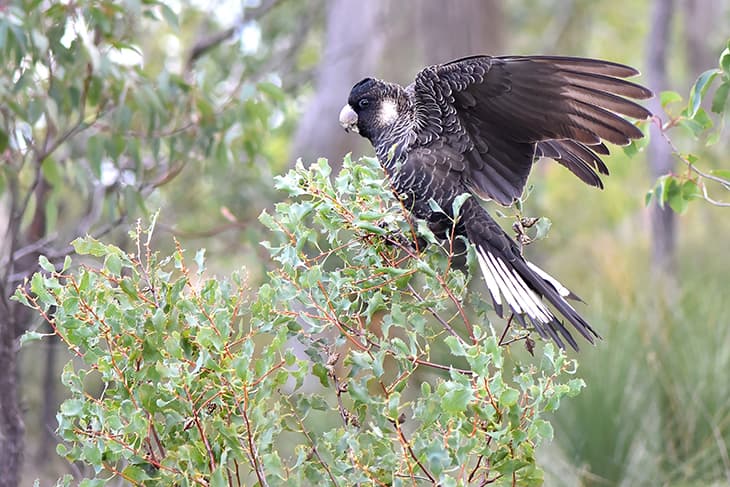
Photo: Carnaby’s cockatoo, by Jean and Fred Hort, CC BY 2.0


Australia’s environmental laws are meant to protect the irreplaceable, not offer accounting tricks that allow their irrevocable destruction.
Yet the Albanese Government’s decision to grant Alcoa an 18-month “national interest” exemption to continue strip-mining Western Australia’s Northern Jarrah forest did exactly that. All in the service of global mining deals that put export markets and critical mineral supply chains ahead of biodiversity.
This forest – the only jarrah forest on Earth – is being strip mined not simply for bauxite, the ore that underpins aluminium production, but increasingly as part of a broader global supply tied to the extraction of gallium and other metals considered “critical” for semiconductors, defence industries and renewable technologies.
The Albanese Government’s statement of reasons for this decision reveal that the exemption was influenced in part by Australia’s mineral arrangements with the United States and Japan. Reflecting a geopolitical priority that elevates foreign demand over local ecological integrity and interests.
Endangered Species at Risk
The Northern Jarrah Forest is not a replaceable commodity. It is habitat for uniquely Australian – and increasingly endangered – species. Forest hollows and old trees provide essential nesting and foraging habitat for threatened birds, including Baudin’s Black cockatoo, Carnaby’s Black cockatoo and the Forest Red-tailed Black Cockatoo. These iconic species are already under severe pressure from habitat loss, with Baudin’s experiencing steep population declines and migration patterns that depend on intact jarrah forest in winter months.
Strip-mining obliterates the forest ecosystem these species rely on. Ancient tree hollows that take centuries to form and cannot be recreated, especially on mining rehabilitation timetables.
The Offset Myth
Offsets have become the central justification for continued clearing. Under environmental law, developers pledge to compensate for habitat loss by conserving or restoring habitat elsewhere. But as research and experience have repeatedly shown, this is not how it works in the real world.
The Australia Institute has documented how offsets and emerging biodiversity markets create loopholes that allow destruction to proceed under the veneer of conservation. Rather than delivering “like for like” habitat protection, biodiversity offsets allow miners, loggers and others looking to clear biodiversity to pay into a generic fund.
Sue Arnold, in a piece for Crikey, called ‘biodiversity offsets on of the most damaging environmental policies in a smorgasbord of bad policies’. These bad policies allow business as usual payments to destroy. Relieving the likes of Alcoa, and the government, of direct responsibility for tangible ecological outcomes.
Across Australia, biodiversity markets modelled on these ideas have failed to demonstrate real protection or restoration. The Australia Institutes analysis of similar schemes in New South Wales found fundamental flaws in design and operation, raising “serious questions about whether… schemes can achieve the stated goal of ‘no net loss’ of biodiversity.”
Offsets also mirror the fundamental weaknesses exposed in Australia’s carbon credit system, where markets and accounting mechanisms have too often justified business-as-usual rather than genuine environmental repair. As critics note, these market-based approaches risk locking in continued declines of nature rather than reversing them.
The Jarrah Forest Reality
In jarrah country, the offset model has never delivered the ecological recovery it promises. Independent scientific reviews show that after decades of mining and rehabilitation, much of the cleared forest has not returned to self-sustaining native forest. Species richness, ecological function and landscape complexity remain damaged and altered. There is no evidence to date that restored areas replicate the intricate web of relationships found in undisturbed jarrah forest.
Even where offsets are established, their track record elsewhere in Australia is alarming. Federal audits of biodiversity offsets have found that many restoration sites are in worse ecological condition than before designation, undermining the claim that offsets counterbalance environmental loss.
Investigations into Regulatory Breaches
The crisis has deepened with additional revelations that Alcoa may have breached its state-imposed mining conditions, even under the exemption that was supposed to regulate its activities.
Recent reporting by ABC News that Western Australia’s Department of Water and Environmental Regulation has launched investigations into multiple alleged breaches of Alcoa’s mining agreement. The allegations include mining too close to a significant jarrah tree and the possible destruction of another protected tree. These investigations follow the A$55 million penalty paid by Alcoa for unlawfully clearing land.
That a multinational corporation accused of breaching its conditions can continue stripping forest while investigations proceed exposes the fragility of regulatory safeguards when political and economic priorities overwhelm environmental protection.
Export Markets over Environmental Integrity?
The Government’s argument that continued clearing is justified by the “national interest” — particularly in supplying minerals for global supply chains – sets a dangerous precedent. It essentially declares that economic and strategic value trumps ecological value. This is a retreat from the protective spirit of environmental law, and an embrace of extractive logic dressed up in diplomatic language.
If a unique forest ecosystem is expendable because a mineral found beneath it is deemed strategically important for trade, what hope is there for other threatened species and landscapes when their economic value is outstrips everything else?
The True National Interest
If environmental protection means anything, it must protect what is rare and irreplaceable. That includes the Northern Jarrah Forest and its endangered ecosystems. Allowing its systematic dismantling under the guise of offsets, as part of critical mineral trade strategies, weakens environmental law and erodes public trust.
There is no offset for what cannot be replaced. If we continue to trade unique ecosystems for minerals trading advantage, future generations will look back on this moment not as a triumph of clever policy, but as a surrender to short-term geopolitical tensions, at nature’s expense.
Related Articles
Victoria's duck hunting season begins amid declining support and compliance concerns
At 8am, 18th of March, Victoria entered its duck hunting season for 2026. That’s right, until thirty minutes after sunset on 8 June, native waterbirds can be shot for “sport” across 3.5 million hectares of public land in Victoria.