Communities win again in the Otway Basin, but why do they have to keep fighting?
The recent rejection of the CGG Regia 3D marine seismic blasting survey off Victoria’s south-west coast was a hard-fought victory for coastal communities, marine life and common sense.

Wed 18 Feb 2026 01.00
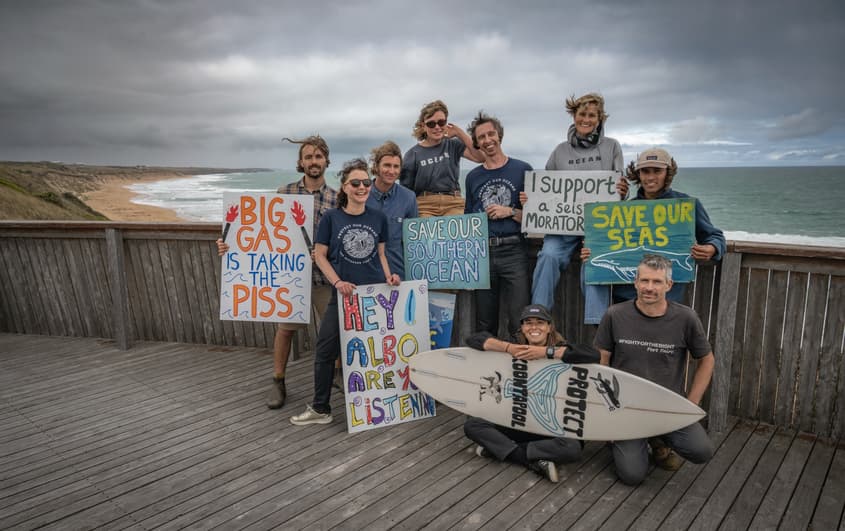
Photo: supplied


The recent rejection of the CGG Regia 3D marine seismic blasting survey off Victoria’s south-west coast was a hard-fought victory for coastal communities, marine life and common sense.
The proposal, reported by ABC News, would have subjected 2750 km2 of ocean in the Otway Basin to high-intensity seismic blasting in search of new gas reserves. After years of community opposition and regulatory scrutiny, the project was refused by the National Offshore Petroleum Safety and Environmental Management Authority (NOPSEMA).
NOPSEMA was explicit about why:
NOPSEMA can confirm it has refused to accept CGG Services (Australia) Pty Ltd’s Environment Plan for the proposed Regia 3D marine seismic survey on 11 February 2026, as it did not meet the regulatory acceptance criteria under the Offshore Petroleum and Greenhouse Gas Storage (Environment) Regulations 2023.
Following its assessment, NOPSEMA was not reasonably satisfied that the acceptance criteria in regulations 34(c), (d), (e), (g) and (h) had been met. This includes the requirement for an Environment Plan to demonstrate that environmental impacts and risks, such as those relating to Blue Whales, would be reduced to acceptable levels…CGG may choose to commence a new assessment process, via the submission of a new EP. This will attract a separate EP levy, a new financial assurance confirmation and public comment period.
In other words, the regulator was not convinced the company could adequately protect marine life – including endangered pygmy blue whales – from the impacts of seismic blasting.
Importantly, this is the second major win in the Otway Basin in recent years. In 2024, multinational company TGS withdrew its own seismic blasting proposal after years of sustained public pressure, tens of thousands of submissions and widespread opposition from fishing, tourism and coastal industries. Together, these rare victories demonstrate both the strength of community resolve, and the systemic failure that keeps putting these proposals on the table.
Communities and First Nations groups from Port Fairy to Torquay mobilised to defend their ocean back yard. They should be proud, but they should never have had to fight these battles in the first place.
This is the exhausting reality of Australia’s fossil fuel policy: a whack-a-mole system where communities are forced to defend their oceans one proposal at a time.
Even when a project is rejected or withdrawn, another soon follows. The burden is placed on volunteers, Traditional Owners, fishers, tourism operators and residents, while governments continue approving new exploration and drilling permits.
Seismic blasting is not a minor procedural step. It is the first step to new fossil fuel extraction.
Here lies the real contradiction of our government words and actions on climate action.
Australia has committed internationally to contribute to the global phase-out of fossil fuels. At last year’s climate talks in Belém, governments acknowledged that expanding fossil fuel production is incompatible with holding warming to 1.5° C and agreed to accelerate a transition away from coal, oil and gas under the Belém Declaration.
Yet at home, new exploration areas continue to be released. Offshore acreage is handed over to fossil fuel companies. Seismic blasting surveys are proposed. Drilling gas basins is promoted. The machinery of fossil fuel expansion rolls on.
You cannot commit to phasing out fossil fuels on the international stage while enabling new fossil fuel frontiers domestically. The two positions are irreconcilable.
As Kumi Naidoo argues in his new Vantage Point essay, What We Owe the Water, bold climate leadership demands more than rhetoric. It requires governments to stop expanding fossil fuel production if they want credibility at future climate talks.
Australia cannot seek legitimacy, while holding a Presidential position, at COP31 while continuing to greenlight new fossil fuel exploration at home.
The back-to-back wins in the Otway Basin show that communities can prevail. But regulatory refusals and corporate withdrawals are highly unusual and are not the result of climate policy.
If Australia is serious about a fossil fuel phase-out, the solution is simple: stop approving new fossil fuel projects.
That means:
- No new seismic blasting approvals
- No new exploration licences
- No new drilling permits
- No expansion of fossil fuel fields that lock in decades of additional emissions
Communities should not have to shoulder the responsibility of enforcing climate action proposal by proposal. That responsibility belongs to government.
The lesson from the Otway Basin is not simply that two bad proposals were stopped. It is that our current system invites endless conflict and locks communities into a case-by-case death by consultation trap. All while keeping the door open to fossil fuel expansion.
Advertisement

Related Articles
Why we garden
An edited extract of 'Why We Garden' by Hannah Moloney, available in stores nationally from April 14.

Pressure mounts to save Macquarie Harbour as salmon farming backlash grows
Environment Minister Murray Watt is facing renewed pressure to intervene and protect Tasmania’s heritage-listed Macquarie Harbour amid deepening public opposition to the state’s salmon farming industry.