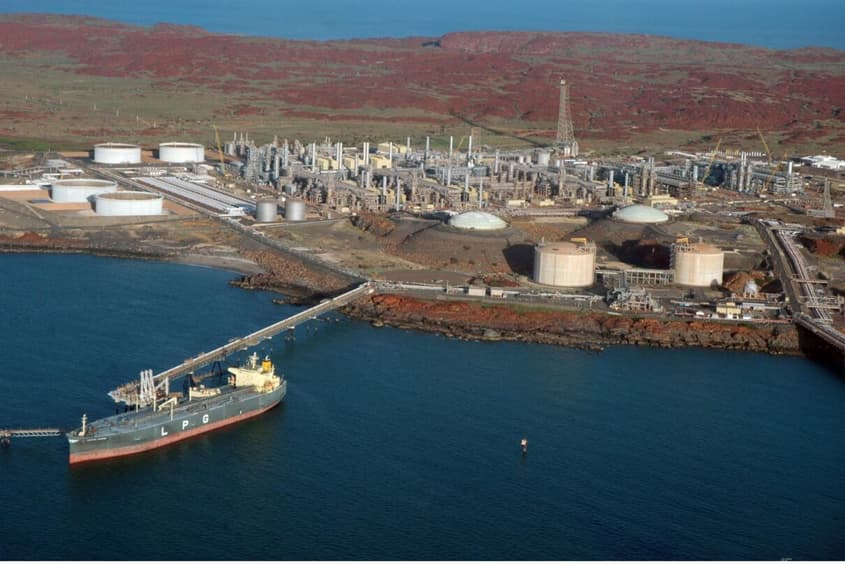
When Russia invaded Ukraine, it triggered something far less discussed in Australia: one of the biggest unplanned gas export profits in modern history. Gas prices spiked. Exporting companies made off like bandits. Australians failed to reap any benefit from our exported gas price spike

Fri 20 Mar 2026 10.00
Photo: AAP Image/Mick Tsikas


On 24 February 2022, Russia invaded Ukraine. The human cost has been immense. But the war also triggered something far less discussed in Australia: one of the biggest unplanned gas export profits in modern history.
Gas prices spiked. Exporting companies made off like bandits. Australians failed to reap any benefit from our exported gas price spike
Before the invasion, Australia’s LNG exports averaged around $530 per tonne. Within months, prices jumped to $848. By 2022–23, they had skyrocketed to $1,311 per tonne, more than doubling in the wake of the invasion. A windfall driven not by Australian effort, but by global instability.
Even now, prices remain elevated sitting around $767 per tonne as of December 2025, still 45 per cent above pre-Ukraine war levels.
This is where the story stops being about global markets and starts being about political choices and missed opportunities.
Analysis from The Australia Institute makes clear just how significant that missed opportunity is.
When the Albanese government came to office in May 2022, it did so at precisely the moment this windfall began. If it had acted swiftly and decisively – introducing a 25 per cent tax on gas exports from 1 July 2022 – Australia would have collected $63.8 billion between then and last December.
That is money we have already missed out on.
$23 billion in the first year alone. Another $17 billion the next. Then $16 billion more. Add six months of 2025, and the total reaches $63.8 billion.
For those (like me) who struggle to visualise how many zeros that is, here you go: $63,800,000,000.00
We only get to tax our gas exports once – and we’ve missed out so far
Once the gas is extracted and shipped overseas, it is gone. The opportunity to collect a fair return disappears with it. And during one of the largest price spikes in history, Australia let that opportunity sail away.
$63.8 billion is enough to fully fund free university and TAFE for around six years. It could have delivered free dental care through Medicare for four years. It could have made early childhood education and childcare free for seven years.
In a cost-of-living crisis defined by rising rents, medical costs, childcare costs, interest rates and energy bills, that is not small change. It is the difference between pressure and relief.
And to quote Shirley Bassey, it’s all just a little bit of history repeating…
Australia Institute analysis shows how as conflict escalates in the gulf states, global oil and gas prices rise. The pattern is familiar: war pushes up prices, households pay more, and fossil fuel exporters reap the rewards.
Without reform, Australia once again finds itself in the same position – rich in resources (exported) but failing to turn that export market into public benefit.
This is not bad luck. It is bad policy.
Unlike citizens of other resource-rich nations, Australians do not gain when prices rise. In fact, we often feel poorer, because we pay international prices for energy produced from our own resources, while the profits flow elsewhere.
That is the core failure.
Because even beyond the missed windfalls from price spikes, the long-term opportunity remains. At average prices, a 25 per cent export tax on gas would still raise around $17 billion a year, enough to sustainably fund major public services into the future.
Australians would be better off today if government had acted when the opportunity was there. Instead, we have allowed extraordinary profits to accrue to multinational gas companies while asking Australians to absorb higher costs at home.
Defenders of business as usual for fossil fuel exports argue that taxing exports would hurt investment or raise domestic prices. But this misunderstands the system.
Australian gas is sold into international markets at global prices. A 25% export tax on exports captures part of that profit as it leaves our market – it does not determine what Australians pay.
We could have taxed the export boom without hurting households.
$63.8 billion is an enormous amount of money to have given away. A gas export tax could really have helped Australians struggling with a cost-of-living crisis, rising interest rates and skyrocketing petrol prices.
Instead, we chose not to. We have already given away too much, and it’s time to fix the ledger.
The $63.8 billion opportunity may be gone, but the lesson is not. Future price spikes are inevitable and arguably upon us. The only question is whether we continue to repeat the same mistake or fix it.
Free childcare, free university should not be out of reach for a country as resource rich as Australia.
If we choose to tax our gas exports fairly, Australians would – as we should – be better off.
Because every time we fail to tax finite gas exports, we are not just missing out on revenue. We are giving away Australia’s wealth – one ship at a time.
The Reserve Bank’s decision to raise interest rates this week was a double whammy for Australians struggling with petrol price increases in the past month that have already cost them more than the impact of the rate rise.
Advertisement

In February the unemployment rate rose from 4.1% to 4.3%, providing further evidence the Reserve Bank misread the economy when it raised rates in both February and this week.
The Senate Select Committee on the Operation of the Capital Gains Tax Discount tabled its report on Tuesday. In short, it found that Australia’s current tax system favours investors and fuels intergenerational inequality. But the Coalition maintains the CGT discount is “working as intended.”