The easiest way to understand the structural shift taking place in Australian politics is to understand that you can now win a landslide majority of seats in parliament even when your primary vote declines.

Tue 24 Mar 2026 00.00
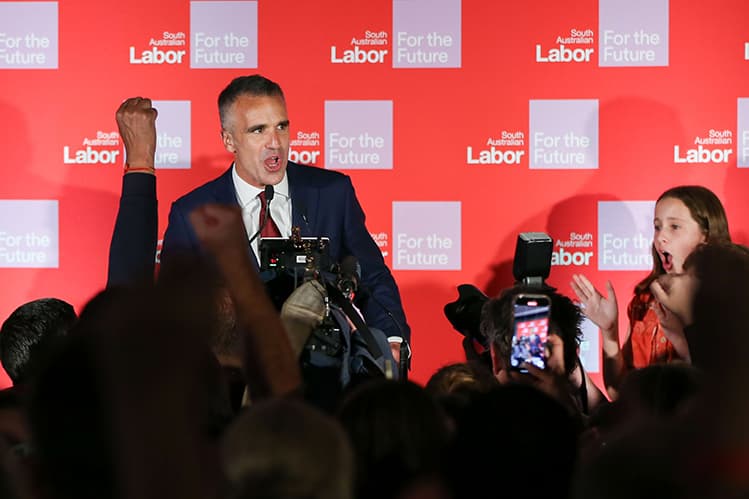
Photo: Re-elected SA Premier Peter Malinauskas at his post election function during the South Australian state election in Adelaide, Saturday, March 21, 2026. (AAP Image/Matt Turner)


The easiest way to understand the structural shift taking place in Australian politics is to understand that you can now win a landslide majority of seats in parliament even when your primary vote declines. On Saturday’s South Australian state election, Labor saw their primary vote fall by 2% while their seat count rose from 27 to between 32 and 34 in the 47-seat House of Assembly.
The fact that a party can now win more seats with fewer votes in no way detracts from the significance, or legitimacy, of Peter Malinauskas’ thumping victory. In 2025 Anthony Albanese won a record haul of lower house seats off one of the party’s lowest ever primary votes. Indeed, Bill Shorten won a higher share of the vote in 2016 than Anthony Albanese did in 2025 and, unfortunately for the former Labor leader, his loss was as clear as Albo’s win.
Much will be made of the fact that Pauline Hanson’s One Nation won a larger share of the primary vote (22%) than the Liberals (19%) but appear to have won fewer seats than the Liberal Party. But while the conspiracists and the Hanson boosters in the media will wring their hands and demand changes to Australia’s preferential voting system, it’s a safe bet that few right-wing whingers will mention that the Greens have been outpolling the National Party for decades and the National Party always wins more seats than the Greens.
At the 2025 general election the Greens polled 12% in the lower house and won one seat while the Nationals and Liberal Nationals in Queensland managed just 11% but collected 25 seats. Excluding the Liberal Nationals, it looks even more extreme: the National Party in the rest of the country won 9 seats off less than 4% of the vote.
That’s not a fluke, it’s a design feature of our electoral system, but now that the design feature seems to disadvantage Pauline Hanson I suspect you will hear a lot more about it.
Australia’s House of Representatives contains 150 MPs each elected to ‘represent’ their local electorate.
Parties like the Nationals have endured because their traditional constituencies, or their ‘base’, are highly concentrated in small pockets of Australia. So while 11 percent of Australians voted for the Nationals or Queensland’s Liberal Nationals in the 2025 election, they recorded some enormous primary votes, like the 53 percent of the vote then party leader David Littleproud won in Maranoa. And while 12% of people voted Green at the 2025 election, because Green voters are spread out across the country far more evenly than the Nationals, they only won the seat of Ryan and that with a primary vote of just 29 percent.
One of the main things to understand about the electoral system Australia currently uses to elect members of parliament to our House of Representatives is that is based on ‘single member electorates’, which simply means that each electorate picks one person to represent them.
The second thing to know about our current system is that within each of our ‘single member electorates’ we use preferential voting to decide who wins when no single candidate gets more than 50 percent of the vote. Preferences often get a bad rap from people who don’t understand them or from those who think their party would be more likely to win without them.
Consider the following example:
Imagine there were three candidates vying to be elected as the single representative of an electorate. One candidate who wanted to stop all immigration won 40 percent of the vote, another candidate who wanted to maintain current population growth won 35 percent of the vote and a third candidate who said they didn’t care that much about immigration, but who really wanted to tax billionaires got 25 percent cent of the vote.
Which of the three candidate is ‘best’ to represent their electorate?
Different people have different answers to that question.
In the UK and the US they have single member electorates like we do here in Australia, but they don’t have ‘preferential voting’ so whoever tops the poll wins. But that causes a real problem for people who care about population growth and billionaires. It also creates an opportunity for parties to run ‘spoiler’ candidates who have little chance of winning but can split the vote of opponents, causing a less-preferred candidate to win. Famously the consumer rights campaigner Ralph Nader ran against Al Gore and George W Bush for president back in 2000 and while he only won 2.7 percent of the vote, he arguably cost Gore the presidency.
In Australian House of Representative elections, we ask voters to not just tell us who they like the best, we ask them to rank all of their ‘preferences’ for who they like second, third, fourth and so on. That means in the example above, it’s the ‘second preferences’ of voters who really wanted to tax billionaires that will decide whether the pro- or anti-immigration candidate wins the seat.
On the weekend a record 22 percent of South Australians voted for candidates running under the banner of Pauline Hanson’s One Nation party but, to state what should be the obvious, 78 percent of South Australians didn’t vote for those candidates. Significantly, none of the One Nation candidates came close to winning more than 50 percent of the primary vote but their best performing candidate did win 39 percent of the primary vote in the seat of Narungga.
So how many One Nation candidates ‘should’ win given that their party won 20% of the statewide result?
Rather than wonder about what ‘should be’ under our preferential voting system we literally ask voters and, unfortunately for those One Nation candidates, most of the 82 percent of people who didn’t vote for One Nation made clear that they would much prefer someone who wasn’t from One Nation to represent them. That’s why One Nation led in seven seats but will not win nearly that many.
Another uncomfortable fact for those trying hard to pump the right wing’s tires is that if you simply look at the combined Liberal and One Nation primary vote it comes to just 41 percent of the vote whereas the Labor–Green combined vote is 48 percent. The ‘One Nation surge’ was in no way a right-wing surge.
There is no ‘right’ way to elect representatives to our parliaments but if we really don’t like the fact that a 22 percent vote for One Nation or a 10 percent vote for the Greens doesn’t result in 22 percent of MPs being One Nation and 10 percent being Greens then we could switch to a system of ‘proportional representation’ for our lower houses of Parliament the way that Tasmania, the ACT, NZ and about 40 European countries have.
Personally, I’m a fan of proportional representation, and it would help us navigate the structural shifts in our democracy without so much whinging about preferences and elections being rigged all the time.
But I feel a warning is necessary, while PR nearly always results in a much more representative parliament, it almost never results in one party having an absolute majority. I, for one, think forcing parliamentarians to work together in power-sharing governments is a good thing, but keep in mind that many of the loudest media voices that will focus on how our electoral system is broken because One Nation didn’t win 22% of the seats are the same voices that rage against the dangers of ‘minority’ government.
No one gets everything they want in a democracy.
Richard Denniss is co-chief executive of the Australia Institute
So much of what passes for Australian political discourse relies on existential threats. It’s easy to make grandiose statements and take positions when the threat is some amorphous vague maybe that could possibly happen.
Advertisement

With South Australia in its final week of campaigning ahead of the state election, you may have noticed while there’s been a few scandals around mistaken identity of hospital patients and controversial candidates’ opinions, accusations of politicians lying are muted.

You could be forgiven for assuming that we have a robustly protected ‘right to protest’ in Australia. The ‘right to assemble in public’ has long been respected in common law legal systems; but in Australia, this right only applies if it is not overridden by parliamentary laws.