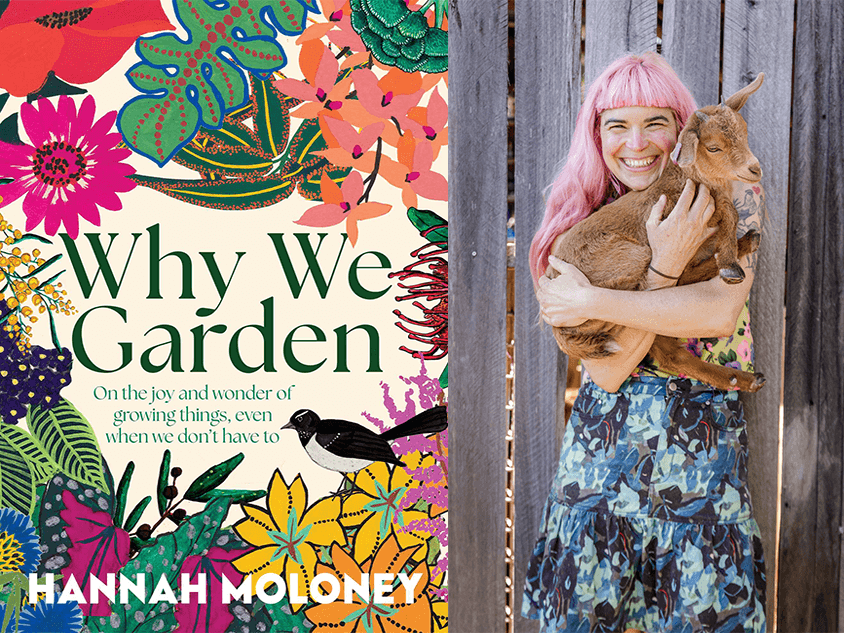
An edited extract of 'Why We Garden' by Hannah Moloney, available in stores nationally from April 14.
Thu 2 Apr 2026 00.00


If you look at a map of the world, you’ll see that I live pretty much at the bottom on a little island called Lutruwita/Tasmania. You’ll find me and my family in a bright pink house on a patch of land that’s around 3000 square metres with a 30-degree slope that borders Nipaluna/Hobart. Behind us is native bushland that squirms with wallabies, pademelons and an array of birds, while in front of us looms the city and ocean. We look out over Nipaluna/Hobart, the timtumili minanya/River Derwent, the distant mountains and the ever-dynamic sky.
For more than a decade my sweet husband, Anton, and I have lovingly shaped this steep slope into productive terraces. We’ve filled them with fruit and nut trees, vegetables, cheeky milking goats, chaotic chickens, shy ducks, herbaceous shrubs, native plants, a stunning greenhouse, flurries of flowers, a unicorn sculpture, our sassy daughter, Frida Maria, and Olly, our dog who’s also known as Little Bro or Sacred Angel. It’s all love.
***
We pour ourselves into this landscape and in ‘real-estate speak’ have over-capitalised. But we don’t care about resale value; we care about soil health and soul health. For us, the two are inextricably linked.
But sitting quietly beside the complete adoration we have for our garden is the persistent pulse of how much work we must do to maintain or evolve it. There are regular moments when that pulse spills over into overwhelm and I ask myself … do we really need this amount of garden in our lives? Why grow tomatoes when we can buy them? Why tend flowers that only bloom for a short period before they die and have to be replanted?
Thankfully it’s not long before the voice in my head snaps back: ‘Oh, shut up, Hannah, just get on with it,’ and I go back to gardening.
I do wonder, though, what is it that has made this such an essential part of my daily life?
One of my earliest memories is more of a feeling than a vision. I’m sitting on the grass in our urban backyard. I’m old enough to walk, but not effortlessly. My dad’s somewhere nearby because I can hear him working in the garden – the shuffling of his boots and the distant thumping of garden pots being moved around. The sun is soaking my bare legs and the grass is gently prickling the skin between my toes. It feels good and right. I feel good and right.
I was born into a gardening life. A few months before I entered the world, the youngest of five, my family moved into a rambling Queenslander on a quarter block in inner city Meanjin/Brisbane in Kurilpa/West End. I loved (and still love) that house and dream of it often. All open windows, big verandas full of plants and people, creaking timber floorboards, walls heaving with art, photographs and floor to ceiling bookshelves, and wide-open doors welcoming you in. It was the early 1980s and Kurilpa/West End was multicultural magic with Aboriginal and Torres Strait Islander mob, the Anglo-Irish, Lebanese, Vietnamese, Greeks and more mixed in together. There was the strong and delightful presence of poor artists and students and lots of young working-class families like mine, who were flush with imagination and a strong work ethic but not so much cash.
Dad got busy transforming the backyard into what became a thriving herb nursery, which kept him busy for the next two decades. Every spare crack of our childhood was filled with helping Dad in the nursery – which was honestly pretty boring as far as I was concerned. Hot and boring. If I heard Dad coming in one side of the house, I’d hop to and rush out the other side, avoiding him and his inevitable demands for help. I wanted to be roaming the streets with my mates and yarning in gutters, not potting up herbs for my dad.
But my whole adult life has circled around gardening both personally and professionally. In recent years I’ve come to recognise that there’s a type of spirituality wrapped up in it as well. Gardening has been a part of who I am for so long that I rarely stop to ask why. It’s just what I do. Like breathing, I don’t stop to ask why, I just breathe. But unlike breathing, gardening isn’t always an essential task in our modern world. And yet so many of us shape our lives to include moments of hands in earth and bodies bent over baby plants, willing them to live. We spend hours crawling around on our hands and knees pulling weeds, planting trees, tucking in plants with blankets of mulch while talking to them. We’re obsessed.
So, why do people garden?
As I grow older my curiosity is also growing about the choices people make with gardening. What inspires them to start, and what makes them continue?
To answer this question, I knew I couldn’t rely on my sample size of one. So I began to ask around. One day, I was in the small town of Deloraine in northern Lutruwita/Tasmania, giving talks on gardening at an annual craft fair. There I met fellow gardeners, and I asked them what they loved about gardening. One woman said, ‘There’s just something about gardening … Something that just keeps me coming back and keeps me there.’ Those listening all nodded knowingly. We knew what that something felt like – unique to all of us of course – but something we could all relate to.
I kept asking. I talked to my gardening mates and acquaintances. Then I looked further and spoke to well-known Australians. I yarned with authors, a journalist, a landscape architect, Aboriginal and Torres Strait Islander peoples, a former politician and a musician.
But of course, I couldn’t just speak with well-known people about gardening! I needed to hear from the everyday gardeners out there, the thousands of Australians who pour their hearts into their patches of earth. So, I conducted a survey. In the end, I surveyed almost 1500 people for this book – an overwhelming amount of garden delight to wade through. The survey results were enlightening. Joy, beauty, money, resilience – there are so many interesting reasons why people garden. This is why I wrote this book. I wanted to dig deep and unearth (so many puns!) the ‘why’ behind gardening.
But there’s another, more personal reason why I wrote this book. As well as trying to understand the something the woman in Deloraine was referring to, I want to understand my own special something.
After tending to the soil that I’ve lived and gardened on for over ten years, I recently had a moment of clarity. I realised that while I’m out there regularly feeding it, nourishing it – all to make it as healthy as possible – the soil is doing the same for me. The soil feeds me, nourishes me and makes me as healthy as possible. The garden is gardening me. It’s only healthy when I’m healthy and I’m only healthy when it’s healthy.
I know I’m not alone in this deep feeling of connection to plants, and to the earth. It touches on some essential part of being human and alive. When we die our bodies return to the earth. Whether we’re buried in the ground, burned, or undergo a sky burial where vultures eat our remains on top of a mountain (as is tradition in parts of Tibet), our bodies change form. They become the earthworm, the ash, the vulture, the bird poo and then eventually, one way or another, they find their way into the soil. The ground beneath our feet is made up of our ancestors. In time, we all become one big, interconnected garden.
Gardening is one of the few activities in modern life that reconnects us to nature in both a practical and invisible way. It’s a tangible thread that ties us all – living and dead, human, animal and plant – together into one giant ecosystem. But there’s an invisible pulse to it that pulls at my heartstrings. There’s a type of spirituality in that interconnectedness. I bow down to it and it holds me up.
Maybe this is my something. The juicy feeling of big connectivity that helps remind me that we are the soil, the carrot crop, the compost, the goat manure, the gum tree, the dahlia flowers. The same force of life running through me is also running through my almond trees. We have this in common. Same, same – not different. We. Are. The. Garden.
And if there’s one thing we need more of in this world, it’s finding what we have in common and focusing on that rather than on what keeps us apart.
This is the miraculous wormhole that this book will spiral down. So, are you ready? Let’s get digging.
Hannah Moloney is a TV presenter on ABC’s Gardening Australia, permaculture practitioner, bestselling author and climate activist.
This is an edited extract from Why We Garden by Hannah Moloney (Affirm Press, RRP $39.99). Available in stores nationally from 14 April.
Advertisement
Environment Minister Murray Watt is facing renewed pressure to intervene and protect Tasmania’s heritage-listed Macquarie Harbour amid deepening public opposition to the state’s salmon farming industry.
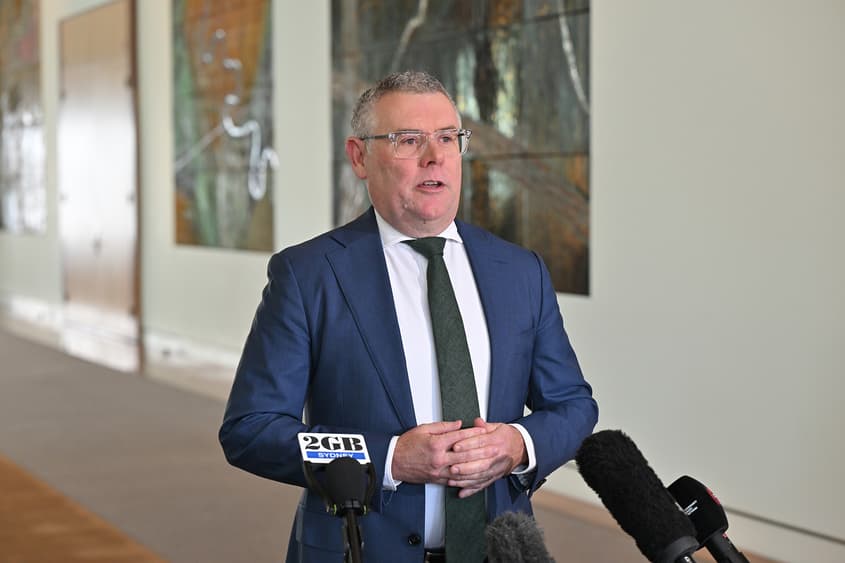
Australia’s poisons regulator shows how hard it is to rebuild an institution after it is damaged. As it rebuilds, Australian native animals are dying.
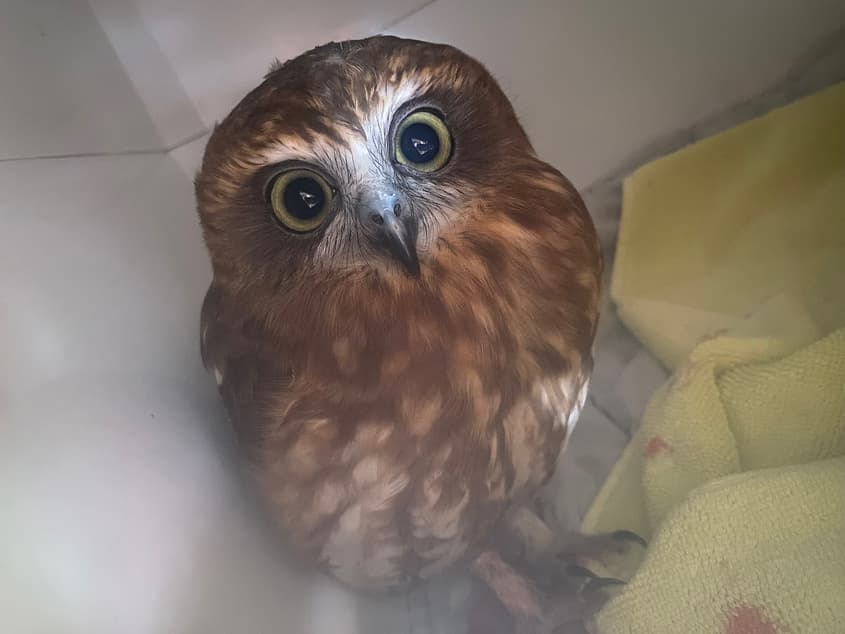
We’ve just had an epic win for our native animals, such as owls, goannas and eagles. And after years contributing to the scientific evidence on the wildlife impact of rodent poisons, it’s a day scientists like myself feared would never come.
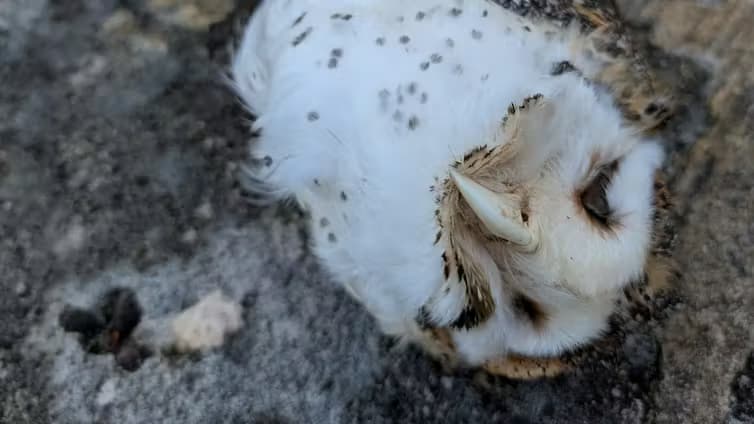
Australia’s wildlife is facing a quiet and unnecessary threat, not just from habitat loss, bushfires or climate change, but from something sitting on the shelves of hardware stores and supermarkets, and in turn households: rat poison.