An economist’s advice on why EV ‘range anxiety’ is overrated
If you are thinking about buying an EV, the faster you can abandon the ‘rational’ way of thinking about ‘filling up’ with petrol, the more relaxed you will be, and the less you will spend, ‘topping up’ with electrons.

Sat 11 Apr 2026 01.00
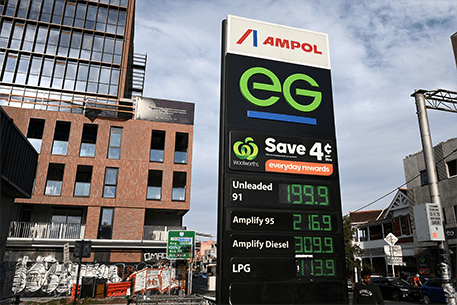
Photo: AAP Image/Jono Searle


I’ve had an electric vehicle (EV) for a bit over a year, and it’s so relaxing to drive and ‘fill up’, that the only problem I encounter is that I sometimes just forget to charge and wind up with single-digit battery capacity (which still provides dozens of kilometres). When this happens, I often ring my sister to taunt her of the ‘risk’ I’m taking, as she hates being below 20 per cent on hers, which I find odd, but people are different.
Apart from being quiet, cheap to maintain, cheap to run and effortless to drive in any situation, the biggest difference between EVs and fossil fuel powered cars is the way you need to think about ‘filling up’.
Spoiler: ‘filling up’ is what you do with a petrol or diesel car to avoid stinky petrol stations full of expensive snacks. You rarely ever need to ‘fill up’ an EV, and unless you regularly drive 700km or more, you will never need to ‘fill up’ in a hurry.
But before I explain that, let me first explain how driving a fossil fuel powered car has trained you to think, and let me use some simple economic language to help explain it.
Economists assume that people like to do things they like, avoid things they don’t like, and spend as little money as they can to get the things they like. There are lots of exceptions, of course, like parents paying to take their kids to the Easter show, but let’s keep it simple for now.
Because most people think petrol stations are smelly, expensive, and not much fun to hang around, most people try to avoid taking their car there too often.
Some people feel anxious when they get below 1/4 tank (looking at you, Rachael), some people can only afford to put $10 or $20 in at a time (looking at you, young uni student Richard), but almost no one goes recreationally petrol shopping the way some people like to hang out in malls on weekends.
In short, because filling up a car with petrol or diesel is no fun, people want to do it rarely, so they ‘fill up’, and they want to complete the process as quickly as possible (few people want to prolong the experience of standing, pump in hand, smelling fumes).
But EV charging isn’t like that. At all. And in turn, there’s rarely a need to ‘fill up’, even more rarely a need to ‘fill up’ fast, and, as a cherry on top, the slower you put charge in your car, the better it is for your wallet and your car’s battery.
But unlike hanging around petrol stations, when you fill up your car slowly, you get to hang around in your lounge room, your workplace, or maybe even at a cafe or movie cinema.
Hint: sometimes you can get a great parking spot for free just for putting some electrons in your car for an hour or so.
As soon as you realise that there’s no need to avoid the task of plugging in your car whenever its convenient, as soon as you realise that its ok to unplug whenever you like, and perhaps most importantly, as soon as you realise that putting electrons into your car slowly, and not filling it right up, is the best way to protect your battery, then most of your range anxiety will vanish.
While media and sales brochures are filled with claims about how fast you can fully charge your battery at ‘supercharger’ stations, in reality, you will rarely use such chargers and even more rarely, use them to ‘fill up’.
For example, my car can get me from Canberra to Newcastle without a charge, which is great, but I usually stop somewhere for 10 minutes to grab a drink and stretch my legs.
While I’m doing that, I will put around 20% charge in my car, but unless I need to drive double the range of my car that day, I would never bother waiting to ‘fill up’.
And to be clear, if I regularly had to drive 800-1000km in one day, I wouldn’t buy an EV yet. That’s not their strength, and for those who need that, you are right to stick with a non-EV.
But for that minority, the more people who drive EVs, the less crowded your petrol station will be, a win-win.
Once they understand that filling up fast is the least of their problems, EV owners start to think about other ways to ‘optimise’ their charging strategy.
Thanks to changes by the Albanese Government, by mid-2026, some eligible Australians will be able to get free electrons on their home electricity account between 11am and 2pm (QLD, NSW) or 11am and 3pm (SA). This is obviously a great time to charge when you are home.
Importantly, you don’t need to spend a cent installing anything fancy; you can literally plug your car into any power point, and away you go. It will take ages to ‘fill up’, but again, unless you are driving 400km the next day, that’s not the goal.
One real problem, experienced by some over the Easter long weekend, is the relative shortage of rapid chargers in some regional centres on the heaviest traffic days of the year.
As in so many other ways, Australia’s transition away from fossil fuels lags most other wealthy countries, and there is a clear need for more investment in fast charging stations across the country. But it would be a mistake for our governments and EV drivers to focus too heavily on these visible, but rarely used, solutions.
Fast chargers are expensive and complicated to install in publicly accessible spaces, and they often require not just specialised skills but also local grid and transformer upgrades.
But the more people using slow chargers the night before they head off on holidays, and the more people using slow chargers at their caravan park or hotel each night they are away, the shorter the queues at the fast chargers will be.
The obsession with charging speed doesn’t just make people anxious about switching to EVs; it also distorts government policy.
More fast chargers would be great, but there’s a really low cost technology that can turn every power point in a publicly accessible spot into a slow charger which, to be clear, would be pointless for those in a hurry to ‘fill up’ and great for anyone planning to spent 8 hours at work, 4 hours at the beach or 14 hours parked at a powered camp site.
And again, the more, cheap, electrons some people use to ‘top up’ on the slow chargers, the shorter the queues will be at the fast chargers on the long weekends.
So, to conclude, if you are thinking about buying an EV, the faster you can abandon the ‘rational’ way of thinking about ‘filling up’ with petrol, the more relaxed you will be, and the less you will spend, ‘topping up’ with electrons.
Fast charge times have become the equivalent of 0-100km/h claims for cars… salespeople and new car owners talk about them a lot, but they are irrelevant to people driving to work each day.
EVs aren’t perfect, but they’re really good for most drivers, and they’re getting better.
The sooner people shift their concern from the time to ‘fill up’ to the cheapest and most convenient way to ‘top up’, the better (including for people in petrol station queues who are just desperate to fill up as fast as they can, as often as they can). To each their own.
Related Articles
Japanese climate coalition joins growing push for 25% gas export tax
Calls for Australia to impose a 25 per cent gas export tax have gained international backing, with a coalition of Japanese climate and advocacy groups urging the Albanese government to act.