As state, territory and local governments face increasingly constrained budgets and mounting deficits, the need for greater investment across all facets of disaster risk reduction, response and recovery is growing. Remember the outcry from volunteer firefighters about 30-year-old fire trucks? This is just the tip of a growing iceberg.

Mon 20 Apr 2026 01.00 AEST
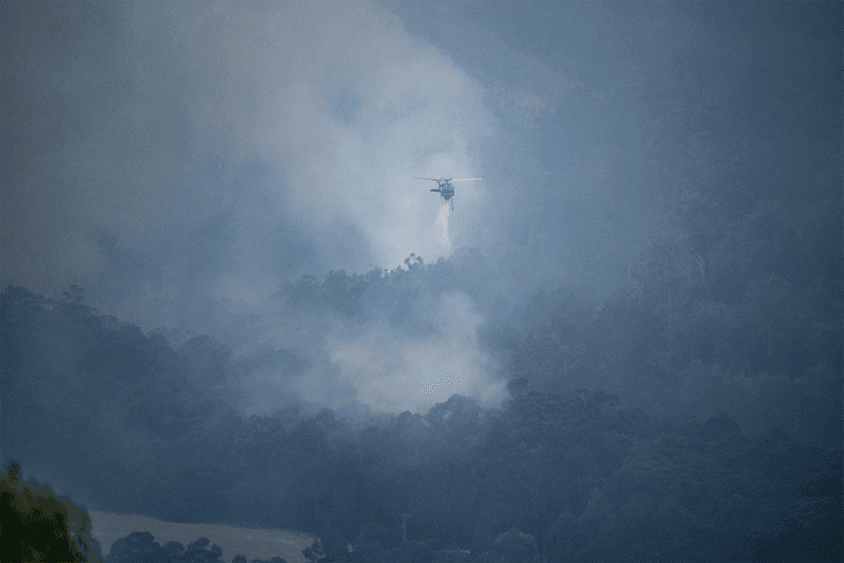
Photo: AAP Image/Michael Currie
The 2025/2026 Summer reinforced that climate change continues to increase risks to all Australians from bushfires, floods, storms and the biggest killer, heatwaves. Bushfires destroyed nearly 500 homes and more than 1,000 other buildings across Australia. As torrential downpours caused flash flooding at Wye River, fires raged in the nearby Otway Ranges. Nearly every state faced serious flooding.
As state, territory and local governments face increasingly constrained budgets and mounting deficits, the need for greater investment across all facets of disaster risk reduction, response and recovery is growing.
Remember the outcry from volunteer firefighters about 30-year-old fire trucks? This is just the tip of a growing iceberg.
Whichever way you look at it, Australia needs to invest tens of billions of dollars in upgrading our disaster preparation, prevention, response, and recovery capabilities in the face of increasingly frequent and extreme weather events.
This isn’t optional. The safety and wellbeing of all Australians depend on it. As we saw when Los Angeles burned, even people in urban areas are not safe on days of extreme weather because fires and floods are indiscriminate.
Governments are struggling to keep up with these necessities. Yet they are giving Australia’s gas resources away to a handful of mostly foreign-owned energy giants for free and letting them off the hook by paying manifestly inadequate amounts of tax.
As all levels of government continue to play catch up with escalating disaster costs, it is ludicrous that those who have caused and continue to exacerbate the problem get off scott-free.
There are clearly established precedents for those who cause harm to pay restitution – think asbestos, tobacco and DDT. But fossil fuels? No, these polluting industries sell our resources to the highest bidders overseas, receive huge subsidies to do so, pay little tax, and line their pockets as ordinary Australians suffer from relentless, worsening disasters while paying more for energy because of our unnecessary dependence on fossil fuels.
I am utterly perplexed that in this rapidly and dangerously warming world, those who continue to stoke the flames are paying nothing to help us deal with what we’re facing. Surely, multinational gas export companies operating in Australia, whose activities are making the problem worse should help to pay for the harm they have caused and continue to cause?
But there is a clear alternative to this ridiculous state of affairs. For example, a Climate Disaster Levy, as proposed by the Australia Institute, would provide funds to help Australia respond to increasingly frequent and extreme climate-related disasters.
Emergency services are just one part of a far bigger picture. Improved preparation, resilience measures, and building standards are necessary and costly. Bolstered emergency response capacity is also essential, and that’s the part I examine here.
Top of the list would have to be developing an Australian-owned and operated aerial firefighting capability as recommended by the Royal Commission following the Black Summer fires. During those fires, Australia used 11 Large Air Tankers (LATs), capable of dropping over 10,000 litres of fire retardant to support ground crews. All but one of these crucial aircraft and all of the very large firefighting helicopters were contracted from overseas.
However, lengthening fire seasons around the world now regularly overlap, meaning that these critical assets are sometimes not available when still being used in the northern hemisphere during severe fire seasons. We must urgently build sovereign capability, including LATs and other smaller aircraft, and consider keeping soon-to-be-retired RAAF Hercules C130 aircraft for conversion into air tankers.
Purchasing, maintaining and operating a fleet of these aircraft so they are available when we need them isn’t cheap, and presently the states and territories share lease costs with the Commonwealth. An injection of tax dollars to ensure we have these vital assets year-round would transform our rapid aerial fire attack capability and help to stop new fires from becoming mega blazes.
Volunteers in regional communities across Australia do the heavy lifting, fighting bush and grass fires across the country, but some governments struggle to provide sufficient capital funding to keep fire truck fleets up to date.
This can not only risk firefighters’ lives but make it increasingly hard for the niche Australian fire truck construction industry to maintain a steady pipeline of work to keep on their specialised workforces, risking our capacity to keep producing affordable and suitable fire trucks in Australia.
It is not good enough to put volunteer community firefighters at risk with outdated equipment while the fossil fuel industry pays nothing. The nation’s regional fire truck fleets need appropriate age and safety standards, funded by the companies profiting from destroying our climate and increasing risks to emergency responders.
Beyond these immediate disaster response needs, even greater resources are needed to make our homes, businesses and infrastructure better able to survive increasingly extreme fires, floods and storms.
As it stands, one way or another, ordinary Australians shoulder virtually all the costs of disasters, whether through our taxes, insurance premiums, loss and damage, or disruption to our lives.
It’s time our governments put the burden where it belongs, on the cashed-up corporations that are causing the problem. If they don’t, ordinary Australians will struggle to keep up with ever-increasing costs. A climate disaster levy on fossil fuel exports to ensure we can adapt to worsening conditions is essential and appropriate.
Greg Mullins (AO AFSM) is an Adjunct Fellow at the UNSW Institute for Climate Risk and Response. He is also a former Commissioner Fire & Rescue NSW and the founder of Emergency Leaders for Climate Action
Advertisement
Greens Senator Sarah Hanson-Young said on ABC’s 730 last night that a 25% tax on gas exports would be “bigger and simpler” than Labor’s proposed gas reservation policy. She's right.