Isn’t it peculiar that we get to this week in April and suddenly the impossible seems so inevitable that we start hearing about all the “sensible” compromises?
Six months ago, any sort of talk about a gas tax was dismissed as leftie pipe dreams.
Then came public momentum, helped along by the ACTU’s background campaign, independent senator David Pocock’s unapologetic embrace of the policy, Labor backbencher Ed Husic’s work in building support in caucus and taking the manufacturing industry’s concerns to the public and a population sick of coming in second.
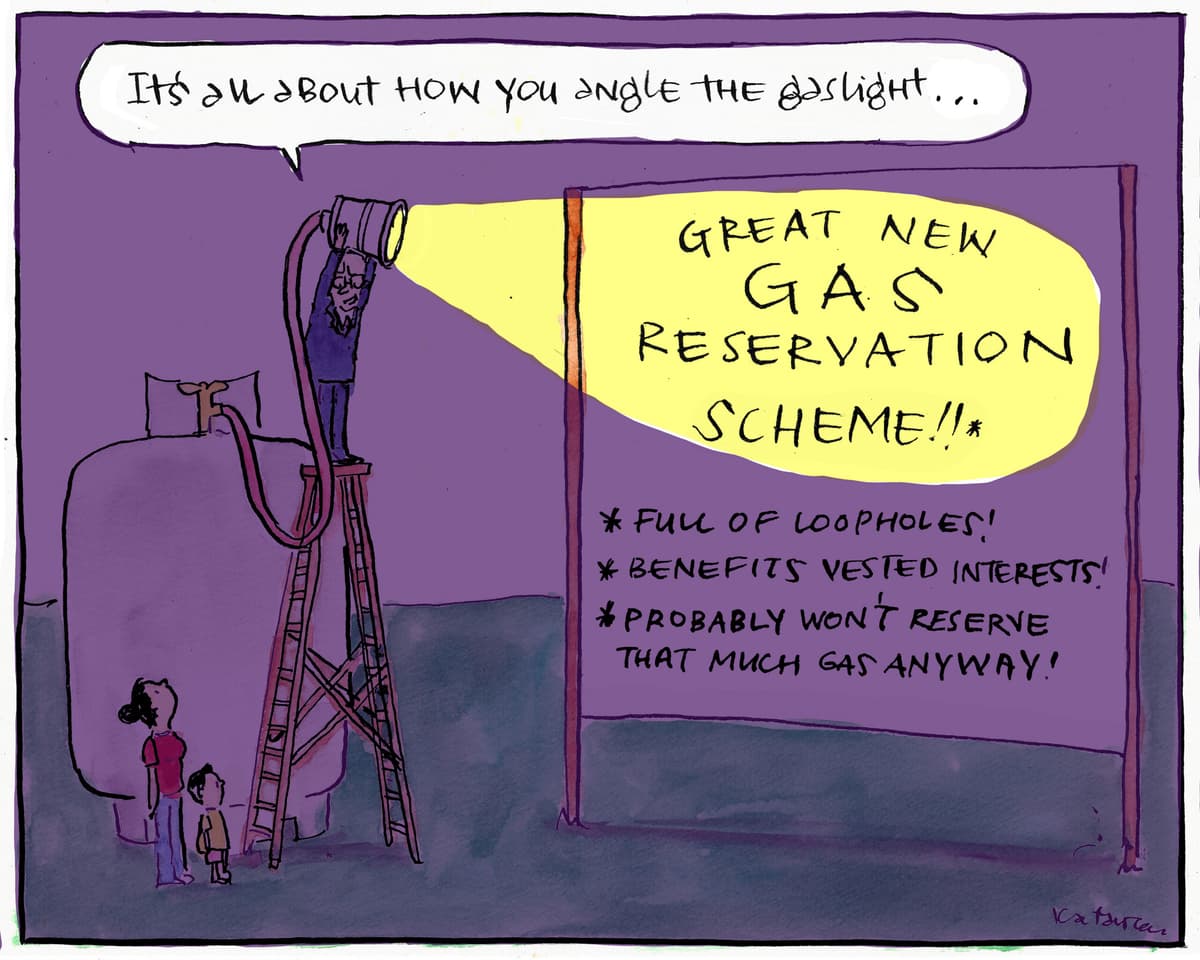
Now we are hearing about “windfall” taxes and “profit” taxes and what the gas industry would accept, as fears within the fossil fuel industry start to grow that the government will be spooked enough to do something to answer the public’s anger.
The Greens-led Senate committee looking into taxing the gas industry in Australia begins on Tuesday. This is where you will see both sides try to win the information war ahead of the May budget.
There is some appetite for change within the government, given Anthony Albanese is still trying to reassure people there will be no tax on existing export contracts.
In the time since the US and Israel launched their illegal attacks on Iran, Santos’s share price has grown by 12 per cent and Woodside’s by 17 per cent. At the same time, the ASX has dropped about 2.4 per cent.
This has led to talk of a windfall or “super profits” tax as a compromise, with claims it would address the profit imbalance while not causing long term “harm” to a multibillion-dollar (profit) industry.
The issue with that is the failed Petroleum Resource Rent Tax is already supposed to be a windfall tax, and it doesn’t raise anywhere near the revenue it was supposed to because gas companies never seem to make too much profit in Australia. Their profits are made off-shore – a handy trick when you own so much of the extraction-to-production pipeline. You can decide where you make the profit, and the costs of extraction, storage and transport.
A windfall tax might seem like a compromise, but it’s really just re-establishing the status quo. The gas industry knows that. Its supporters know that. And so does the government. The question is, will it be foolish enough to think the public will fall for it?
The government knows it can no longer hold the line on housing. It is all but accepted that change is coming to the capital gains tax discount (the only question is how many investment properties it will still apply to), as well as negative gearing (again, same question).
These changes are barely making a ripple in the discourse, which would blow the mind of anyone in 2019 when suggestions such as these were greeted with cries the economy would fall.
Similar fights occurred just before the changes to the stage-three tax cuts, with warnings any deviation would lead to economic devastation, followed by suggested changes of extending limited lower and middle-class tax breaks, before the government bent and created a more equitable tax reform. The debate moved on so fast, people have already forgotten it.
But gas? That’s the new untouchable. The claims are the same – the industry will pack up and leave (and go where? Somewhere it will be taxed even more?), Australians will suffer, the “sovereign” risk isn’t worth it (Australia has enough gas to service existing contracts and the overseas markets if companies stopped selling so much gas on the spot market), but the public is different. The old lines aren’t working any more.
That this is happening at the same time as a fossil fuel price crisis, where the cost of petrol, food and basic necessities risk creating global stagflation, and people are increasingly rushing for personal exit ramps by taking up renewables (just look at EV sales, for example) has only added to the fossil fuel industry’s panic.
The culture war against renewables in Australia in the past 30 years has been knobbled by reality, with energy security as national security clearly understandable by all but the most ideological.
While the gas industry and its supporters pretend the status quo will continue forever, recent research by Climate Resource found that the global LNG market is approaching oversupply, as demand plateaus and declines. Australia’s government may be planning for gas to be a major part of our nation’s energy supply until 2050 and beyond, but the countries we export it to are transitioning.
The report’s lead author, Dr Anita Talberg, said the most recent energy crisis may end up expediting the transition away from fuels like gas, with Indonesia, South Korea and the Philippines indicating they are accelerating their renewables capacity in response to the latest energy shock.
“We’re seeing leaders across Asia announcing major renewable energy programs in response to the energy security shock,” Talberg said in the little covered report.
“Our analysis shows that this was already the direction of travel; the crisis might just compress the timeline … even if you accept gas as a transition fuel, that doesn’t protect LNG. Countries meet their gas demand from domestic sources and pipelines first. LNG is the most expensive option and the first to go. LNG demand falls faster than gas demand.”
Given Australia exports more than 80 per cent of the gas it produces (part of the reason east coast gas prices are so high – because domestic supply is linked to international prices), we are particularly vulnerable to changes in energy policy elsewhere. The gas industry knows demand will fall and the glut is coming, which is one reason it wants to speed up exploration in Australia – and take advantage of the last of the fossil fuel golden years. Which also means, it’s one of the last chances for Australians to recoup what they are owed by gas giants.
The government knows this too. Which is why it’s testing how the windfall tax proposal will land. As is the gas industry. The only question is whether or not it will appease voters already being told they will have to prepare for cuts as we enter this latest period of “global unrest”.
If the government wants to give any hope it has heard voters, it won’t push them too far on accepting second best.
Amy Remeikis is a contributing editor for The New Daily and chief political analyst for The Australia Institute
This article was first published in The New Daily.